

Clocaenog Forest Man
You can now listen to this case on YouTube by clicking the link to the left. Also available on podcast platforms.
Disclaimer: this article contains information which some may find distressing. Discretion is advised.
This casefile is going to be a little shorter than some of the others on Undiscovered, mainly due to the low amount of information which exists in relation to the case. However, we hope that by getting this story out there it may help to raise awareness and perhaps encourage someone to come forward with information which helps to give a name to this man.
In this casefile, we're going to talk about the story of the victim known as the Clocaenog Forest Man.
The Discovery
2015 was the year of the 43rd season of the World Rally Championship, an event which is held across a full calendar year. The rally racing competition is divided into thirteen stages, held at a different location across a total of four continents, with each stage lasting up to four days across nearly 350km of closed roads. The events are carefully coordinated and attract thousands of racing fans and spectators.
The thirteenth and final leg of the 2015 World Rally Championship was due to be held in Deeside, Flintshire, in North Wales between 12th and 15th November. On the evening of 14th November, brothers Andrew and Mark Middle had opted to camp in Clocaenog Forest, despite the wet and windy weather forecast, in a bid to be close enough to the planned route to watch the cars go by. The woodland was criss-crossed with man-made forestry tracks which were generally used to mobilise felled trees and other materials, but which also made an ideal location for rally car racing. The shelter of the trees made an ideal location for a front-row view of the vehicles passing through the area.
The two men set up camp in a quiet area of the woodland which was very close to one of the forestry tracks, and Mark headed away from the tent in search of wood for the fire. Light faded early in the British autumn season, with darkness having fully set in by early evening, and Mark had to use a torch to navigate the uneven terrain.
As he turned the beam of light in different directions, it fell on what appeared to be a large stone covered in moss. Something about the stone didn't look right, however, and as Mark got closer to the object he realised that he was looking at a skull. A more thorough look revealed that the shocked man had discovered a skull which had come from a human.
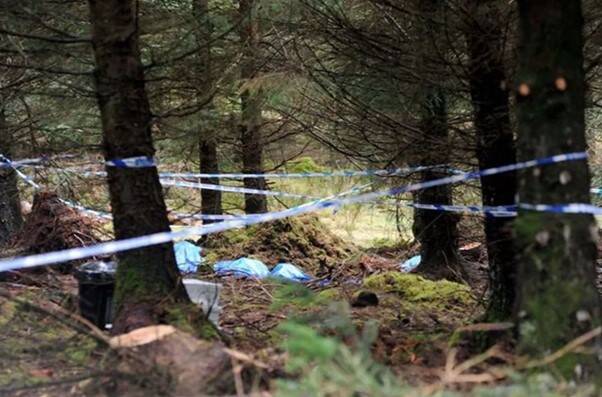
Image 1: a photo of the forensic search being undertaken of the area around where the body was found
At 20:35 the brothers made contact with authorities, who sent a local police officer to assess the situation. Once the officer had seen the skull and concurred with Mark's suspicion that it was human, further resources were rapidly sent to the area and a cordon was put in place around the scene. Police and forensic teams spent three weeks trawling the area where the skull was found. Over the course of several days, they unearthed more and more body parts until the near-complete skeleton of an adult male was found, with most of the remains concealed by dense undergrowth. Several scraps of severely decomposed clothing were discovered nearby and were duly collected by forensic officers, but it was impossible to tell if these had belonged to the man.
The rally was still able to go ahead, with the sound of passing vehicles forming a backdrop to the intense police search.
The Investigation
Once all available parts of the skeleton had been uncovered, the remains were moved from Clocaenog Forest and transported for examination by a pathologist.
No identification was found with the body, and forensics resorted to using information gained from the environment to try to ascertain how long the unknown male may have led there. The relevant part of Clocaenog Forest was planted in 1985, and the rate of tree growth, the condition of the roots surrounding the deposition site, and the level of decomposition of the skeletal remains indicated that the male had been lying in the undergrowth since between 1995 and 2005. This date was later amended by police following input by biologists and forensic anthropologists, with the man's death estimated to have occurred between 2004 and 2010.
Police were able to tell that the victim had been killed elsewhere, and had subsequently been disposed of at the site in the forest. The rural environment led police to question if the killer had local knowledge - it was far enough off the beaten track that one would have had to know of such a site to be able to find it, but they also potentially knew of the forestry tracks which enabled vehicular access to the area. Transportation of the weight of a male body would surely only have occurred with the use of a vehicle.
Examination of the body indicated that the male had died from blunt force trauma to the head, making an accidental death very unlikely. The consideration that the victim may have been a hiker who had fallen and injured themselves, perhaps passing away where they fell, was cast aside and the investigation turned into one of suspected murder.
Aside from assessing the cause of death, pathologist examination unearthed a wealth of information about the deceased. His structure gave the impression that he had been 'well-built' during his lifetime, and would have stood somewhere between 5ft 8in and 5ft 10.5in tall. Radiocarbon dating of his bones indicated that he had been born prior to 1950, and was at least aged 54 but most likely in his 60s at the time of his death. He had broken his nose at some stage during his life, with evidence that it had healed. He had also sustained an injury to his spine with two of the vertebrae having fused, and there was an indication that he had injured his left wrist, although it's unclear whether this had occurred earlier in his life or in the period just before his death.
The pathologist found evidence that the victim had had arthritis, although the type wasn't specified, in addition to an inflammatory condition in his spine and joints, although the name of the condition - if it could be ascertained - hasn't been made public. The combination of these medical conditions would have left the man living with chronic pain and a reduction in mobility, perhaps using aids to get around day-to-day.
Examination of his teeth provided further useful information. He had lost all twelve of his posterior molars, with the pathologist suspecting that this had occurred early in life. The loss of these teeth would have given his cheeks a somewhat sunken appearance. Despite the apparent lack of dental care earlier in life, there was evidence that the male had received some high quality dental work during his later adult years. A number of crowns had been fitted to his front teeth sometime between 1980 and 2000, and an alteration or amendment had been made to a temporary plastic crown which had worn over time in a procedure which was deemed to be quite rare. It was thought that this dental work had been completed in the UK, and forensic odontologist John Rosie described the work as distinctive and with a high chance that it would enable a dentist to recognise the victim.
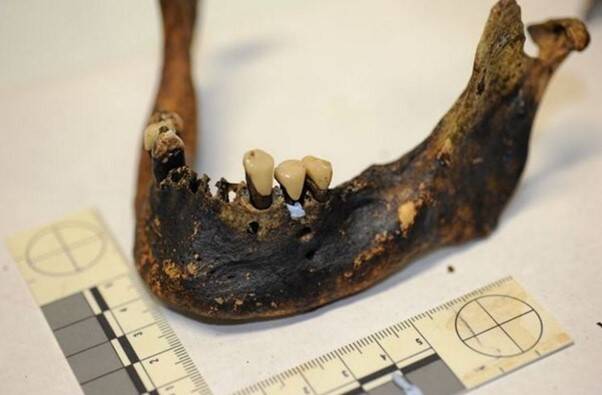
Image 2: the lower jawbone of the victim
On the back of this, police made the decision in 2016 to publish information about the victim's teeth and dental procedures in dentistry journals across the UK in the hope that the dental practice or dentist involved in carrying out the work may recognise it and speak to police. Articles included specific details about the work which had been carried out, forensic x-rays of the jaw and images of the jaw bone. Despite their hopes that this may provide a lead, no-one came forward from the dental profession with information which could help identify the victim.
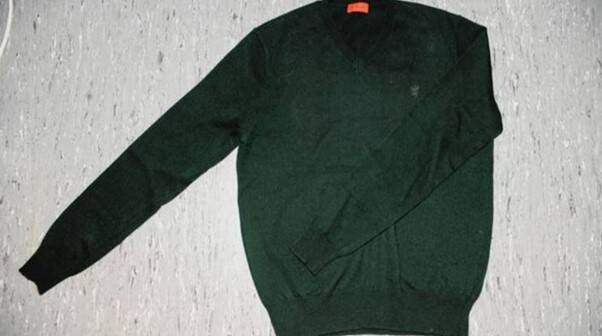
Image 3: an example of a Pringle of Scotland jumper similar to the one found near the victim's body
Thoughts turned to the clothing which had been found near to the body in Clocaenog Forest. Despite these being heavily decomposed, careful examination identified that the items had consisted of a dark green Pringle jumper and dark red underwear from Marks and Spencer, with the label on the waistband showing that they were size 36in to 39in waist. Investigation into the manufacturing of the items found that the underwear had been produced in 1999, and Pringle of Scotland were able to confirm that the jumper was made sometime between 2000 and 2004. Of course, knowing what the clothing looked like and when it was made was useful but both of these items were manufactured for large companies and sold extensively across the UK, so tracing a purchase would be near on impossible.
Although it's never been confirmed by police, it's highly possible that both items were too decomposed and had been exposed to the elements for too long to obtain any forensics from the material. If this had been possible, it may have been that forensic testing could have linked the clothing to the body so that police could tell for certain if it belonged to the man.
The case took an exciting turn when a male DNA profile was able to be extracted from the skeleton of the Clocaenog Forest Man. Sure that this would help them identify the victim, the profile was run through the national DNA database... but no matches were found. Police went on to try to find a familial hit, but to date nothing has been uncovered.
BBC's Crimewatch aired a program on 26th September 2016 which discussed the case of the Clocaenog Forest Man, and showed three facial reconstructions - one of how he may have looked at aged 50, 60 and 70 years of age. As they had been unable to pin down the exact age of the victim and only had an estimate to work on, this provided the public with different examples which may trigger someone's memory. Forty new leads were generated from the program, but each of these eventually dwindled into nothing.
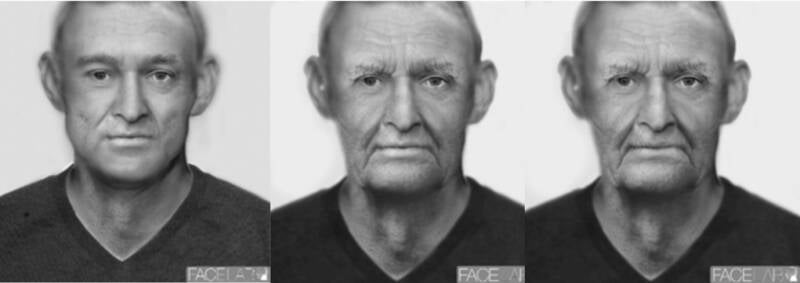
Image 4: from left to right, facial reconstructions of how the victim may have looked aged 50, 60 and 70
Police attended the 2017 Wales Rally GB to hand out leaflets and promote the case in the hope that new witnesses may come forward. If the event had been held in the Clocaenog area in previous years, it's not unreasonable to think that someone attending the rally may know something about the case, especially if they were familiar with the area from attending the events.
The victim who had been dubbed the Clocaenog Forest Man wasn't the first body to have been found in that region of the forest, something which hadn't escaped the attention of police.
Peter Moore
I don't want to dwell too much on this convicted serial killer, as police suspect that the body of the Clocaenog Forest Man was disposed of in the area long after Moore was incarcerated for his crimes. However, I do think it's important to talk about his crimes - after all, it's quite a significant coincidence that the body of one of Moore's victims was found a short distance away from a second suspected murder victim.
Prior to being sentenced to a life behind bars, Moore had been a successful businessman and was well known across North Wales. He owned and ran a chain of cinemas, keeping expenses low by purchasing second hand equipment and restoring it to good working condition. This subsequently meant that entrance prices to the cinemas were kept low for customers, and that former cinema premises which had fallen into disrepair were restored and used for the benefit of the local communities. Had he continued his endeavours to repurpose the old buildings and provide locals with cheap trips to the cinema at weekends, he would probably have continued to be popular and respected.
All of this changed, however, when he was arrested on suspicion of murder in December 1995.
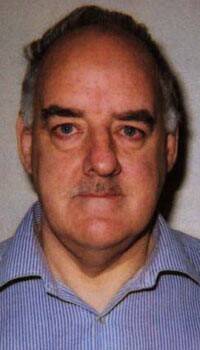
Image 5: Peter Moore
On 18th December 1995 the body of 40-year-old Anthony Davies, employed as a crematorium worker, was found on Pensarn Beach, Abergele. He was thought to have died the day before, having sustained a total of sixteen stab wounds to the abdominal area. The car park of Pensarn Beach was, at the time, noted to be an area where gay men would linger in the hopes of finding a casual sexual encounter, and it was a witness who spotted Peter Moore's van in the area which gave police their first lead.
During the attack on Anthony Davies it transpired that Peter Moore had received a significant cut to the back of his hand, and a blood sample from both victim and killer were retrieved from the scene. The sample from the culprit would later be matched to Peter Moore, who was arrested on 21st December 1995. A search of his property found a collection of Nazi memorabilia, a blood-stained knife and - worryingly - multiple discarded items in the pond on his land.
Examination of the items in the pond found that they had belonged to, and likely been stolen from, multiple different people, leading police to suspect that Anthony Davies may not be the first victim of the business owner. He quickly became a suspect in other unsolved murders.
Henry Roberts, 56, had lived alone in a property in Caergeiliog, Anglesey, North Wales. He had been lured outside of his property at night time and stabbed twenty times, with his trousers being pulled down and stab wounds inflicted to both buttocks during the attack. Moore was linked to this crime, as Robert's was known to have a collection of Nazi memorabilia from which a flag had been stolen.
In October 1995, 28-year-old Edward Carthy had been partying at a gay nightclub in Liverpool's city centre. Moore had also been present in the nightclub, and he and Carthy had exchanged conversation before the latter asked if Moore would drive him back to his home in Birkenhead, a town to the west of Liverpool. Carthy had been drinking and was intoxicated, so didn't notice that Moore had driven him to North Wales instead of his home town until they were well into the journey. Edward Carthy made a bid to escape from the vehicle whilst it was still moving, but was subsequently restrained by Moore and stabbed, sustaining three wounds to the stomach which would quickly prove fatal. His body was disposed of in a shallow grave covered with foliage in Clocaenog Forest, just metres away from where the Clocaenog Forest Man would be found nearly twenty years later.
Nightman Keith Randles, 49-years-old, had been hired to keep overnight watch on equipment being used to restore part of the A55 and had been staying in a caravan near the roadway as part of his contract. On 29th November 1995, Moore knocked on the door of the caravan and repeatedly stabbed him, later describing the attack as a form of 'stress relief'.
Anthony Davies, the last known victim of Moore, had been attacked on 17th December at Pensarn Beach. He reportedly met Moore and chatted to him, with Moore later telling police that Anthony Davies had exposed himself to him, triggering the fatal attack by Moore.
Despite initially denying any involvement, Moore called police to his prison cell on Christmas Eve 1995 and confessed to four murders. At the time, the police hadn't been aware that Edward Carthy had been murdered and were only investigating three deaths, but a hand-drawn map by the suspect enabled them to locate Carthy's body in Clocaenog Forest, finding that it had sustained heavy damage from animal activity. As part of his confession, Moore also admitted to 20 assaults on men over the course of nearly two decades and to planning the murder of the manager of the HSBC bank in Abergele over his frustration at debt he owed to the organisation. He would later recant all confessions, blaming the crimes instead on his boyfriend.
Now denying any wrongdoing, it was somewhat inevitable that Moore went on to plead not guilty to all charges when his trial opened on 11th November 1996. He took the stand and declared to the court that his boyfriend, whom he called Jason, was the one who committed the crimes, although Moore admitted to being present at each murder scene. He explained away his previous confessions by saying this had been a tactic to delay the police investigation and give Jason time to escape the area. Under questioning, he did admit that he had been responsible for sexually assaulting men, with one of his previous victims testifying against him at his trial. Whilst police made every effort to track down the man Moore described as his boyfriend, they were unable to find any evidence of his existence.
Despite the information that Moore provided under oath, the jury found him guilty on all counts and the judge handed down a sentence of life in prison with the recommendation that he never be released, making Moore one of less than 100 prisoners in the UK serving a whole-life order. He attempted to appeal against this decision in the European Court of Human Rights in 2011, but in January 2012 an announcement was made that the appeal had failed.
Moore attempted to insert himself into the investigation of the Clocaenog Forest Man by contacting North Wales Police and informing them that he knew the identity of the victim. In a letter to the authorities, he claimed that the man had been a student at Aberystwyth University who had disappeared in 1996. He didn't specify the identity in his letter, and left this to be speculated on by the police and press. And speculate they did - The Daily Post suggested that a good candidate could be a 46-year-old student named Roger Evans, who was last seen on 16th January 1996. He was in his first year at the university before he disappeared.
If you've been keeping track of the dates in the case of Peter Moore's victims, you'll note that he was arrested in December 1995 but had suggested that the Clocaenog Forest Man went missing in 1996. On the basis that Moore was behind bars since 21st December 1995, it was impossible that he was responsible for the death of the Clocaenog Forest Man based on his own account. Without knowing the full contents of the letter which he wrote to police we can't know what he suggested or insinuated, but is it possible that he knew who the victim was because he knew who the killer was? Or was he just trying to draw attention to himself by getting his name back into the media?
DNA testing would eventually rule out Roger Evans as being the potential identity of the man found on 14th November 2015, and the involvement of Peter Moore was ruled out by police based on the timeline of his arrest and the years when the victim was suspected to have died. They also considered that the clothing found near the man was manufactured after Moore had been sentenced to life in prison, but it's worth remembering that authorities had been unable to categorically confirm that the clothing belonged to the victim.
Recent Investigations
After a quiet period lasting eight years, North Wales Police announced that their Major Crime Review Team were completing a renewed investigation into the case in November 2025. They told the public that detectives were working with members of the National Crime Agency in addition to specialists from across the UK in a fresh attempt to identify the male.
CrimeStoppers added to this by offering a £20,000 reward for any information which would lead to the identification of the man and to the conviction of the person (or people) responsible for his death. CrimeStoppers are an autonomous organisation, meaning that they aren't connected to the police, and this reward only stands if the information is passed through the organisation directly. Hayley Fry, CrimeStoppers National Manager for Wales released a statement as part of the appeal, saying: '"someone knows who was responsible for this man's death. His family and friends, wherever they are, deserve answers and justice. We're appealing to anyone who has information to contact CrimeStoppers. You can tell us what you know whilst staying completely anonymous. We don't want your name, just what you know. Every piece of information could make a difference."'
Residents local to the Clocaenog area are also desperate for answers. They have watched police, forensic teams and media companies pass their doors in the direction of the woodland for many years, without knowing the identity of the man who had lay for so long in the undergrowth nearby. Megan Hughes, a local councillor, said: '"identifying this man is not just about solving a decade-old mystery; it's about justice, accountability, and providing closure. It reminds us that even long-forgotten cases deserve attention and that modern forensic science can make a real difference."'
Conclusion
The renewed police investigation is still in it's early days, with the announcement of the review only occurring a couple of months ago. Advancements in technology, DNA testing and forensic testing over the last decade will surely be put to good use in the search for answers.
From the outside looking in, it seems as though authorities have many pieces which could help provide answers in this case. They have a near full skeleton, a male DNA profile, details of some of the victim's medical conditions, and information about unusual dental procedures carried out on his teeth. Crimes have been solved with much less information in hand.
Perhaps, after more than a decade, a new DNA profile may have appeared on the national database which could provide a familial link to help trace the identity of this unknown man. Perhaps reissued information about his dental procedures may reach corners of the country where it hasn't been seen before, or may fall into the lap of someone who didn't read the publications ten years ago. Perhaps the medical conditions can be linked to those of a missing person and a name can be suggested which may start the ball rolling.
The police believe that the body was disposed of in the wooded location somewhere between 2004 and 2010, but what if there are other possibilities?
What about the clothes? They have never been officially linked to the body yet they were utilised in the ruling out of Peter Moore as a potential suspect, as they were manufactured after he'd been incarcerated. There's every chance that the clothes could have belonged to the victim, but what if they didn't? The police found pieces of a pair of underwear and a jumper, but nothing else which they have released to the public. If the body had been buried clothed, would there not have been something else in the vicinity, such as shoes, which may have been affected less by decomposition? What if the body was buried naked, and the clothes had nothing to do with the victim? We already know that the area was used for wild camping, especially around the time of rally competitions - is there a chance that the clothing was left behind by a careless camper?
Police believe that the body was disposed of at the site sometime between 2004 and 2010 based on evidence obtained from the surrounding environment, but the original estimate was between 1995 and 2005. Is there a possibility that the body had been there since sometime in the 1990s? Or is there a chance that advancements in technology could narrow down the window of deposition?
Without an identification for the Clocaenog Forest Man, there is little chance of finding out what happened to him and who could be responsible for his suspected murder. It's vital that a name is put to the victim, not only so that the search for justice can commence, but so that his family and friends can find out what happened to him and lay him to rest. Someone, somewhere must be missing this man. There must be someone who wondered why they stopped hearing from a friend or relative. The fact that police have been unable to tie the victim to any missing person accounts could mean that the victim was never reported missing, or that the matching missing person report hasn't been uncovered yet. Perhaps the victim isn't local to the North Wales area, and the missing person report was filed in a different part of the UK.
We can only hope that the renewed police investigation manages to find some answers. This man deserves to stop being referred to as the Clocaenog Forest Man, and to have his own name restored. He deserves to be buried in a plot with a headstone where people can visit to pay their respects. He deserves to have his story told, and for justice to be served for what happened to him.
Someone must know something. Perhaps one tiny piece of new information will provide the key which will unlock the rest of the story.
If you have any information about the male victim whose remains were found in Clocaenog Forest on 14th November 2015, please contact North Wales Police on 101, or submit a report on their website using this link:
Home | North Wales Police
Information can also be submitted anonymously to CrimeStoppers by calling 0800 555 111 or by using their online form at:
Giving information anonymously | Crimestoppers
Credit for images:
Image 1 - photo of the forensic search: The murder victim with no name found dumped in a Welsh forest as search for answers goes on | Wales Online
Image 2 - lower jawbone of the victim: The murder victim with no name found dumped in a Welsh forest as search for answers goes on | Wales Online
Image 3 - example of a Pringle of Scotland jumper: The murder victim with no name found dumped in a Welsh forest as search for answers goes on | Wales Online
Image 4 - facial reconstruction: Can you help solve the mystery of man found dead in North Wales forest? | Crimestoppers
Image 5 - Peter Moore: Peter Moore (serial killer) - Wikipedia
Add comment
Comments