

Lilian Tharme
You can listen to this case on YouTube by clicking the link on the left, or on podcast platforms.
Disclaimer: this article contains details which may be upsetting for some readers. Discretion is advised.
1960 held a number of events of note in the UK. A shooting occurred in a pub in Sheffield, killing three and injuring two, deemed to be the work of a mentally ill male. Queen Elizabeth II gave birth to her third child, making her the first reigning monarch to have a child in over a century. Harold Macmillan was the prime minister and leader of the Conservative party. The Grand National is televised for the first time, as is the first Royal wedding. A then little-known band performed their first show in Hamburg, Germany under the name The Beatles. The first successful kidney transplant took place at Edinburgh Royal Infirmary. Conscription ended on 31st December after the last man was called up for national service.
But for a family in Poole, Dorset, 1960 is notable for an entirely different reason. In a freezing cold January, a much-loved wife, mother and grandmother didn't make it home from an evening of dancing with friends, with her body being found in the early hours of the following morning. No-one has been arrested or charged for her murder, and information in the public domain is limited as the National Archive documents remain sealed until 2051 due to the investigation still being active. This also means that images relating to the crime are very limited, so very few are included in this article.
This is the story of Lilian Tharme.
Lilian Maud Emily Tharme lived with her husband and younger children in a flat on Alder Road within the area of Parkstone in Poole. The flat sat above a military drill hall and was a short distance from the Territorial Army base on Wallisdown Road, where her 46-year-old husband and former sergeant-major, George, had been an instructor for the previous ten years. Their eldest daughter, in her 20s, had left home, married and started a family of her own, leaving the couple's 18-year-old and 16-year-old daughters and their 10-year-old son living in the family home. Lilian was described by her neighbours as being an attractive woman who always dressed well, and looked younger than her 44 years. She was a clearly devoted mother, with the Tharme's being described as a quiet family.
Lilian and George often went dancing, which a friend would later tell police was how the couple met. On the evening of Saturday 16th January, Lilian decided to attend a dance at the Territorial Army hall on Wallisdown Road. In the interest of childcare, George remained at home with Lilian being collected in a car by a family friend, 37-year-old Leslie Palmer.

Image 1: Lilian Tharme
The pair went for a drink before heading to the Territorial Army hall a short distance away. Lilian was wearing a grey woollen dress with high heels and a large off-white stole. She had a short beaver-lamb coat to wear over her dress when outside.
Image 2: map showing the approximate locations of the Tharme family home and the Wallisdown Territorial Army Hall

The dance in the hall finished at around midnight, with Lilian being part of a group of 15 people who then went upstairs in the venue to the sergeant's mess where they continued to drink and party. What had been good-natured humour reportedly turned sour after a time. The hall had been decorated with cardboard cut-out pink elephants for an event, with Lilian getting hold of one and carrying it with her. She was told that she was not able to remove it from the hall - something which apparently caused some upset, although it's not clear why. One of the group dropped a key down the front of Lilian's dress as a joke, and then reportedly attempted to retrieve it. This caused further upset, and a frustrated Lilian collected her things and left the venue just before 1:30am. Leslie Palmer walked a very short distance outside with her, perhaps trying to convince her to let him give her a lift home, but she continued on her way and Leslie returned to his car. He gave a lift to two of his friends, leaving the car park at 1:30am. They didn't see Lilian on their way down Wallisdown Road, but they did wait for her some distance along in case she had changed her mind about a lift. When she hadn't appeared after an hour, they assumed that she had accepted a lift from other friends and continued on their way home.
The Discovery
In the early hours of the morning, a patrolling policeman came across items of women's clothing strewn across the pavement on Wallisdown Road, including a beaver-lamb jacket, a dress and a stole. A waterworks attendant, Mr James Pittwood, had been starting his rounds a short time after this discovery when he stumbled across a cardboard cut-out pink elephant and some woman's underclothes. This discovery was made just half a mile from the first, prompting police to search the area for the owner of the clothing to check her welfare.
Police had been continuing this search for three hours when, just as light was starting to break, news reached them that the naked body of a woman had been found at 7:30am in Wheeler's Lane, on the outskirts of Poole. They headed to the scene, likely already putting two and two together that this was the owner of the discarded clothing.
When they arrived at the location, they were met by Mr Yves Kergozou, the member of the public who had unwittingly stumbled across the body. He led them to where the figure of the woman lay face-down in the frozen mud on the edge of the lane, just 9 feet away from a green Morris Minor 1000 car, registration VRU 968, which had become wedged on the road verge. With no clothing and no purse, early identification of the woman was impossible - and so, therefore, was informing her next of kin.
The scene was rapidly cordoned off, with the pathologist and forensics team being alerted. News quickly spread around the local community and reached the ears of George Tharme, who - by this time - was aware that his wife had failed to return home after the dance the night before. After making contact with police, he was forced to do something that no spouse should ever have to do - identify the body of his wife.
The Investigation
Once the police had been able to put a name to the deceased woman, they were able to start tracing the movements which had led her to the edge of a dirt road on a bitterly cold night in January. Information from her husband enabled them to start their investigation at the Territorial Army base, where they interviewed as many of the dance attendees as they could locate, including Leslie Palmer, the family friend who had transported Lilian to the dance. He was thought to have been the last person to speak to Lilian as she left the sergeant's mess, and he would be quoted in the Daily Mirror as saying: '"I had known Lily for eight years but I cannot remember actually how we met. Her husband George and I became friends and when Lily and he were going to a dance I went, too. When I bought a little car I generally took them home in it. It was understood that if Lily went to a dance without George, either I should take her home or see that one of the crowd did, but there was no set rule about it."' '"When I drove off with two of my pals, both men, about 1:30am none of us in the car saw Mrs Tharme, but I assumed she was with other people, so I didn't worry. I must admit I am a bit hazy about it all."'
Leslie Palmer was quick to admit that he and Lilian had been for a few drinks prior to going to the dance, with the landlord of the Woodman Tavern in Poole Road confirming that he had seen both Leslie Palmer and Lilian Tharme in the pub in the hours before the dance. They were reportedly Saturday night regulars, so the landlord was well able to identify them both. Leslie Palmer went on to say: '"we had a jolly good evening, but I can't remember much about what happened when the dance ended. It was a terrible shock when detectives told me about Lilian's death the following morning. I can only think it was the work of a madman."'

Image 3: an example of a Morris Minor 1000 car
'The work of a madman' would transpire to be close to the truth, for detectives were uncovering information which left them horrified.
Analysis of the clothing which had been discarded on the side of the road had shown evidence of a tyre mark, leading police to consider that Lilian had been hit by a car. This theory was bolstered when a set of skid marks were found only 400 yards from the Territorial Army hall along Wallisdown Road, indicating that a car had collided with an object at that location.
It was information from Lilian Tharme's body, though, which proved to be the most horrific of all.
The pathologist found evidence that Lilian had, indeed, been hit by a car upon leaving the dance venue. This had caused injuries to her left side and back consistent with impact from a vehicle. From the gravel, scrapes and bruises found on her body, it seemed that Lilian was then dragged from the surface of the road into the car - whether under the pretext of taking her to hospital or getting her medical aid, it's impossible to say.
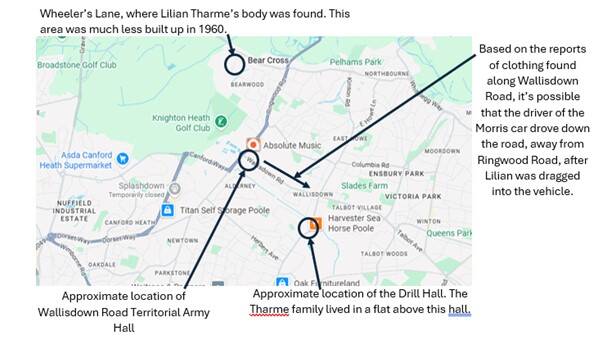
Police believed there to be more than one occupant in the car as Lilian was subsequently stripped of her clothes, with these being thrown from the window of the car, landing where they would later be found along Wallisdown Road. If the car was still moving at the time, it would have required one person to drive and one person to remove her clothes.
The car was driven to the outskirts of town and down Wheeler's Lane. Today, Wheeler's Lane consists of houses on both sides of the road along with a nursery and school, leading to farmland and a no-through-road. Back in 1960, however, houses occupied only one side of the road, which was largely a dirt track. It was locally dubbed 'Lovers Lane', as a lack of street lighting meant that it was dark at night and attracted couples looking for privacy. Once in Wheeler's Lane, Lilian was sexually assaulted then removed from the car and savagely beaten around the head. She was thrown, probably unconscious, into the mud along the edge of the road.
The perpetrators were unable to make their escape using the car, as it had become stuck where it was found on Sunday morning, leading police to guess that they had fled the scene on foot. If they hoped that the discovery of the car would advance their investigation by linking it to the owner, they were left disappointed - the Morris was reported stolen on the evening of the 16th January. The car was transported to the police laboratory in Bristol for full forensic examination, with the fingerprints of the original owner being taken so that they could be differentiated from any others found in the vehicle.
The post-mortem examination of Lilian Tharme's body found that she had died from a combination of factors. The injuries from the car collision would have been survivable had she received prompt medical attention, but she likely went into shock as a result of the impact, followed by a severe sexual assault and injuries to the head. Subsequently being left in the freezing cold without any clothes meant that exposure led to the end result. The pathologist found that, distressingly, there was a chance that she was still alive when left on the side of the road.
Image 4: map of the approximate locations of Wheeler's Lane, the Wallisdown Road TA hall and the approximate location of the Tharme family home. The Morris Minor 1000 may have travelled down Wallisdown Road with Lilian in the car based on where her clothing was found, rather than turning onto the main route of Ringwood Road.
48 hours into the investigation, the police contacted Scotland Yard to request assistance with the investigation. Such was the increasing complexity of the case that the local police felt that additional support was needed to catch what appeared to be a very dangerous criminal. Detective Superintendent Stanley Shepherd and Sergeant Ernest Bond of Scotland Yard made their way to meet Superintendent Jack Gray, who had been leading the investigation within the first two days.
After a thorough briefing and integration into the investigation, Shepherd told the press: '"the primary cause of death was the act of leaving a nude and unconscious woman exposed on this cold, frosty night."' '"I think the murderer may be sheltered by his family or friends. Mrs Tharme did not leave the dance until 1:30am, so the murderer must have arrived home late. That must have aroused some suspicion among his own family."' He appealed for anyone who saw the Morris 1000 car between the hours of 10:50pm on Saturday 16th January and 2:30am on Sunday 17th January to contact police immediately. The police also requested help from any landlords or landladies who may have notice a tenant arriving home in the early hours of the morning on Saturday 17th January.
In the early hours of Sunday 24th January 1960, exactly a week since Lilian was attacked, police set up road blocks on every route which led to Wheeler's Lane. Between midnight and 2:30am, every car approaching these road blocks was stopped and its occupants questioned as to their whereabouts and activities the weekend before, with police considering that the culprit
(or culprits) may have been out at the same time of night.
Uniformed officers were sent to all army barracks within a twenty mile radius of Poole to question military members due to the incident's connection with the Territorial Army hall. It was considered that the offender may have been present at the event that evening, perhaps targeting Lilian after seeing her at the dance. It was a possibility which could not be ruled out, and police questioned as many soldiers and military staff as they could during the inquiry, but no leads were uncovered.
Detectives started to theorise that Lilian had been offered a lift by the occupants of the Morris 1000 car. They considered that she may have refused this, leading to the occupants of the car giving chase to her in a rage at being turned down. Whether they intended to hit her or not was unclear, but it was possible that they saw their opportunity to abduct her from the scene whilst she was stunned from the impact. Detective Superintendent Shepherd said: '"it is impossible to say she was deliberately driven down by the car for the purpose of rape. But even if it was someone who took advantage of the fact that they had knocked a woman down accidentally and criminally assaulted her, then we must warn that we are looking for a dangerous man."'
Police released an appeal to the public to help find a person of interest after witnesses reported seeing a male walking along Ringwood Road at 2:28am on the night Lilian died. Ringwood Road is a main road through Poole, with Wallisdown Road branching off of this. Wheeler's Lane can also be reached from Ringwood Road in approximately 18 minutes walking time, meaning that someone heading along this thoroughfare in the early hours of Sunday 17th January would certainly be of interest to police - especially as Lilian's attacker(s) were thought to have left the scene on foot. The male was described as being between 17 and 20 years old, approximately 5ft 9in tall and of slight build. He was wearing a three-quarter length Italian style raincoat in a light fawn colour. Despite multiple appeals for him to make contact with police, no-one matching this description ever came forward, and police had only a vague description of the man which made actively seeking him very difficult.
Police also appealed to speak to three men who were seen pushing a 1936 Ford car along Wallisdown Road that evening. They stressed that they did not believe the men to be involved in Lilian's attack and death, but the car was seen being pushed in the area where she was knocked down, and police wanted to enquire if the men had seen anything which could help the investigation. The three men duly contacted authorities, but could offer little assistance with the investigation.
Lilian Tharme was buried at Poole Cemetery on 25th January 1960. Although police prepared for crowds of people to attend the funeral and internment by placing officers at the location, only 25 people attended. Detectives reviewed the notes pinned to wreaths left at the burial site and presented at the funeral in case anything stood out in relation to the investigation, but nothing arose from these. It's a known fact that some killers can get a perverse thrill from covertly attending the funerals of their victims to see the result of their actions, so it was common practice for police to be in the background at these events in an act of surveillance.
By the time March 1960 rolled around, police had spoken to 3,500 soldiers at a variety of military bases in the area, issued thousands of questionnaires to local residents and approached 7,000 people in house-to-house enquiries. Despite the enormity of the investigation, no progress had been made.
The Inquest
An inquest into the death of Lilian Tharme was opened in March 1960, with a number of people who had been present at the Territorial Army hall on 16th January being called to give evidence.
Pathologist Dr A C Hunt, who had examined Mrs Tharme's body, gave evidence as to the injuries she had sustained. He described the injuries to her left side and back from being hit by the motor vehicle, but advised the court that the car was unlikely to have been travelling at a high speed based on the nature of the injuries. He also described the scratches and bruises obtained as she was dragged into the car, ending his evidence by saying: '"the underlying cause of death was multiple injuries. It is highly likely that her death could have been accelerated by having her clothes removed on a cold night."'
One of the males who had left the sergeant's mess with Leslie Palmer was called to give evidence at the inquest. Mr Gordon Yeoman backed up Mr Palmer's version of events of the evening, describing the incident with the pink elephant which had led to Lilian leaving the venue. He had seen Mr Palmer walk a short distance along Wallisdown Road with Mrs Tharme before returning to the Territorial Army venue almost immediately. Gordan Yeoman caught a lift from the venue with Mr Palmer, and talked about how they had lingered in the area in case Lilian changed her mind about being taken home in the car. He said: '"we waited between half an hour and an hour at a corner for Mrs Tharme. When she did not turn up we thought she had got a lift from someone else."'
The inquest concluded on Tuesday 12th April 1960, recording a verdict of 'murder by person or persons unknown'.
Following the conclusion of the inquest, police expressed their opinion that the killer or killers lived in the Poole area and were likely being protected by members of their family - a sentiment which was echoed by Lilian's husband, George Tharme, who said: '"I share the police theory that someone is shielding the killer. I earnestly appeal to anyone who has information to contact the police."'
A joint statement was issued by Detective Superintendent Stanley Shepherd (Scotland Yard) and Chief Superintendent Bert Smith (Dorset CID) following the inquest. The statement read: '"the medical evidence given shows that this killer is a dangerous paranoic - a sex maniac who may strike again. It is imperative for the safety of women that he should be caught."'
From information released by the police and at the inquest, it certainly appears that the motive for the attack on Lilian Tharme was a sexual one - although whether this was a crime of opportunity, or whether the driver of the Morris car had been prowling in a pre-meditated attempt to find a victim on 16th January 1960 is unclear.

Image 5: a newspaper clip showing the photograph found three miles from Wheeler's Lane
Two months after the inquest closed, Scotland Yard appealed for the public's help in identifying three people in a photograph which had been found on the side of the road approximately three miles from where Mrs Tharme's body had been found. The photo displayed three people - a woman with two children - and a spaniel dog, and writing on the back of the polaroid read 'Gail and David with Mummy and Smoky'. No further update was provided about the photograph, so if police managed to identify the occupants of the image they did not release this information to the public. As the photograph was found some distance from the scene where Lilian's body was found, the likelihood of it being related to her attack and death seemed remote, and nothing further ever came from this.
Conclusion
Unfortunately, the appeal relating to the photograph in June 1960 is the last real update available. No other information has been released in more than sixty years since Lilian Tharme's death, and no suspects have been identified. Her case remains unsolved, leaving her husband, children and grandchildren without answers. This horrific crime against a woman who was just trying to walk home from an evening out needs a resolution, and the people responsible for the violent assault should be brought to justice.
Lilian's death has been featured amongst articles in the Dorset Echo in recent years which list unsolved murders in the county, and the case remains open. Advances in DNA testing may prove to be the key which solves this crime, but this relies entirely on a DNA link being made to the offenders - either directly or via a family member. If the offenders are still alive, they would surely be advanced in age by now - but Lilian and her family deserve to see someone answer for the crime and the subsequent trauma it has inflicted on her loved ones, no matter how long it takes.
If you have any information relating to the case of Lilian Tharme, please contact Dorset Police via 101 or their website using this link:
References for text:
Lilian Tharme – Crime Immemorial
By John Sandiford | Daily Mirror | Wednesday 20 January 1960 | British Newspaper Archive
Murder Lane Lights | Portsmouth Evening News | Wednesday 02 March 1960 | British Newspaper Archive
Times | Daily Herald | Tuesday 26 January 1960 | British Newspaper Archive
Murder Verdict At | Birmingham Daily Post | Wednesday 13 April 1960 | British Newspaper Archive
Snap May Solve Murder Mystery | Daily Mirror | Tuesday 28 June 1960 | British Newspaper Archive
Liettio Mi | Daily Mirror | Monday 25 January 1960 | British Newspaper Archive
Mother Dies For Child In Blaze | Daily Herald | Saturday 30 April 1960 | British Newspaper Archive
Credit for images:
Image 1 - Lilian Tharme: Lilian Tharme – Crime Immemorial
Image 2 - map of Wallisdown TA hall and Tharme family home: map taken from Google maps, with endorsements by the author
Image 3 - example of a Morris Minor 1000 car: taken from Google Images, origin www.simoncars.co.uk
Image 4 - map of important locations: map taken from Google maps, with endorsements by the author
Image 5: newspaper clip: Snap May Solve Murder Mystery | Daily Mirror | Tuesday 28 June 1960 | British Newspaper Archive