

Mary Boyle
Disclaimer: this article contains details which may be upsetting for some readers. Discretion is advised.
St Patrick's Day is observed across the world each year on 17th March. Once the cause of festivities solely in Ireland, residents would celebrate how their patron saint brought Christianity to their country, establishing churches, monasteries and schools in the 4th century. St Patrick is noted to be the origin for Ireland's beloved symbol - the shamrock - which he reportedly used to explain the holy Trinity, and the country still has a heavy catholic following to this day. The emigration across the centuries of many Irish citizens to the United States turned the tradition of observing the day of their patron saint international, and it rapidly blossomed into a holiday celebrating not just St Patrick, but all things Irish. St Patrick's day parades have been held in the USA ever since the 1700s, and it is used by many as an excuse to let loose and have a good time, decking the streets out with the Irish flag and a stream of green decorations.
For one family in County Donegal, however, St Patrick's day became an annual date of note for an entirely different reason. As a unit of two parents and three children travelled to their relatives' home in Cashelard to celebrate the day as a family, they had no idea that their lives were about to be thrown into turmoil and that they would be returning home with one less in their midst.
In this casefile, we're going to delve into the tale of Ireland''s longest running missing person inquiry - a case which has remained unsolved for nearly 50 years. This story is about the disappearance and suspected murder of Mary Boyle.
The Disappearance
Mary Boyle and her identical twin sister, Ann Boyle, were born in Sparkhill, Birmingham on 14th June 1970 and lived in the family home on Esme Road for the first two years of their lives. They were watched over by older brother Paddy, mum Ann and dad Charlie, who worked in the city as a road worker and bus conductor.
In 1972 the family relocated across the Irish sea to the area of Burtonport, County Donegal, on the rugged west coast of the Republic of Ireland. Charlie had obtained work as a commercial fisherman, so the close proximity of their new home to the Atlantic coastline worked well for the family, who were described as kind and modest people.
On Friday 18th March 1977, the family of five had travelled south to the rural region of Cashelard to visit Mary's maternal grandparents for the St Patrick's Day celebrations. The grandparent lived in an isolated cottage surrounded by hills, with the landscape turning to bog land to their east and interspersed with small lakes.
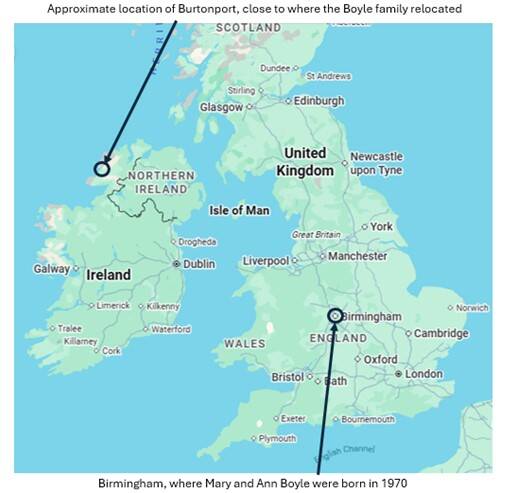
Image 1: map showing the approximate locations of Birmingham, England, and Burtonport, ROI
As wild and untamed as the area appeared, it would have made something of a paradise for children to go outside and play. It was quite, with very few vehicles travelling along the road, and surrounded by open space in which to run, shout and mess around, which is exactly what the three Boyle children were doing that Friday afternoon. Mary had helped her mother to wash up in the cottage kitchen, after which Mary had told her '"mam, I forgot to kiss you this morning,"' before wrapping her arms around her Ann. Ann Boyle would later describe this as the last thing that Mary said to her before she ran out of the door into the garden to play with her siblings and two cousins.
Image 2: map showing the distance between Burtonport, where the Boyle family lived, and Cashelard where the maternal grandparents resided
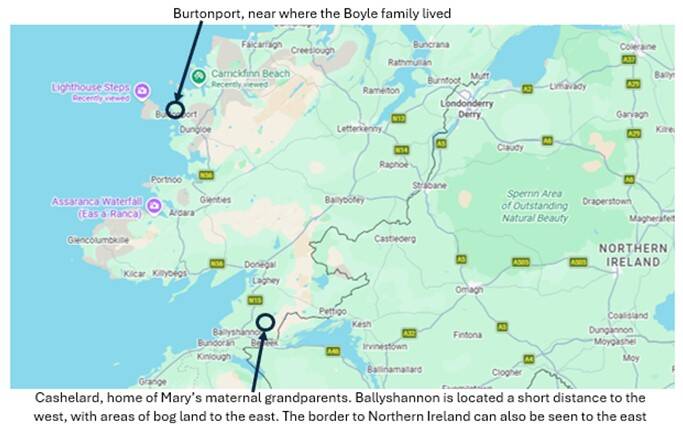
Ann set about preparing dinner for that evening whilst the children played in the garden, seemingly without a care in the world.
Gerry Gallagher, Mary's uncle, had been fixing part of the property roof earlier in the day and at 3:30pm he left the cottage to return a ladder to a neighbour, having borrowed it for the day to complete the works. He walked in the direction of the Cawleys' home, a neighbouring farm which sat just 400 yards (370 metres) away on the side of a hill. Mary, full of the intrigue of a six-year-old, had decided to follow him. She was munching on a packet of Tayto crisps (or potato chips, for our international readers/listeners) and merrily hopped after him as he made his way across the land.
However, she paused as they reached a pool of water which was too deep for the young girl to cross - even in her black Wellington boots. The wider land around the grandparent's farm house was formed of soft, boggy fields which made for difficult terrain for a small child and it's not clear who exactly made the decision - whether Mary was told to go home by her uncle or whether she made the decision herself - but she turned back and headed towards the cottage. Gerry Gallagher would later say that Mary had walked away at 3:45pm, and that it should have taken her no more than 5 minutes to reach the safety of the garden.
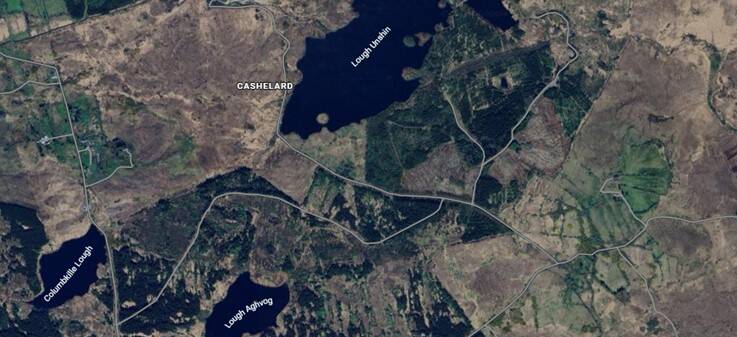
Image 3: an aerial view of part of Cashelard, showing the isolation of the area and the ruggedness of the landscape
Gerry continued on his way, standing at the door of the Cawleys' home to chat to the neighbours for around half an hour before returning back to the St Patrick's Day festivities with his family. He arrived back at the cottage at 4:30pm, thinking nothing to be amiss.
Ann Boyle would later recall the moment she realised that one of her twin daughter's was missing when speaking in an interview with The Irish News, saying: '"I looked out the front door. The rest of the children were playing in a thicket in the front garden, Mary was not there. My brother Gerry was fixing a stone wall in front of the house. I asked him did he see Mary, he didn't answer, he must not have heard me. Ten minutes later I asked if anyone had seen Mary and Gerry shot off in his car down the road. I remember in desperation asking my mother to light a candle. I shook Holy water all over the place. I felt so panicky and remember I ran out to the rocks shouting and crying. I hoped and prayed that God would protect her. When Gerry came back to the house he said she had followed him earlier to the Cawleys' house and that she turned back. I got in the car and drove along the road in different directions. It was a nightmare."' Remember, Ireland was - and remains today - a strongly Catholic country, with many people going to Mass on a regular basis. Reminders of this can be found everywhere across the country - a drive down a quiet country lane can result in finding a statue of the Virgin Mary tucked in a hedgerow. It wouldn't be unusual for the first response in an overwhelming situation to turn to God as a first line of support. It would have been a great source of comfort.
Few properties in rural County Donegal had access to landline phones in the 1970s, something which would cause a crucial delay in the initial hours after Mary disappeared. As the family collectively trawled the area around the farm house, calling for Mary and hoping to hear her small voice in response, they attracted the attention of a group of three fishermen on Lough Colmcille a short distance from the property. Noting immediately that something was wrong, the fishermen rowed their small boat to the shore and spoke to Mary's mother.
PJ Coughlan, one of the men on board the boat, would later speak to the BBC podcast No Body Recovered and describe the initial reaction to the word of a missing child. He said: '"there was panic, surely, with a wee girl missing on the mountain. They were all out roaring and shouting 'Mary, Mary' - we could hear them for maybe 10 minutes before we could see them."' He would be the one to return to his vehicle, parked on the shore of the lake, and drive the winding country roads west to the town of Ballyshannon to report the disappearance at the Garda Station.
The Investigation
In a bid to get the word circulating quickly, officers from the station headed to the town theatre where many of the residents were attending the annual drama festival. They went up on the stage to issue an appeal for volunteers to help in the search for the missing 6-year-old girl, describing her as 3ft 11in (119cm) tall, approximately 49lb (22kg) in weight, with light brown hair tied up in a ribbon. She had been wearing clothing identical to her twin sister at the time she was last seen - a lilac coloured hand knitted cardigan, brown jeans and black Wellington boots. During the time when PJ was at the Garda Station, the Boyle family continued to search the radius of the farm house, stopping passers-by to ask if they'd seen Mary.
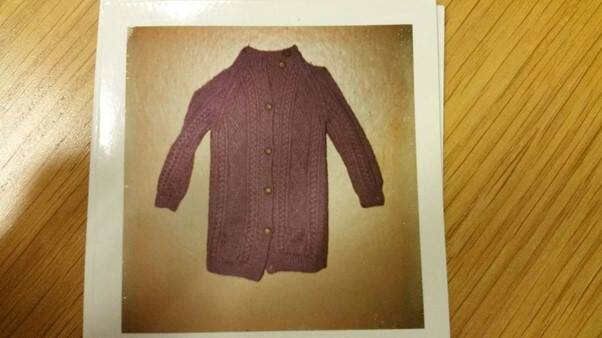
Image 4: Ann's cardigan, identical to the one worn by Mary on the 17th March 1977
One local fisherman - although it's unclear if this was one of the three on the lake, or another male - was reported to have told the family that he had seen Mary get into a red car, but this was later clarified in the BBC podcast that he had simply seen a red car in the area, but had not seen Mary getting into it.
Gardai commenced a search of the Cashelard area which would continue for four long, strenuous weeks as the Boyle family waited desperately for answers. The entirety of a lake beside the grandparent's home was drained in case Mary had perhaps slipped in and drowned, with diggers being drafted in to excavate the lake bed in search of any of her possessions.
The bogs around the farm house and lying to the east of Cashelard were also drained as much as possible, with the ground then being scoured in a bid to find the slightest clue or hint as to what had happened to the little girl. It was pointed out early on that, even if Mary had slipped into bog land, the crisp packet she had been carrying at the time would likely have stuck to the mud and remained near the surface, yet there was no sign of this in the area.
Only one week after Mary disappeared, local newspaper The Donegal Democrat printed words which likely echoed the fears of many at the time, but perhaps wouldn't be permitted to be printed in todays press, saying: 'her fate is a heart-rending mystery and any lingering hopes of finding her alive have now gone.' One can only hope that Charlie and Ann Boyle weren't shown this article or stumbled across it, as the words would likely have destroyed any hopes which they were still clinging on to.
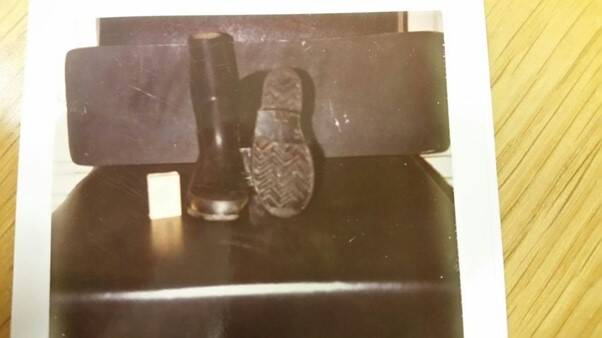
Image 5: Ann's Wellington boots, identical to the pair which Mary was wearing when she vanished
The search radius expanded as no hint of Mary Boyle was found in the areas close to her grandparent's home, and support was drafted in from the Irish Defence Forces (the Irish army) and from thousands of volunteers who stepped forward to offer their assistance. The increased footfall covered lakesides and rivers as well as more areas of bog land and forests. Despite the increased numbers and the hours put into the search, no sign of the six-year-old child was found.
As the weeks ticked on gardai continued to treat the case as one of a missing person, contrary to the indications that pointed towards some form of criminal activity having taken place.
In a bid to draw up fresh leads and new information, a reconstruction of Mary's last confirmed movements was filmed and broadcast with twin sister Ann playing the role of the missing girl. I can only imagine the emotional strain that this put on Mary's sister - knowing not only that her sister, her identical twin, was missing, but also being posted in the role for the purposes of publicity. The impact of trauma on such a young child cannot be understated, and whilst the decision to film her may have been with all the best intentions, it's impossible to predict how this may affect the young one as they grow.
Ann, Mary's mother, would later speak to The Guardian newspaper in 2007 after the disappearance of Madeline McCann, describing the response of their own family to their child going missing. By the time of the interview, she was 61 years old and living in a bungalow in Kincasslagh, just north of Burtonport along the Irish coast. She spoke of how she had experienced a feeling that something was very, very wrong as soon as she realised that her daughter was missing, although she couldn't identify why the feeling had come about. She vividly remembered the ribbons Mary had been wearing in her hair when she went missing, and had prayed for a fragment of the material to be found, although no scrap has ever been located.
Ann described how the family had remained at the grandparent's house in the immediate aftermath of Mary's disappearance, and how Ann had felt the need to place the household in a state of mourning. She spoke about how she refused to let the children turn the television on, maintaining a sombre atmosphere within the property, until Charlie quietly spoke to his wife and said that they still had the welfare of their other children to consider.
Ann and Charlie had sent Paddy and the young Ann back home to Burtonport in the week after Mary disappeared to be looked after by Ann's sister and in-laws in an attempt to recapture some kind of normality for them. The parents, however, remained in Cashelard for eight weeks before making the decision to return home. Ann captured the immense difficulty of the choice by saying: '"When do you decide to pack up and leave? When do you think 'I've got to go back home, I've got to get my two other children back to some kind of normal life, I can't stay here forever.' I remember the drive home from Ballyshannon and it was truly awful, even though I still held on to hope that Mary would be found. Sometimes I still do."'
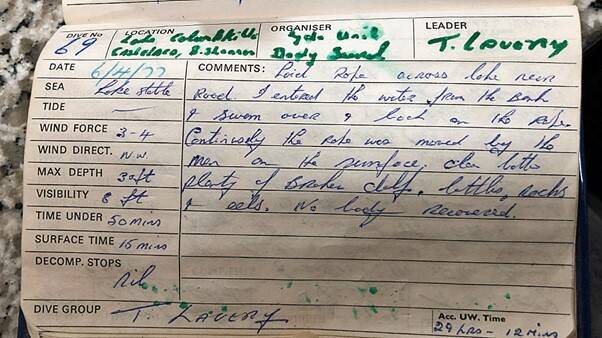
Image 6: a divers log completed on 6th April 1977 by dive leader Tosh Lavery. It concludes with 'no body recovered'
Going home without their daughter - either alive or deceased - would have surely felt so final and hopeless. Staying in the Cashelard area would have at least given them the hope that they may come across something new - a fresh clue which hadn't been found before, or a witness who hadn't previously spoken up. Going home to Burtonport took them away from the centre of things, and away from the place where their beloved daughter was last seen. Indeed, Ann told the press how she had found it difficult to stay away from Cashelard in the early years after Mary went missing. The family staged another search of the area on New Years Day in 1968 to keep the thought of Mary at the forefront of people's minds, but as the years moved on she began to dread going near her parent's home.
To add further distress to an already heart-broken family, Charlie died in a fishing accident in 2005. Ann spoke of her husband in the 2007 interview, saying: '"because of what happened to Mary, I used to keep Paddy and Ann under my eye all the time. They were never allowed out of my sight. Again, Charlie - he was such a good, gentle man - he said to me: 'we have to give the kids their freedom. They should be able to do normal things too'. He was right. We had to let them live as normal life as possible. It was Charlie who held us together, although the poor man never got over what happened to our Mary."'
The Boglands
I'm going to add a bit of information here about the Irish landscape and why the close proximity of Cashelard to Ireland's bogs could be important in the case of Mary Boyle. I'm not saying that this is the reason why gardai chose to spend so much time treating the case as that of a missing person and continuing to search the wilderness of County Donegal, but it could be a contributing factor. If you're already familiar with what a bog is, then feel free to skip ahead a little.
Ireland is well known for being a wet country. I've been to the Emerald Isle myself a few times and I can confirm that it rains - a lot. The weather can turn with little notice, but it keeps the landscape that lush green colour which the rest of the world sees in photographs and on television. The heavy rainfall contributes to areas known as blanket bogs, which are common in west Ireland on land with poor drainage. Blanket bogs are unique ecosystems, coating hills and valleys in soft, soggy layers of decomposed plant material.
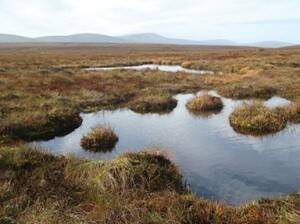
Image 7: example of a bog
They don't appear overnight, though - they have generally taken thousands of years to form and their importance in the world has only really become apparent over the past few decades, leading to them becoming closely examined and protected by environmental agencies. The unique conditions make an ideal habitat for animals and plants to thrive, with some plants - such as sphagnum moss, which holds up to twenty times its own weight in water - being essential to the ecosystem. The protection of peat bogs has hit the headlines in recent years - they play a vital role to the balance of greenhouse gases and, therefore, the mitigation of climate change.
They aren't just valuable to environmentalists, though. Historians have been fascinated with the secrets in their depths for many years, as the texture and qualities of the bogs make them excellent at preservation. Historical artefacts and even centuries-old bodies have been recovered in exceptional condition from bog material, with a couple of the bodies being on display at the National Museum of Ireland in Dublin city.
Although the Irish landscape was previously made up by 17% of bogs, this level has diminished over time with the peat and turf being harvested as far back as medieval times, with the material being used to heat homes and provide fuel for stoves. With development and the changing of the use of land factored in, only a quarter of the original bog land is estimated to still exist.
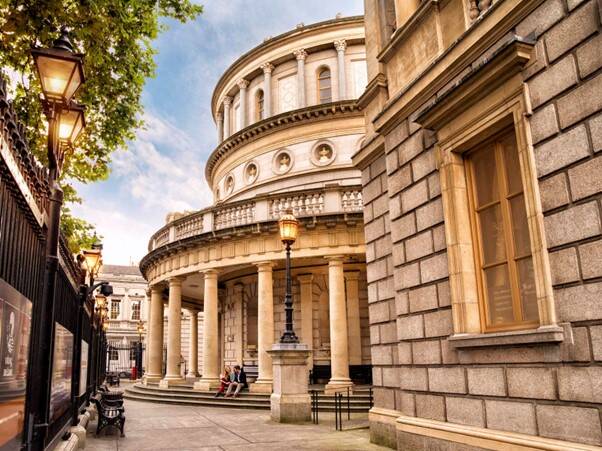
Image 8: The National Museum of Ireland in Dublin city
It's all very interesting, but how does this play into the case of Mary Boyle? Well, bogs are historically known for being unpredictable and somewhat dangerous places to traverse. The boglands are composed of 90% water and the depth of the underlying peat can vary greatly. The carpet of decomposing plant material can be deceptive, sometimes hiding deep water with the sides being too soft and spongy for someone to be able to climb back out - something termed a swallow hole or referred to as a 'swally-hole' in Ireland. The unstable ground and the suction which can occur in the deep water can lead to people disappearing with one step, and simply not resurfacing.
So, is this what could have happened to Mary? Could she have started making her way home and strayed from the path, only to fall into a swallow hole? Could she have thought that an area of peat was safe to walk on, but it transpired that it wasn't? Could her childhood curiosity have drawn her away from the safety of her grandparent's home? The weeks which were spent trawling the countryside around Cashelard for the young girl may have seemed excessive, but it's important to recognise how complex the terrain would have been - not only for Mary, but for the search party. They would have needed to navigate the area very carefully in order to keep their officers and volunteers safe.
As the family pointed out early on, though - if Mary had fallen into the bog and been drawn down into the ground, wouldn't the crisp packet had remained near the surface? Could it have floated and provided something of a beacon to gardai officers, indicating where the young child may have last been? It's very possible, but there's also a chance that once the packet was empty she had folded it and tucked it into her pocket on the way home.
Although the area has been searched extensively over many, many years with no sign of the six-year-old being found, centuries-old bodies have been discovered in the peat across recent decades and there is every chance that a missing person may lay, undiscovered, in the depths. I'm no expert on the terrain, though, and it would be interesting to hear the opinions of environmentalists who work in boglands to see if they could offer any insights.
The Irish Independent 1999 article
In 1999, more than twenty years after Mary Boyle disappeared, journalist Brighid McLaughlin wrote an article for The Irish Independent, not only throwing Mary's case back into the public spotlight but also launching the name of a potential suspect into the midst - and it's a name that we've come across on Undiscovered once before.
Brighid started her review on the case by visiting Charlie and Ann Boyle at their home - it would be six more years until Charlie would pass in a fishing accident, and the two now lived in an empty nest, with both Paddy and the younger Ann having moved out. They were grandparents by that time, with a granddaughter named after their lost child.
Ann, Mary's twin, had married just a few years prior to the article being written, in 1995, and had reportedly kept putting off the wedding day in the hopes that her twin would be found in time to be her bridesmaid. The distress and deep-rooted trauma which sat with the family each day was palpable, with Brighid commenting in the article of the sense of hopelessness in the home. Two decades later, the family still had no answers - and how is anyone meant to move forwards when they have no closure, and no grave to visit?
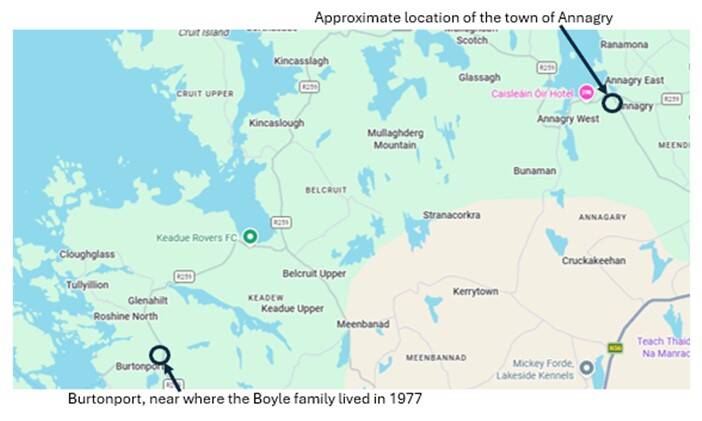
Image 9: map showing the locations of Burtonport and Annagry
From the Boyle's home, Brighid headed north along the west coast of Ireland to the town of Annagry, somewhere which she had spent an enjoyable summer as a child. She settled into a pub for the afternoon to read by the fire, perhaps trying to dispel some of the emotions which had sat with her from her visit to Charlie and Ann. She described in her article how she was approached by a woman who chose to remain anonymous, but was clearly aware of Brighid's reason for visiting the area.
The woman asked if Brighid was aware that notorious serial killer Robert Black had visited the Donegal area between 1976 and 1978. Not only had he been in the region of Donegal, but he had been sat in the very pub where Brighid was reading her book. The woman talked about a group of girls who used to come into the pub at the time, saying: '"they were always off in a group to a disco in Dodges, Gweedore, one night or to Annagry another night. He turned up at a pub in 1976, a year before Mary went missing. None of us knew who he was. He was also here in 1978, a year after Mary went missing. According to the girls he had been coming there for years. The girls in the pub knew him as a man who visited several times, delivering posters."'
If you're a regular reader or listener of Undiscovered, this name should be very familiar. If not, I'd suggest heading over to the casefile about Genette Tate, who went missing from an East Devon village in 1978, where you can read about Black's history and his offending, which he carried out across the country using the cover of his role as a delivery driver to quickly leave the area. You can find the Genette Tate casefile by clicking here: Genette Tate / Casefiles | Undiscovered.
As a brief reminder, Robert Black came to the attention of police after his arrest for the abduction and sexual assault of a six-year-old girl from the Scottish Borders in June 1990. The manner in which he'd committed the offence, and the seriously disturbing items found in his van which could only be called a kidnapping kit, gave police reason to believe that it wasn't his first serious crime, and he quickly became a prime suspect in the disappearances, attempted abductions or murders of several young girls across the UK. An enormous police operation ensued, with multiple forces working together to trace the areas he had been working as a courier over the course of decades prior to his arrest in a bid to find out if he had been near the crime scenes.
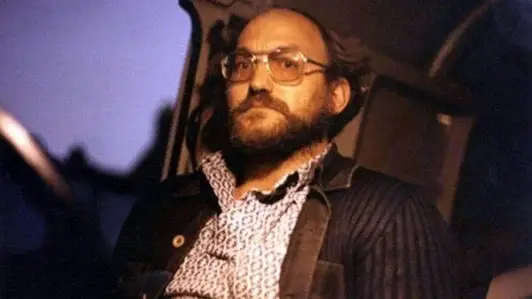
Image 10: serial killer Robert Black
In 1994 he was taken to trial on ten charges, and subsequently found guilty of the murders of 11-year-old Susan Maxwell in 1982, 5-year-old Caroline Hogg in 1983, 10-year-old Sarah Jayne Harper in 1986 and the attempted abduction of Teresa Thornhill in 1988. Although Brighid and the anonymous woman in the Annagry pub wouldn't know it in 1999, he would also go to trial in 2011 and be found guilty for the murder of Jennifer Cardy in 1981. Jennifer disappeared from a quiet country lane near her home in Ballinderry, County Antrim, in Northern Ireland and her body was found in McKee's dam a short while later.
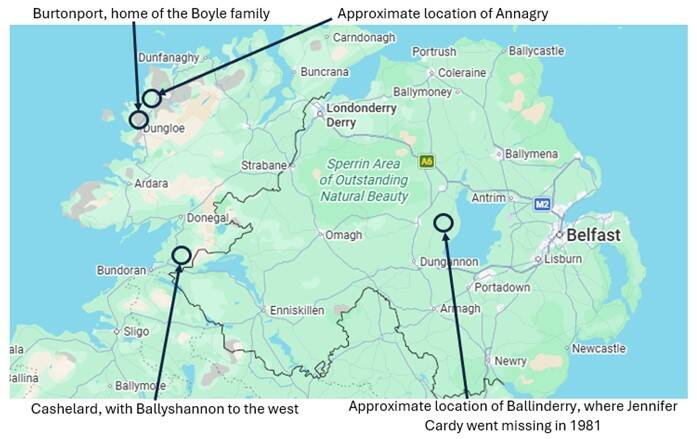
Image 11: map showing where Jennifer Cardy disappeared in comparison to key locations in the Mary Boyle case
Remember, Black's involvement in the crimes which earned him a full-life term behind bars only came to light in the 1990s, so the extent of his criminal behaviour in the 1970s was unknown. This didn't mean that he didn't draw attention to himself during that time, though. The anonymous woman in the Annagry pub spoke of how the group of girls who knew Black had been present in a pub in Dungloe, a short distance south of Annagry, when one of them started talking about Mary Boyle in 1977. Black had asked the girl and her group of friends if they would show him where Mary's house was so that he could see where her twin sister lived - and became enraged when they said no. Despite Black pressing the point, the girls continued to refuse and changed the subject.
The same girl reportedly spoke about how Black never allowed any of his drinking companions near his van, and never offered them a lift home. She had walked past his van on the way out of a pub one night and had heard what she believed were sounds of crying in the back. She had assumed that he had a pet of some kind in the rear of the vehicle. On another occasion, one of the group was reprimanded by Black for walking too close to his vehicle, with his aggressive response frightening her.
The anonymous woman speaking to Brighid also mentioned that Black had lodged with a family when he stayed in Donegal - something that probably gives those who remember his history from the Genette Tate case a sickening feeling in the pit of the stomach. He was known for preying on young girls in families with whom he lodged over the years. The woman took this story a step further, however, with what she mentioned next.
Black had borrowed the family car one Sunday, saying that he wanted to purchase a newspaper from the local shop. Whilst driving through Annagry, he had slowed the car down alongside a small figure with long hair walking along the pavement. The young person transpired to be the anonymous woman's son, who had long hair in keeping with the fashion of the 1970s. The woman had theorised over the years that Black had seen the young person from the back and had assumed that it was a girl, peaking his interest enough to slow down. The young man had been on his way to Sunday Mass when Black rolled the window down and asked if the boy could direct him to the nearest shop. He continued to beckon the boy closer to the car until he realised that the child wouldn't come any closer, at which point he sped away. Later that day, there were reports of the attempted abduction of a girl from the same town.
This story is, of course, all from the unconfirmed reports of the anonymous woman who had approached the journalist in the pub in 1999. Black's arrest occurred nearly twenty years after the incident where someone attempted to lure her son towards a car, and there is no way of confirming categorically that it was Robert Black. The coincidences are surely significant, though - if the man had been trying to coax the child into the car without realising that they were actually a boy, this could indicate two attempted abductions in the same town on the same day.
These incidents happened in 1977, according to the woman, meaning that they occurred in the same year that Mary Boyle went missing.
Black had even been placed on gardai records in 1978 after receiving a charge for out-of-hours drinking in County Donegal. He perhaps could have gotten away with a slap on the wrist and a ticking off had he not given the gardai officer a bit of cheek, at which point he was placed on record. When the extensive investigation into Black's crimes commenced in 1990, this documentation would help to trace his movements across the years. Detectives were able to contact his work company and obtain travel receipts and records to track his activities over the decades, and could ascertain beyond doubt that Black was in Northern Ireland not only on the day when Jennifer Cardy was kidnapped, but also at the time when Mary Boyle vanished.
The anonymous woman had only recalled Robert Black's name when it was released in the press following his arrest in 1990. As information about his crimes was released during his criminal trial in 1994, events across the 1970s in County Donegal started to take on a far more sinister meaning than they perhaps had at the time, and her opportunity to speak to journalist Brighid McLaughlin was a chance to get a huge amount of suspicion and concern off her chest.
Brighid would visit the Boyle family again in the following days, and took the information she had obtained in the Annagry pub with her. Ann Boyle (senior) mentioned that a car had been seen along the road past the Cashelard farm house on the day when Mary disappeared, but at the time no-one had thought to take a registration or description of the vehicle because Mary wasn't yet known to be missing. Despite repeated police appeals throughout the gardai investigation, the driver of the car never came forward.
From her second meeting with the Boyle parents, Brighid went to the Cashelard area and met retired Superintendent Aidan Murray, who had worked on the Mary Boyle case.
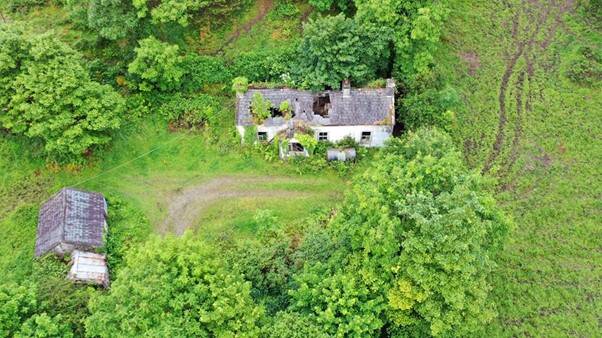
Image 12: an aerial view of Mary's grandparent's home, which has since been abandoned and fallen into disrepair
The journalist and the retired detective walked around some of the bogland near the desolate cottage, with Aidan Murray saying: '"before I retired I wanted to find the body, and now I want to find it before I snuff it myself."' He pointed out to Brighid the two houses which formed such importance on 17th March 1977 - the grandparent's farm house and the Cawleys' property - and how they were only a 15-minute walk apart. '"She definitely disappeared between A and B. How could anybody dispose of a body in 20 minutes? On the day Mary went missing there were three poachers illegally fishing with an otterboard, which is a piece of timber with hooks hanging off it. These guys have eyes at the back of their heads and would have been keeping their eyes out for gardai. They never saw anything that day. It is very unlikely Black was up there. Somebody would have spotted his van. On December 16, 1994, myself and Superintendent Michael Duffy attended a meeting in Newcastle on Tyne about Black to see if there was a link with Mary Boyle. Because we had no body, there wasn't enough to go on. We had no high-tech equipment like we have now. We were basically plumbing the depths of bogs with short sticks rather than detectors. She could have fallen into a swally-hole, a big bog hole covered over with a layer of old vegetation, it floats like a mat and opens like a skin. But we've nothing, only this mountain."'
After speaking to Aidan Murray, Brighid travelled to Bundoran to speak to Superintendent Michael Duffy, the man with whom Murray had travelled to Newcastle in 1994. She asked him about the possibility of Robert Black being involved in Mary's case. Duffy was familiar with in-depth knowledge about Black's movements, and paused for a long time before answering: '"from what I know of this investigation and the information I have, Black should be interviewed about the disappearance of Mary Boyle."'
2008 onwards
As the case of Mary Boyle faded from the media over the years, support came from an unlikely place. Popular country singer Margo O'Donnell, a distant relative of the Boyle family and brother to singer Daniel O'Donnell, helped to fund publicity for the case in addition to further searches of the Cashelard landscape. In January 2011, she engaged the assistance of Danish psychic Yans Sterns, who directed the searchers to a specific location on a hillside near Ballyshannon where a fresh dig was undertaken. The dig, and two further ones attended by Sterns, were supervised by gardai but nothing of note was uncovered. Material was taken from the scene for examination, but no results were ever made public.
In 2014, convicted paedophile Brian McMahon was transported from his cell in prison, where he was serving a two year sentence, to a Garda Station for questioning in the Mary Boyle case. Formerly a soldier in the Irish army and subsequent amusement arcade owner, McMahon had been convicted in 2013 of historic sexual offences against two brothers, with the crimes occurring in Ballyshannon between 1966 and 1974. Nothing came of his interview with the guard's and he was returned to prison, but he would later give an interview to a journalist stating his opinion that gardai had been trying to frame him for the crime. He publicly denied any involvement in Mary's disappearance.
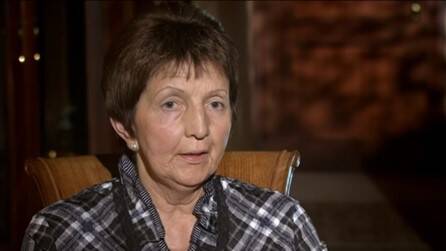
Image 13: Margo O'Donnell
The case hit the headlines for all the wrong reasons when suggestions of political interference began to surface. Questions had already been raised about the way the gardai investigation had been handled, and it came as a further blow for such accusations to be brought to public attention. It was suggested that a politician had integrated themselves in the investigation by calling the gardai in 1977 and demanding that they cease interviewing someone who the officers deemed a key suspect. Margo O'Donnell brazenly approached the politician and confronted him about the accusations, asking if he had made the call to authorities. She later said that the male had replied that it '"was untrue and called me a bare-faced liar"'.
Margo became close friends with Ann Doherty, Mary's twin, who became known by her married name after her wedding in 1995. As well as supporting elements of the family's pursuit for justice in a financial sense, Margo brought emotional support and joined Ann in attending Pearse Street Garda Station in 2015 for individual interviews. Information had been brought to light in private inquiries, and gardai were keen to effectively start the investigation afresh with a new, refreshed outlook in the bid to find out what had happened to the missing six-year-old, who had been absent for nearly forty years. Ann Doherty provided a 16 page statement across nearly six hours being interviewed, with Margo O'Donnell being interviewed for five hours and providing a 10 page statement. Gardai were keen to reassure the women that they would leave no stone unturned in their dedication to find the truth.
Matters became somewhat clouded a year after these interviews took place when controversial media personality and investigative reporter Gemma O'Doherty released a documentary which she described as '"the story RTE [Irish television broadcaster] do not want the Irish public to know."' She had reportedly been approached directly by Ann Doherty, Mary's twin sister.
Having commenced her career as a journalist in 1995 writing for The Irish Independent, O'Doherty contributed to articles about travel, but also wrote about criminal justice and corruption with work relating to police corruption raising her career profile. She was dismissed from The Irish Independent in 2013 after turning up at the home of the Garda Commissioner at 10pm to question him and his wife, with other journalists questioning the ethics of her investigative techniques. O'Doherty lodged a formal complaint about her dismissal from her role, resulting in an apology and an undisclosed pay out. From here, she worked freelance which provided her the freedom to produce the 2016 documentary Mary Boyle: The Untold Story.
The documentary was published on YouTube and was originally blocked until an appeal released it to the public. Ann Doherty was interviewed as part of the program, expressing her own opinion that her twin had been sexually assaulted and murdered. Ann had believed for many years that she knew the identity of Mary's killer, with the information having reportedly been given to her by a local. She believed it to be someone who still lived in County Donegal all those years later - but that it was also someone who had been known to the family in 1977.
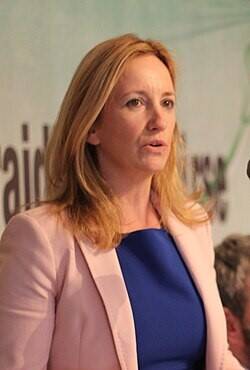
Image 14: Gemma O'Doherty
Ann described her twin sister as 'bubbly and feisty', and said that '"she would do the talking for two of us... I believe Mary had a secret and because Mary was feisty, Mary would have told. So I believe Mary had to be killed to stop her telling."'
Margo O'Donnell also featured in the documentary, hoping that it would create new interest in the search and investigation. She echoed some of the sentiments from Ann Doherty, telling the program: '"I honestly believe that if this person is questioned, then the truth will come out. He has never been arrested in connection with Mary's disappearance."'
Even without the comments made by Ann Doherty and Margo O'Donnell, the documentary created a fresh controversy of its own. Ann Doherty approached the then head of the Irish political party Fianna Fail, Michael Martin, and handed him evidence which reportedly backed the suggestion that a politician had intervened in the gardai investigation during the early stages. Two former detectives who had been involved in the original investigation were brought before the cameras for the program, both of whom denied being pressured by politicians at the time. Suggestion was made during the documentary that a telephone call had been received at the Garda station whilst he was interviewing a suspect, and that he had subsequently been told to 'ease off' during questioning. Collins, the former detective who mentioned the telephone call, was quoted in the program as saying: '"the result of that phone call is that certain people weren't allowed to be interviewed and it was all hands off. The sting went out of the whole investigation after that... The gist of it was that none of a particular family should be made suspect for Mary's disappearance."'
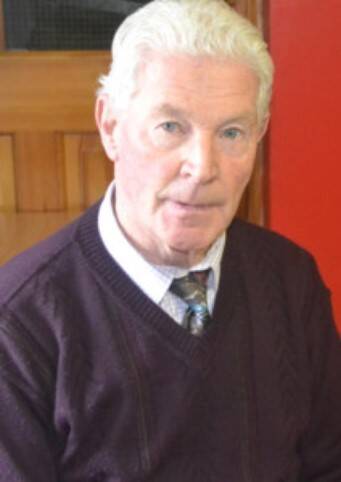
Image 15: former sergeant Martin Collins
Aidan Murray, one of the retired officers interviewed, gave a statement via his solicitor which said that the documentary had 'taken a number of my comments out of context and creates the wrong impression'. He stated that he was unaware of any telephone call being made to the Garda station, and had only heard the rumour about this many years down the line. He added: 'the reason Inspector Daly asked me to pause the interview was because of his genuine concern for the mental health of the person being interviewed. It was not for any other reason.' He described the documentary as being selectively edited to suggest interference at a political level, describing this suggestion as 'absolutely incorrect'.
Collins also responded to the broadcast of the documentary and spoke to a Donegal newspaper to deny any political interference with the case. Both officers were reportedly deeply unhappy with the program upon its release, citing selective editing which gave the impression that there had been a political agenda behind the case.
Although the politician wasn't named in the documentary, a lawsuit was submitted against Gemma O'Doherty by politician Sean McEniff on the basis of defamation. Although McEniff passed away in 2019, a judge decided that the case could continue under McEniff's estate.
This wasn't the first interview which Martin Collins, who had retired in 1994, had given in the wake of his police career. He spoke to The Sunday World newspaper in 2013. He said: '"Mary was dead within an hour of going missing and never left the Cashelard hillside alive. That was my view very shortly into the investigation and, 36 years later, that view has not changed. Within 48 hours I was convinced that she had died and my view was cemented when an interested party came to me and said that he knew who had killed Mary. He said the perpetrator had some kind of history. He wouldn't talk after that and to this day that witness has never spoken of it again."' He considered that the search of the Cashelard area potentially went on for too long and that the inquiry should have been converted to one of murder, saying: '"maybe we would have made more progress if we were a little more realistic and less hopeful. It is not plausible that she left the hillside under her own steam and that wasn't appreciated soon enough in the investigation."'
As part of their look into the case, The Sunday World hired a company to undertake a geophysical survey of a particular area. A geophysical survey involves a review of the properties and variations of earth and material in an area, reviewing elements such as soil density and seismic activity to detect features or anomalies under the surface. This enables scientists to identify areas of interest without having to disturb the area and risk damaging potential evidence. With the results of the survey, any necessary excavation can take place in a carefully conducted manner.
Local farmer John Gallagher, who had taken part in the search for Mary in 1977, had noted an area of depression in the soil which he felt was unusual and could have been a shallow gravesite. He had found this area just days after Mary disappeared. The results of the survey were handed to the gardai, but like many of the reports before it, no updates have been released to the public.
Ann Doherty and Margo O'Donnell made a fresh appeal for information in 2016, focusing particularly on the residents of Birmingham city in England, where the Boyle twins had been born in 1970. Ann pleaded for help to find her sister, saying: '"I really hope the people of Birmingham and Britain will support our fight for justice for her so that her remains can finally be laid to rest in a decent grave and her killer and those who have shielded him are brought to justice."' Margo O'Donnell supported this statement by adding: '"we are reaching out to the people of Birmingham where Mary was born. We are asking for their help. Anything they can tell us will be treated in confidence. We believe that things happened in Birmingham that could be crucial to solving the murder. I have very fond memories of Birmingham. I played in the ballrooms and clubs there many times and I know the Irish community there would like to see Mary's murder solved."'
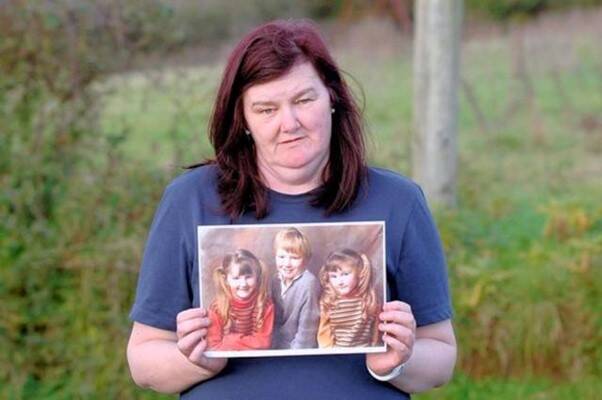
Image 16: Ann Doherty, Mary's twin sister, holding a photo of Mary (left), Paddy (centre) and Ann (right) as children
Gemma O'Doherty persisted in her bid for recognition for Mary Boyle's case, fuelled by her own belief that Mary was killed by someone who was known to her and that the murder had been covered up in a politically motivated agenda. She refused to accept that no inquest had been undertaken, no commission of investigation had occurred, and that the case had never been debated in Irish parliament despite the mounting evidence calling for it to be publicly discussed.
The Commissions of Investigation Act 2004 was introduced in the Republic of Ireland to give the government the opportunity to set up a quick method of investigating matters of urgent public concern, rather than taking the issue through the lengthy process of a tribunal. However, the commission must be proposed by a minister and approved by the Minister of Finance in order to take place - something which has never occurred, as Mary's case hasn't been discussed in Irish parliament. If this went ahead, the commission would have the power to conduct an investigation however it feels is most appropriate provided it adheres to the procedures of the Act. Those involved in the commission would have the power to compel witnesses to give evidence, and request the provision of documents relating to the investigation. Although the commission is carried out in private, the findings are handed to a named minister and a report is subsequently published. This may compel action from authorities such as the gardai in relation to moving the case forwards.
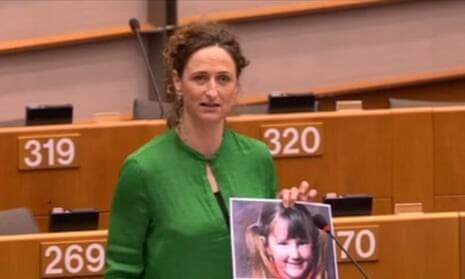
Image 17: MEP Lynn Boylan
Gemma O'Doherty's persistence paid off to some extent when she made contact with MEP (member of Irish parliament) Lynn Boylan, who stood for Irish political party Sinn Fein. O'Doherty had been calling for a formal investigation into the way the gardai had handled Mary Boyle's case - something which Lynn Boylan took to European Parliament, standing in front of the assembly and saying: '"Mary Boyle has been failed by the Irish state."' This was the first time the case was formally mentioned in a political setting, bringing attention to the case and its complexities not only to the forefront of the media, but to the front of the political scene in Europe. It publicly questioned the investigation completed by the gardai in front of the world's media.
Following the publication of the YouTube documentary and the address to European Parliament, gardai responded by opening a fresh investigation in 2016 and completing a new search of an area near to the grandparent's cottage in Cashelard, but nothing was found. Ann responded with scepticism to this development, describing it as a move to '"mislead the public and give an impression the gardai are taking the case seriously - it is my belief they are not. I believe it is nothing more than a sham to delay justice further and an outrageous waste of public money."' She went even further by adding: '"it is my opinion that An Garda Siochana have no intention of prosecuting the man who sexually assaulted and murdered my six-year-old twin in Cashelard in March 1977 and all who have shielded him for almost 40 years, including members of their force... through the years I have been intimidated by members of the gardai for trying to find my sister's remains and bring her killer to justice. Mary was my identical twin sister and I miss her desperately every day. I despair about the fact she did not get to live her life."'
The accusations made publicly by Ann Doherty are troubling at best and shocking at worst. She has never released the name of the person she believes to be responsible for the death of her twin, nor the names of the guards she insinuated were responsible for covering up the crime and protecting the perpetrator. The evidence which Ann Doherty, Margo O'Donnell and Gemma O'Doherty feel point to the man in question has never been made public, although it can be assumed that this was handed to the gardai in the interviews conducted during 2015. If this information brought forward any new leads, it has been kept quietly behind the scenes and there have been no updates provided by authorities.
In 2017, Ann Boyle - the family matriarch - released information to the press that she had been the target of hate mail. Two items had been sent to her, with one being a Christmas card and the other a letter written as though it had come from Mary and reportedly made threats to Ann's life. The motive behind these was unclear, but it gave Ann enough of a fright that she became scared to leave her home. A suspect was identified and arrested for writing the letters, transpiring to be a person local to the area, but he died before he could be taken to trial.
Later that same year, the Chief Superintendent of the Gardai Serious Crime Review Team, Walter O'Sullivan, released an update that a full review was being conducted into the case, with officers aiming to identify each and every person who was in the Cashelard area on the day Mary Boyle went missing. He said in a statement: '"although a rural area, there would have been a number of people in the area, living there, farming, visiting, driving through. When a child goes missing it goes right into the heart of a community, it struggles to understand why this has been visited on their community. The community has provided information confidentially, anonymously and through making statements. I believe there is further information to be obtained an I am appealing for people to come forward."'
In March 2018, a crowd of protestors assembled outside the office of Dr Denis McCauley, the then Donegal County Coroner, to stage a silent protest under the Justice for Mary Boyle campaign. They wore purple ribbons and purple balloons, and Ann Doherty handed across a petition with 10,000 signatures calling for an inquest to be held into the suspected death of Mary Boyle in 1977. Joe Craig, a cousin of Mary and Ann and the spokesperson for the group, said: '"this needs to happen so that justice can be served and that the person behind Mary's disappearance can be brought to justice. Time is running out and we simply cannot allow this to be dragged on any longer. All we are asking is to allow the events of that day to be pieced together at an inquest so we can move on. Is that too much to ask?"'
Where is the case now?
Across the nearly fifty years since Mary Boyle went missing, it feels as though little progress has been made at all. There are theories being thrown around, and the names of suspects passed between members of the community, but no arrests have been made which have resulted in someone being charged. Mary's body has never been found, despite extensive searches in the Cashelard area. Her family remain without answers.
The last appeal for information made by the gardai came in 2018, at which point they stated that the case was still very much active. Since then, the authorities have remained quiet, perhaps under the pressure from Gemma O'Doherty and various protestors, perhaps because there simply isn't any clear evidence to progress the case.
Gardai had release an age-progressed image of how Mary may have looked in 2011, but this hasn't been updated since. Of course, an idea of how she may look if she were still alive today can partly be gauged from her identical twin sister, Ann, who has been photographed many times in recent years.
The Boyle family has suffered a huge divide across the last two decades. Ann Doherty and her mother, Ann Boyle, have not been on speaking terms for many years. It's no uncommon for families to experience an irreparable fall out in the wake of such enormous tragedy, but the Boyle family were affected two-fold after the death of Charlie Boyle in the 2005 fishing accident. The reason for the rift has only started to become more clear in recent years.
In 2023, news emerged that Ann Boyle's brother, Gerry Gallagher, had passed away. Gerry was the last person to knowingly see six-year-old Mary alive, and this fact apparently hadn't gone unnoticed by members of the public. Comments on social media exploded with remarks which indicated that Gerry had been suggested in multiple communities as being responsible for the disappearance of his niece, and that he had taken the secret of what happened to her to the grave.
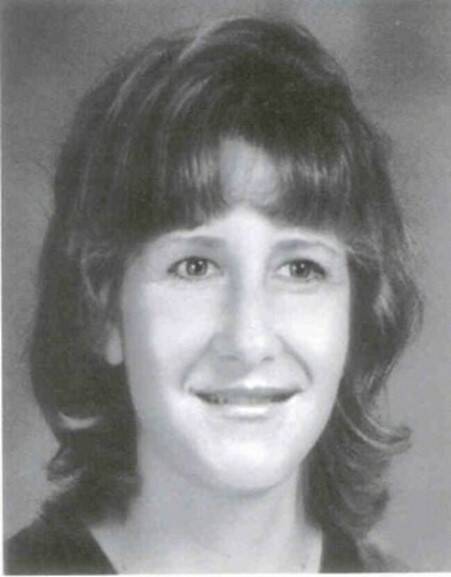
Image 17: an age-progressed image of Mary Boyle released in 2011
If Gerry was the man who Ann Doherty and Margo O'Donnell suspected was responsible, this would go a long way to explain the divide in the family. How was Ann Boyle meant to accept the suggestion that her brother, someone she had grown up with and who clearly still played a role in her life, was responsible for the disappearance of her daughter? Not only that, but the suggestion that he may have been involved in sexual assault against her? It went further than that, though - Ann Doherty spoke to a podcast in 2019 saying that her mother also knew the identity of the killer, but refused to admit it. Could this be true?
In 2018 when Ann Doherty handed over the petition demanding an inquest into the suspected death of her sister, Ann Boyle was firmly against the process being carried out. She continued to believe that Mary was alive somewhere, saying that it was the only way that she could carry on, with the mother and daughter disagreeing strongly that Mary should be declared dead. Ann Boyle said: '"I never lost my faith all through everything. I pray to find out what happened to Mary before I die. Everyday I pray for that. There's times I think maybe she's alive somewhere. I have that hope still at the back of my mind."'
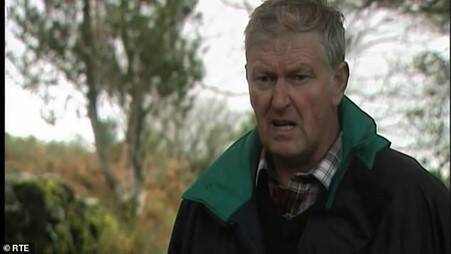
Image 19: Gerry Gallagher
Suspicions around Gerry Gallagher aren't wholly without reason, according to an article written by Gemma O'Doherty in 2017. Gallagher reportedly didn't answer questions from guards about the lead up to Mary's disappearance, and initially failed to tell them that Mary had followed him for a short distance - about 60 metres - away from the farm house. Retired sergeant Martin Collins said that he had initially been denied entry to the property by Mary's family, and upon asking Gerry Gallagher directly if he was involved in Mary's disappearance received no answer from the man. Collins also said that Ann Boyle had initially said that she felt her brother was responsible, although we know that she later refused to comment on this.
The article from O'Doherty suggests that the phone call to the Garda Station was from Sean McEniff, the politician who had taken legal action against her following the release of her documentary in 2016. It goes slightly further than that, though. McEniff was a councillor with political party Fianna Fail, of whom Gerry Gallagher was a long-standing member and local stalwart, publicising the party in the Ballyshannon area along with his brother, Michael. The suggestion from O'Doherty's article seems to sway in the direction of the politician covering for members of his party, but this article is the only one I can find which makes such a suggestion. The article goes on to discuss rumours of a supposed paedophile network across the south of County Donegal involving high-profile public figures, with a woman reported to have come forward to make claims against McEniff specifically. The document is incredibly scathing about the politician and about the Garda in general, and it's worth noting that it was published around the time when McEniff was suing O'Doherty for defamation. O'Doherty, as we mentioned previously, is noted as a highly controversial public figure who has been banned from YouTube since 2019 for breaching its policies on hate speech.
It is, of course, incredibly common for the last person to see a crime victim to become a suspect or to at least be questioned by police. It's perfectly within reason for some suspicion to have fallen on Gerry Gallagher, and it would have been more irresponsible for gardai not to have interviewed him. There's very little clear information on what accounts Gerry Gallagher gave to gardai, and even less on what the rest of the family said in the wake of Mary disappearing.
My main question, though, is this - if Gerry Gallagher is suggested to have had involvement in Mary's disappearance and suspected death, when did he have time?
It was suggested that Gerry headed away from the family farmhouse around 3:30pm on Friday 18th March. He walked the 400 metres to the Cawleys' property across hilly, boggy and wet terrain. Approximately 60 metres into this journey, Mary supposedly turned around and headed home - a journey which should, by gardai accounts, have taken her only 5 minutes. If it would have taken Mary 5 minutes to walk 60 metres home and Gerry had a just over 300 metres to walk, we can assume that the total journey to the Cawleys' would have taken at least 15 minutes. This would have meant that he arrived somewhere around 3:45pm. He stopped and spoke to the Cawleys for 30 minutes - a fact which I must assume has been confirmed by guards, as it has never been questioned in the media - and he back at the family cottage working on fixing a wall at 4:30pm by Ann Boyle's account.
I may be missing something in the research I've completed for this casefile, but I'm struggling to see the time window where Gerry Gallagher would have been able to supposedly sexually assault Mary Boyle, kill her, and dispose of her body. If he had discarded her lifeless figure in the region where the theoretical attack had occurred, it would surely have been found in the weeks-long search which ensued. His car, according to Ann Boyle, was outside the farmhouse - we know this because she said she saw Gerry get into the vehicle and drive away when she shouted across to him that she couldn't find Mary. This surely means that he couldn't have hidden her body in the car to dispose of later, because someone would have seen him - the children were playing outside and Ann was in the kitchen with access to the view out of the window.
The accusations against Gerry Gallagher, which become more open the further you dive into social media and the press, are purely based on circumstantial suggestions. There is no information in the public domain about any physical evidence against him. If the accusation also includes sexual assault against Mary, it's unclear if this relates to suspected sexual assault at the time of her abduction or in the weeks and months leading up to her disappearance. If there was a dark family secret behind the scenes, why would someone choose that particular weekend to 'silence' the six-year-old? Why wouldn't they have been worried about her speaking up beforehand?
For both Ann Doherty and Margo O'Donnell to have taken their suspicions - whomever it may be in relation to - to the guards, they must have far more information than is publicly available. It just seems that the timeline in which the criminal activity was supposed to have occurred is incredibly narrow, and unless it had been carefully planned the abduction of a six-year-old child is unlikely to have been pulled off without a hitch when so many family members were in the area. It is, of course, entirely possible that there was some involvement, but facts are very slim and it's simply impossible to know.

Image 20: the derelict remains of Mary's grandparent's cottage
This brings us back to the other person mentioned in the case - serial killer Robert Black. There are mixed reports as to whether he could have been in the area at the time when Mary went missing, with some media articles stating that Black had been interviewed in relation to Mary's disappearance and was found to not be in County Donegal at the time. Some of the information in the public domain is contradictory, and we do know from the Genette Tate case that Black was notorious for not cooperating in police interviews. His movements were carefully traced through the extensive work by detectives in the wake of Black's arrest in 1990, and the only ones who will have a near-full timeline of where he was working at any given moment will be the police.
If Robert Black was in County Donegal around the 18th March 1977, it would surely put him in the position of a suitable suspect in the case of Mary Boyle. Everything about her disappearance fits with the modus operandi employed by Robert Black - Mary was a lone young girl walking unsupervised in an isolated area who seemed to simply vanish into thin air, with no body ever being located. In each of Black's known crimes, the four girls went missing from quiet roads - either on a bicycle or walking alone - and disappeared without a trace. Their bodies were located many miles from home some time after they went missing.
Black's name has been linked with Mary Boyle's case for years, but there is no chance of extracting any information from him since he passed away in 2016. We know that was criminally active in Northern Ireland, though, as he was convicted in 2011 of the murder of Jennifer Cardy at a location not too far away from Cashelard. We know that he had developed a knowledge of many roads and routes in different areas based on his job, and his knowledge of County Donegal means that it's not a stretch to think that he could have snatched an unsuspecting child and disappeared down a country lane. A van wasn't seen in the area on that day, but we also know that he had previously borrowed the vehicles of people he had been staying with, so there's nothing to say that he couldn't have been driving a different car.
Conclusion
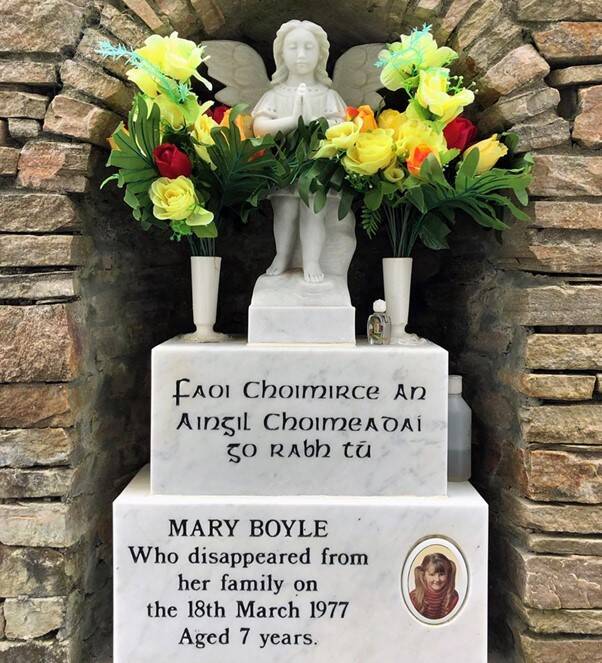
Image 21: a memorial erected at St Mary's Church in Kincasslagh in Mary's memory, which incorrectly states her age as 7. She was 6 years old when she went missing
No matter how many possibilities are discussed in the press and on social media, there is ultimately little information or evidence to give an indication what happened to Mary Boyle. If she was abducted and murdered, there is every chance that her body could have been discarded many miles from home and the landscape of Cashelard. If there was involvement from a family member, it can only be hoped that the passage of time may encourage someone to come forward and speak out. If she fell into a swallow hole and disappeared deep beneath the boglands of Cashelard, it can only be hoped that her body may someday surface and provide her family with the closure they so desperately need. It's clear that Mary has many, many people who are fighting for her to see justice, and they deserve their hard efforts to find a conclusion. She was clearly a much loved, much treasured young girl.
Mary's family has been torn apart by the events of 1977. Ann Doherty remembers her parents telling her that she would cling to their arms as a young child in case she would go missing, too. Charlie Boyle passed away in 2005 without knowing what happened to his daughter, and the rest of the family still strive for answers. Ann Doherty has stressed that she just wants a resting place and a grave for her twin sister, so that she has a decent burial and a site where her loved one can go to leave flowers, reflect and pay their respects.
Mary's family have spent nearly five decades waiting for answers. Fifty years not only without justice, but without a body and without answers. They deserve peace and closure. They deserve to be able to remember the cheeky, bubbly six-year-old as she lived, and not with the dark cloud of mystery hanging over her memory.
Mary Boyle should have been in her mid-50s today. She should have been able to grow up, have a career, get married and have a family of her own. She should have been able to be the bridesmaid at her twin sister's wedding. She should have been able to experience the joy of being an aunt, of being a mother and perhaps even a grandmother. She should have had a full and wonderful life. The opportunity to live as she would have chosen to live was taken away from her in the briefest of moments on what should have been a family day of celebration. She deserves that final resting place, and she deserves answers.

Image 22: Mary Boyle, photo taken just one week before she disappeared
If you have any information about the disappearance of Mary Boyle on 18th March 1977 in Cashelard, Ireland, please contact An Garda Siochana on 071 985 8530.
Information can also be submitted via the Garda Confidential Line on 1800 666 111.
References for text:
Birmingham girl who vanished 39 years ago and known as 'Ireland's Madeleine McCann' - Birmingham Live published 6th August 2016, retrieved 8th April 2026
What happened to Mary Boyle? No body recovered - BBC News by Kevin Connolly, published 23rd November 2019, retrieved 8th April 2026
MARY BOYLE - Age progressed - Garda retrieved 8th April 2026
'After 30 years, I still hold on to hope that she will be found' | UK news | The Guardian by Henry McDonald, published 2007, retrieved 8th April 2026
'Nannie's afraid in her own home' - Ann Boyle receiving hate mail 40 years after daughter Mary's disappearance | Irish Independent by Catherine Devine, published 14th March 2017, retrieved 8th April 2026
‘Time is running out’: call for inquest in case of Mary Boyle – The Irish Times by Stephen Maguire, published 10th March 2018, retrieved 10th April 2026
Mary Boyle - a stolen child | Irish Independent by Brighid McLaughlin, published 16th May 1999, retrieved 11th April 2026
Fresh search for Irish girl missing for 34 years - BBC News published 10th January 2011, retrieve 13th April 2026
Twin sister of missing Mary Boyle brands Garda review of cold case as 'a sham' - Irish Mirror by Stephen Maguire, published 9th August 2016, retrieved 13th April 2026
Relative calls for arrest in Mary Boyle disappearance case – The Irish Times by Stephen Maguire, published 14th July 2016, retrieved 13th April 2026
Why has Ireland's mainstream media turned its back on Mary Boyle? | Media | The Guardian retrieved 13th April 2026
Mary Boyle Mystery - Retired Sgt Martin Collins speaks out as sister calls for inquest - Donegal Live published 1st April 2013, retrieved 13th April 2026
The mystery of Mary Boyle: A missing girl, a heartbroken family and a 38-year investigation published 2nd October 2015, retrieved 13th April 2026
Missing Mary Boyle hate-mail suspect dies by Stephen Maguire, published 31st March 2018, retrieved 13th April 2026
Twelve facts about Mary Boyle - the little Irish girl who vanished and the allegations of 40 year cover up | The Irish Post by Kate Harrington, published 18th July 2016, retrieved 13th April 2026
Second garda denies Mary Boyle cover-up | Irish Independent by Maeve Sheehan, published 14th August 2016, retrieved 13th April 2026
Missing Mary is a mystery to me, says paedophile | Irish Independent by Greg Harkin, published 11th February 2015, retrieved 13th April 2026
Mother of Mary Boyle wants Mary's twin sister Ann to stop seeking publicity for the unsolved case | The Irish Post by Erica Doyle Higgins, published 22nd August 2016, retrieved 13th April 2026
Blanket Bogs of Ireland FactsheetIrish Peatland Conservation Council retrieved 15th April 2026
The secrets of Ireland’s bogs | Ireland.com retrieved 15th April 2026
Ireland’s remaining bogs can have a second tale - of creation rather than extraction – The Irish Times retrieved 15th April 2026
Ireland’s remaining bogs can have a second tale - of creation rather than extraction – The Irish Times by Ella McSweeney, published 31st May 2025, retrieved 15th April 2026
Gemma O'Doherty - Wikipedia retrieved 17th April 2026
Commissions of Investigation and Inquiries retrieved 18th April 2026
'The truth has died with him': Uncle of 'Ireland's Madeleine McCann' Mary Boyle, 6, has died - | Daily Mail Online by Jessica Taylor, published 20th January 2023, retrieved 18th April 2026
Boiling Over - Village Magazine by Gemma O’Doherty, published 21st November 2017, retrieved 18th April 2026
Credit for images:
Image 1 - map of Birmingham and Burtonport: taken from Google Maps with endorsements by the author
Image 2 - map showing Burtonport and Cashelard: taken from Google Maps with endorsements by the author
Image 3 - aerial view of Cashelard: taken from Google Maps (2026)
Image 4 - Ann's cardigan, identical to the one worn by Mary: 'Nannie's afraid in her own home' - Ann Boyle receiving hate mail 40 years after daughter Mary's disappearance | Irish Independent
Image 5 - Ann's Wellington boots, identical to those worn by Mary: 'Nannie's afraid in her own home' - Ann Boyle receiving hate mail 40 years after daughter Mary's disappearance | Irish Independent
Image 6 - divers log completed by Tosh Lavery: What happened to Mary Boyle? No body recovered - BBC News
Image 7 - example of a bog: Blanket Bogs of Ireland FactsheetIrish Peatland Conservation Council
Image 8 - the National Museum of Ireland: The secrets of Ireland’s bogs | Ireland.com
Image 9 - map showing Burtonport and Annagry: taken from Google Maps with endorsements by the author
Image 10 - serial killer Robert Black: Genette Tate disappearance: Father dies without case being solved - BBC News
Image 11 - map of key locations: taken from Google Maps with endorsements by the author
Image 12 - an aerial view of the farmhouse in Cashelard: What happened to Mary Boyle? No body recovered - BBC News
Image 13 - Margo O'Donnell: Relative calls for arrest in Mary Boyle disappearance case – The Irish Times
Image 14 - Gemma O'Doherty: Gemma O'Doherty - Wikipedia
Image 15 - former detective Martin Collins: Mary Boyle Mystery - Retired Sgt Martin Collins speaks out as sister calls for inquest - Donegal Live
Image 16 - Ann Doherty with image of her siblings as children: Birmingham girl who vanished 39 years ago and known as 'Ireland's Madeleine McCann' - Birmingham Live
Image 17 - MEP Lynn Boylan: Why has Ireland's mainstream media turned its back on Mary Boyle? | Media | The Guardian
Image 18 - an age-progressed image of Mary Boyle released in 2011: The mystery of Mary Boyle: A missing girl, a heartbroken family and a 38-year investigation
Image 19 - Gerry Gallagher: 'The truth has died with him': Uncle of 'Ireland's Madeleine McCann' Mary Boyle, 6, has died - | Daily Mail Online
Image 20 - the derelict remains of Mary's grandparent's cottage: Birmingham girl who vanished 39 years ago and known as 'Ireland's Madeleine McCann' - Birmingham Live
Image 21 - memorial to Mary Boyle: What happened to Mary Boyle? No body recovered - BBC News
Image 22 - Mary Boyle: Birmingham girl who vanished 39 years ago and known as 'Ireland's Madeleine McCann' - Birmingham Live
Add comment
Comments