

Mary Speir Gunn
You can now listen to this case on YouTube by clicking the icon on the left, or find us on podcast platforms!
Disclaimer: this article contains details which may be upsetting for some readers. Discretion is advised.
The evening of Saturday 18th October 1913 was wet and stormy in North Ayrshire, West Scotland, with the wild weather battering the coast of the country.
Northbank Cottage was a two-storey stone house set along an isolated coastal path outside the hamlet of Portencross, near the small town of West Kilbride. The cottage perched at the base of stone cliffs, between 200 and 300 yards from the coast line, and could be accessed only via a rough track. Within the property walls, next to an open fire, two women – Mary Speir Gunn and her sister Jessie MacLaren - sat knitting by the glow of an oil lamp. In front of the room’s only window stood Jessie’s husband, Alexander MacLaren, reading aloud from the book At Sunwich Port by W.W.Jacobs to entertain the two women. The atmosphere was cosy, warm and homely as they listened to the fire crackle and the wind whip around the house.

Image 1: the approximate location of Portencross and the coastline where Northbank Cottage sits. Glasgow city can be found to the North East of the area.
But as the clock ticked towards 8:30pm, the peace was unexpectedly destroyed as two bullet shots tore through the air.
The lower windowpane shattered and a bullet hit the hand of Alexander MacLaren, injuring the tip of his left index finger and tossing his book to the floor. Not even noticing his wound, Alexander shouted for the women to drop to the ground as another three shots rang out in quick succession. He threw himself across his wife, Jessie, in a bid to protect her as Mary fell to the floor, shouting that she had been hit. A final shot fired through the window, hitting the stonework. As a lingering silence indicated that the gunfire had ceased, Alexander leaped from the floor and out of the door, running to the outhouse where his two dogs – a collie and an eight month old Scottish terrier – were housed, and released them in a bid to chase down the attacker. The dogs, who normally barked at any unknown passer-by, were oddly calm and quiet. Any hope that Alexander had of his dogs racing into the dark to pursue the attacker dissipated as they lingered by his side.

Image 2: Northbank Cottage as seen in the 21st Century
Isolated as the property was, the area surrounding the stone cottage would have been devoid of any external lighting such as streetlamps. The chances of the human eye catching a glimpse of the assailant amidst the pitch black and the battering rain were next to nothing, and so Alexander returned to the cottage, where he found that his wife and his sister-in-law were both wounded. Mary had been struck by three bullets, with one piercing her heart. Jessie, although still alive, was gravely wounded, having been hit by two bullets despite her husband’s efforts to protect her.
Telephones, although in use across the UK since 1911, were not commonplace and Northbank Cottage did not have a line installed. Alexander MacLaren had no choice other than to run through the night to his nearest neighbour, Alexander Murray, who lived half a mile away on his farm in the hamlet of Portencross. Mr Murray did not have a telephone line either, so the two men made further tracks to the nearby mansion house, Auchenames, the owner of which was wealthy enough to have his own landline. The laird (a Scottish term referring to a land owner, landlord or minor lord) there – William Adams – immediately telephoned a friend in West Kilbride, who then ran to the town’s police station which, bizarrely, also didn’t have a telephone. The friend hammered on the door and alerted the police, before calling on the local GP, Dr More.
Two police officers from the station and Dr More jumped into a car and raced to the scene, picking up Alexander MacLaren and Alexander Murray en route, both of whom had commenced the journey back to Northbank Cottage on foot. They returned to the little cottage to find the devastation that had so unexpectedly invaded the family’s evening. It was reported that Mary's injuries were not immediately fatal, with her passing away some time shortly after the return of Alexander Maclaren with the accompanying party.
Who was Mary Speir Gunn?
Mary Speir Gunn was born on the 31st August 1862 in Stevenson, North Ayrshire, to parents Jane Speir and Gilbert Gunn, a well-known railway contractor and thought to be one of the strongest men in Scotland at the time.
Mary was one of three girls born to the couple, and also happened to be the granddaughter of Margaret Gibson Speir, who founded Speir School in Beith in 1888.
From 1881 to 1891, Mary lived at Burnside in Beith. She was said to have been an incredibly attractive lady, and acquired the nickname ‘the Beauty of Beith’ during her time here - she was still considered to be a remarkably attractive woman by the time of her death, aged 51, in 1913.
In 1891, she was employed in the unusual (for the time period) role of ‘telephone operator’, a role which had only been introduced to the area in 1883. From Beith, she moved to Ardrossan - a short way down the coast from West Kilbride - where it was reported that she held a similar position. Telephones were an incredible novelty at this time, having been introduced by Alexander Graham Bell in 1876, so having a role as a telephone operator would have been an exceptional privilege.

Image 3: Mary Speir Gunn
Ten years later in 1901, Mary was living with her sister Jessie MacLaren (aged 48), Jessie’s husband and Mary’s brother-in-law Alexander MacLaren (aged 48), as well as the sister's mother, Jane, who was 83 years of age – quite an advanced age during Victorian times, where the average life expectancy hovered around 52 years. They lived and worked in Port William, Wigtownshire, where Alexander worked as a baker whilst Mary reportedly ran the business side of the establishment.
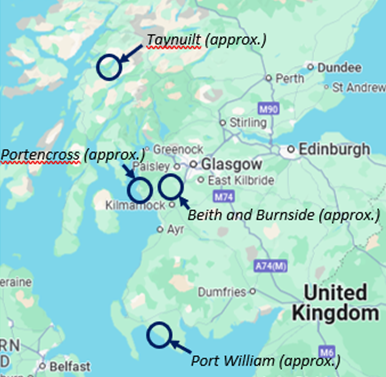
Image 4: map showing the locations in Scotland which Mary called home during her life
Alexander MacLaren would later accept a role running the post office in the more northerly community of Taynuilt. He and Jessie would move to Taynuilt, followed slightly later by Mary once she had tied up what were described as ‘family matters’ in Port William. It doesn’t appear that Jessie and Mary’s mother, Jane, moved to Taynuilt, but it’s unclear whether she had passed away by this time.
Alexander took up farming in addition to his role with the post office and Mary started working on the farm as a manual labourer. Mary was not taken by this role at all - a lack of farming machinery such as we have today would have meant that this role was heavily manual and strenuous. As a result, Mary jumped at an invitation from her other sister to move across the Atlantic to Canada. Whilst living with her sister and brother-in-law, she would start a promising romance with a man in Saskatchewan. This would, however, run its course, and Mary would transfer back across the Atlantic to Scotland.
By 1913, Alexander had retired at the age of 60 and he and Jessie - then aged 61 - had purchased Northbank Cottage, selling the remainder of Alexander's sheep at auction for £100 - equating to over £9,500 in todays money. Mary, aged 51 at the time of her murder, had never married and remained single following the end of her relationship in Canada.
The Aftermath
It was on the stone floor of this two-storey cottage that 51-year-old Mary was found when the two police officers, Dr More, Alexander MacLaren and Alexander Murray arrived at Northbank Cottage. Mary was confirmed as deceased by Dr More, who then proceeded to tend to the gravely injured Jessie MacLaren. He set about removing a bullet from her back, where it had caused significant damage to one of her kidneys. She would later be transferred to Kilmarnock Infirmary, where she would remain for several months whilst recovering from her injuries.
Whilst Dr More was tending to his patient, the police officers set about securing the scene and searching the outside of the property. They were able to find two distinct footprints underneath the window through which the offending shots had been fired, and baskets were placed over these to prevent weather damage until they could be properly preserved. They were compared to the shoes of Alexander MacLaren but did not match any of the footwear in his possession. The footprints were discovered to be made by footwear manufactured by the Halstead company, and were in a size that was smaller than the shoes normally worn by Alexander.
Shell casings were discovered and examined. They were found to be of .45 calibre, leading to the belief that the offending weapon was a British-made Webley or an American Colt revolver. The gun was never found despite extensive searching. The cottage’s close proximity to the sea led to speculation that the gun could have been thrown into the water as the shooter made their getaway. If this was the case, there could be little chance of it ever being recovered. It's always possible that the offender kept the weapon on their person, either keeping it in their possession after the crime or disposing of it at a later date and different location.
Despite being in significant shock, Alexander MacLaren attended West Kilbride police station to give his account of the evening.

Image 5: Northbank Cottage with a police officer standing guard following Mary's murder; image of Mary Speir Gunn
Alexander recounted how Mary had been shopping earlier in the day in West Kilbride, and he had walked to meet her on her return journey home. Remember, the property was very rural and cars were few and far between at this time. The primary method of transport for the family would have been on foot to any local destinations.
They had crossed paths with a stranger on the road home - reportedly a man with a beard - and had walked with him briefly, exchanging casual conversation. Alexander and Mary had returned to the cottage, where they had spent the remainder of the evening with Jessie until the incident had played out.
Alexander admitted to police that he did own a shotgun, but careful comparison of the ammunition and weapon ruled it out as the potential offending device.
By the Sunday morning, further police had been brought in from across Ayrshire to assist in the investigation. Heavy rainfall overnight had put a stop to any hopes of finding further footprints outside the window, but plaster casts were taken of the two preserved prints found the night before. The two-storey stone house and the two outbuildings on the land were carefully searched by the now large team of police. Nothing was found in the cottage garden, short of the fruit bushes and vegetable plants that were so well tended. It was felt by police that the layout of the garden was such that one would have had to have known it well in order to make a quick get-away - otherwise the perpetrator would have risked tripping and falling in the dark during the attack.
Police officers set about patrolling the surrounding area, from the cottage and grounds down to the shoreline approximately 300 yards (just over a quarter of a mile) away. Postcards would later go on to be sold depicting a police officer standing guard outside the cottage – these would prove to be incredibly popular and would sell in their thousands. The crimes of Jack the Ripper in the previous century had led to a widespread public curiosity in such morbid cases, and tokens such as postcards became normal sales fare in their wake.

Image 6: Front view of Northbank Cottage and the property's outhouses
Careful examination of the pantry and the area around the window was completed. Two bullets were removed from the chair in which Alexander had been sitting prior to moving to the window. It was felt that the angle that the shooter had used indicated that they had remained as far out of sight as possible, leading to the thought that the shooter may have been someone that could have been recognised or identified by the residents in the property, as the curtains had not been drawn that evening.The scene confirmed Alexander’s reported version of events, with multiple fragments of glass being found inside the property but only one piece being found outside, indicating that the shots had been fired from outside the window into the room.
A report in the Ardrossan & Scots Herald stated: ‘taking into account the position in which the murderer stood or knelt and the respective positions of the occupants of the sitting room, two facts become clear – the first is that it was Mr MacLaren who was aimed at, and the second is the person who fired the shots was not only accustomed to handling a revolver but was something of a marksman.’
The thought that Alexander was the intended target of the shooting changed the course of the investigation and opened question to potential motive. The police’s initial thoughts were that robbery was the motive, bearing in mind that Alexander had just received a healthy pay-out for the sale of his livestock. However, Alexander disputed this as being a motive, as the attacker had run from the scene without gaining entry to the property. On top of this, why would the attacker have fired shots into the property if they intended to steal money? Why not wait until the property was empty before attempting to break in? It’s a considerable jump to go from burglarising a property to shooting through a window, with the risk of harming any of the three occupants. Police did interview a local man who was thought to be responsible for a number of break-ins around the area, but the man had an alibi for the night of the murder.
Police enquiries in the local area found that an unidentified male had stopped at three properties in the vicinity to ask for directions to Portencross. It is unclear who this male was, as I cannot find any documentation that he was traced and questioned, nor could I find out if this was the same man that Alexander and Mary had encountered on their walk home on Saturday afternoon. Suspicion did fall, for a time, on a group of Irish labourers working on local farms in case there was a political motive behind the attack, but nothing came from this line of enquiry.
As the case began to go cold, police entertained the theory that the killer may have gone on to commit suicide somewhere in the surrounding area, although it’s unclear where this thought originated or why. A watch was duly kept by police on the shoreline for any evidence of a body being washed up on the beach, and a thorough search was completed of nearby woodland. No body was found, quickly quashing this theory.
Despite the consensus that Alexander was the intended target of the attack, enquiries by police were carried out as far afield as Saskatchewan. Mary’s former love interest was traced and questioned, but could offer no insight into the tragedy and was confirmed as being in Canada at the time of the event.
A reward of £100 was offered by police for information relating to the case, but this did not bring forward any new leads.

Image 7: the rural track towards Northbank Cottage, running along the coastline. Northbank Cottage can be seen in the distance on the right hand side.
Just as options were running out, police announced that they had turned their attention to a suspect in Glasgow, and an arrest was imminent. Locals began to gather outside of the police station in West Kilbride to await updates – remember, this is long before the days of electronic news and social media, so news was generally received either via newspaper or by word of mouth!
It was very common for members of the public to gather at such locations, either trying to gain information before the printing of the next day's newspapers, or hoping to catch a glimpse of a newly-arrested suspect. Police in high density areas such as London often needed to exercise crowd control to cope with the hoards of people who would gather outside police stations and jail buildings.
Police had been directed to an acquaintance of Alexander – a man by the name of Andrew Gibson, owner of the Shore Boarding House in Portencross, and shoemaker with a company in Glasgow. The allegation was that Mary had been having an affair with Mr Gibson, and that his wife, Elizabeth, may had found out. This, of course, turns the table back to Mary having been the intended target. The allegation was reported to have come from Alexander himself, but Alexander denied making any mention of an affair on the part of his sister-in-law. Back in 1913, the notion of having an affair with a married person would have been quite scandalous and would have sullied the good name of the family, who were well respected Christians, so it’s unclear where this tip-off to the police originated.
Regardless of where the information came from, the announcement of an arrest was never to come. Mr Gibson had an alibi for the night of the murder, as it was confirmed that he was in Glasgow at the time.
Conclusion:
This is, unfortunately, where the case appears to go cold. The offender was never caught and was never brought to justice. The start of the first world war in 1914 took over the headlines of the nation’s newspapers, as well as taking away a generation of men in battle. Journalist reports of murders and investigations largely fell by the wayside.
Mary would be buried alongside members of her family in the Southern Necropolis, Glasgow, where she would be interred in her favourite plaid (a patterned material featuring criss-crossed horizontal and vertical lines in varying colours. In Scotland, tartan is the most common example of such material, and it can be created in a huge variety of colours, with wealthy families often dressing in their own personalised plaid tartan).
Jessie would go on to be discharged from hospital in January 1914, after which she and Alexander would move away from Northbank Cottage entirely, settling instead in Garnock Street in Dalry.
A year later in 1915, legal action would be brought against Alexander by Elizabeth Gibson, the wife of Andrew Gibson, due to reports that the boarding house business had suffered following the allegations made against Andrew - not only had inference been made to Andrew being a murderer, but a suggestion had been made that he was having an extra-marital affair. As mentioned above, an affair alone would have been scandalous during this time period without the additional accusation of murder. However, this claim would go on to be dropped, leaving Elizabeth to pay for all legal costs.
Vague rumours circulated that Alexander MacLaren had, in fact, been responsible for the shooting, and that Jessie had backed up his version of events through shock. There was a murmur amongst the public that Alexander had hoped to instead marry the younger of the sisters, having grown tired of his wife. However, as discussed above, the footprint evidence recovered from outside the pantry window cleared Alexander as a suspect, although it’s obviously impossible to stop whispers making their way through the community. Alexander himself would go on to pass away in 1916, just three years after taking what should have been a peaceful and happy retirement.
And so, with the rest of the world focussed on war, the unsolved murder in a quiet corner of Scotland fell by the wayside. The police files were, unfortunately, lost long ago, along with any hopes of this crime being solved. There is no statute of limitations in the UK over cases such as murder, but even if the killer was identified after so many years, they would long since be deceased.
In 2018, an author local to West Kilbride named Stephen Brown released a book titled 'Who Killed Mary Gunn'. As reported on the Ayr Advertiser website, Stephen Brown believes that the culprit responsible for the attack may not be Andrew Gibson, but his wife, Elizabeth. Stephen Brown's theory relates to Elizabeth finding out that her husband was having an affair with Mary, and that Elizabeth acted out of rage. This would explain the smaller size of the footprints outside of the cottage window, but any suspicions after such a long time would be near on impossible to prove.
This case leaves a lot of unanswered questions. I’m unsure why the police gave so much sway to the motive of robbery when the offender never did gain entry to the cottage, and nothing was stolen. And the dogs - why did the dogs, who reportedly barked at any stranger walking through the lane, not make a sound on the night of the attack? Were they familiar with the attacker? Was it someone that the family knew well? And, most importantly, was Mary in fact the intended target, or was she collateral damage in the killers bid to reach Alexander? If it wasn’t Mary, and the offender was aiming for Alexander, why didn’t they stay to finish the job? They would have had every opportunity to shoot Alexander again when he ran from the house in a bid to find the attacker. Why risk shooting into a room of three people if they only intended to kill one person? Did the suspect run out of ammunition, or perhaps couldn't see to reload the weapon in the darkness? Did they panic when they realised that Alexander was still alive, and run from the property? Or did they see that Mary was shot, and feel that they had succeeded in their task? The police felt that the gunman was likely an excellent marksman, but if this was the case and they were aiming for Alexander as the police suspected, how did the suspect fail to hit him? Is Elizabeth Gibson a viable suspect? Women were rarely suspected in such horrendous crimes around the time, and it's entirely possible that she was never considered in the police's investigation.
Sadly, it seems like these are questions for which we will never find an answer. I’m intrigued to know your thoughts, though. Who do you think the intended murder victim was? And do you have any thoughts on the motive?
References for text:
Murder of Mary Speir Gunn - Wikipedia
A terrible and most mysterious murder tragedy | The National (bing.com)
Author 'solves' 105 year old murder mystery at Portencross | Largs and Millport Weekly News
United Kingdom: life expectancy 1765-2020| Statista
A terrible and most mysterious murder tragedy | The National
Ayrshire's unsolved murders: Who killed Mary Gunn? | Ayr Advertiser
Credit to the owners of the images:
Image 1: Google maps for imaging of local areas - additions to images made by blog author
Image 2: Northbank Cottage The Portencross Murder - Northbank... © Raibeart MacAoidh :: Geograph Britain and Ireland
Image 3: Mary Speir Gunn - Author 'solves' 105 year old murder mystery at Portencross | Largs and Millport Weekly News
Image 4: map of locations from Google maps, with endorsements by author
Image 5: Northbank Cottage guarded by police: Ayrshire's unsolved murders: Who killed Mary Gunn? | Ayr Advertiser
Image 6: front view of Northbank Cottage: By Rosser1954 - Own work, CC BY-SA 3.0, https://commons.wikimedia.org/w/index.php?curid=33337769
Image 7: the rural track to Northbank Cottage: By wfmillar, CC BY-SA 2.0, https://commons.wikimedia.org/w/index.php?curid=13121334
Add comment
Comments