

Joan Woodhouse
Disclaimer: this article contains details which may be upsetting for some readers. Discretion is advised.
When people talk about the years following the second World War in the UK, there are probably many who think of freedom and peace in a blissful aftermath, with families being reunited and homes being restored. Unfortunately, the reality is far apart from this image. Prosperity wouldn't start to pick up until the 1950s, with the second half of the 1940s still subject to economic hardships across the country. The May 1945 elections produced a shocking result when Labour won with a landslide and were able to form their first majority government, promising to move the UK on from the mass unemployment and the poverty which people had witnessed during the war years.
This was easier said than done, though. Rationing continued well into the 1950s, with items such as sweets being rationed until 1954 - nearly ten years after the war had ended. The new programmes which Labour promised the country were expensive and Britain simply didn't have the money. The country was in the midst of a housing crisis, with half a million houses having been destroyed during air raids and no funding to replace them. Conscription continued and men were expected to serve their time in the Armed Forces, but a lack of marital accommodation meant that married men would be separate from their spouses and families for all but the 48 days leave they were allocated each year. The expectation that the end of wartime would lead to an increase in prosperity and wellbeing for the country seemed a distant hope.
Signs of gradual improvement would emerge, with 1948 bringing several boosts to the morale of the country. The UK hosted the Olympic games between July and August, and the NHS came into existence around the same time, providing free healthcare to everyone regardless of their class or income. The Stoke Mandeville games were held in July 1948, the predecessor of the Paralympic games, and the Duke of Edinburgh and the then Princess Elizabeth welcomed their first child in November of the same year.
However, the promising future for one young woman in London was cut short when she disappeared at the end of July 1948, meaning that she would never see the prosperity that the 1950s would eventually bring, or find out what it had in store for her. Her body was found ten days later, sparking an extensive police investigation and a mystery which still endures to this day. The subsequent police investigation turned in different directions several times, and an incredibly rare private prosecution was sought by the victim's family, who never gave up hope that they would see someone sent to jail for her death.
In this casefile, we're going to look at the unsolved murder of Joan Woodhouse.
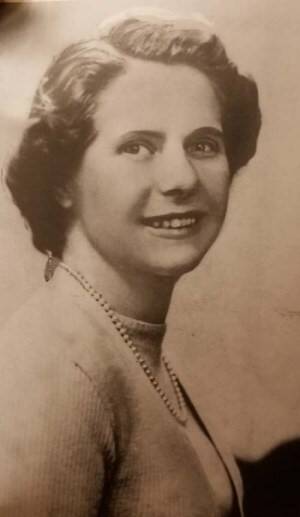
Image 1: Joan Woodhouse
Joan Mary Woodhouse was born on 17th July 1921 in Barnsley, South Yorkshire, to parents John and Nellie. Her mother came from a large working-class family and two of her sisters - Ida and Annie - were both widowed in their 20s, without going on to remarry or have children, and subsequently played an active role in the life and upbringing of their niece.
Joan studied at Barnsley Girls High School between 1933 and 1939 where she opted to take extra lessons in French, German, literature and shorthand. When she left school in 1939, she started work at Barnsley Municipal Library under the supervision of chief librarian Miss Guest, who would later say of her employee: 'Joan was a brilliant girl and would have gone a long way in her profession.'
After two years working at the library in her home town, in 1941 Joan took a job at the West Riding County Library as an assistant librarian, also working for a short period of time as a school teacher at the Worsborough Dale Council School. At this time, of course, World War II was well underway and Joan was called up for National Service in 1942, when she moved to Sheffield to work as a draftswoman. It was here that she met Lena Bamber, someone who would go on to become one of her closest friends, and with whom she maintained regular contact.
After working one year of National Service, Joan was discharged and able to move back to Barnsley where she helped her parents to run a residential youth club. Her mother, Nellie, had struggled with ill health for a while but by the time Joan moved back to Barnsley she was severely unwell. Nellie passed away from cancer one year later, when Joan would have been approximately 22 years old. She was supported through her grief by her aunts Ida and Annie, who lived together in Bridlington, on the east coast of Yorkshire.
Keen to return to the library profession and to develop her education in the wake of her mother's death, Joan obtained a place at the University of London to study librarianship. She obtained an intermediate diploma and was described by her friends and classmates as a talented scholar. After finishing her training, she was successful in securing a job at the National Library, which was then part of the British Museum, set in the London district of Bloomsbury.
As well as being academically gifted, Joan was sociable, enjoyed reading books, listening to music, watching films and playing the piano. She was known to be a deeply religious member of the Anglican church, setting herself goals to pray twice a day, attend regular communion, read the Bible daily and live a respectable Christian life.
Joan rented accommodation at number 32 York Street for a period of three years, dating from when she was a student until the Spring of 1948. When she first moved in, the property was owned and managed by Mrs Mary Thompson, a Scottish woman who lived in the home with her two daughters. Joan had viewed flatlet 10 - similar to what we would call a bedsit today - on the top floor, in the company of her two aunts, and had moved in shortly after. During her time living here she often visited the Old Vic theatre, had small parties in her room with a handful of friends, and recited poetry to herself in the evenings. In 1946, number 32 York Street was sold to Lady Barbara Seymour, who still owned the house at the time of Joan's death and reportedly became very fond of her tenant.
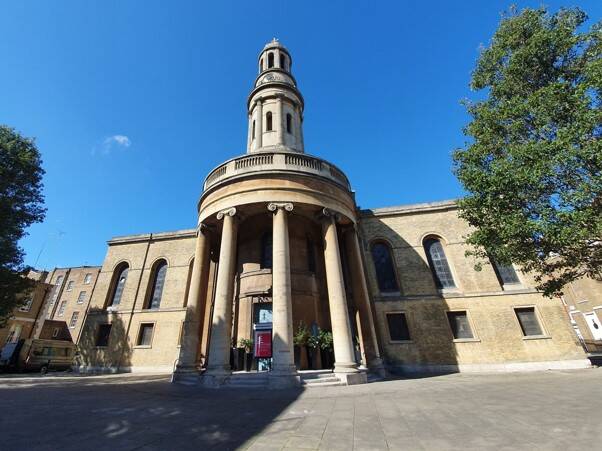
Image 2: St. Mary's Church, Bryanston Square, London
Joan had been a regular member of the congregation at St. Mary's Church in Bryanston Square - just a few minute's walk from her home - and in 1947 she also took on a role as a Sunday School teacher with the church, teaching both boys and girls. Her organised, structured life seemed to derail slightly in the early months of 1948. She had been courting (dating) fellow librarian Ted Roberts, with rumours that the two would become engaged, but their relationship ended as Spring of 1948 approached. Joan's family believed that Ted wasn't able to compete with her strong religious beliefs, but Ted was quick to say that he had ended the relationship as the pair had simply grown apart.
Joan was devastated by the breakup and it appeared to take a considerable toll on her mental health. Within a short period of time she handed her notice into the National Library, left her flatlet at number 32 York Street, and had travelled to Bridlington in East Yorkshire to stay with her aunts. Alice Herron, a housekeeper at number 32, described how Joan - who was affectionately known as 'Woody' to the household - had left the home with very little notice, saying: '"we could never understand why she left. She must have decided very quickly, because I remember coming to clean the house one morning and finding 'Woody' with her luggage all packed, waiting to go off. I thought she looked a little worried."'
When Joan arrived at her aunt's home in the seaside town in March 1948, she appeared far from the cheerful girl she had been when Ida and Annie had last seen her. She was described as suffering from what was termed a nervous debility, and she admitted to her aunt's that she had recently made a half-hearted attempt to end her life by swallowing a quantity of aspirin - an act which was, fortunately, unsuccessful. After spending several weeks in the company of her two relatives, however, Joan seemed to have rallied and - under the advice of her aunt's, who were keen to keep her busy - she contacted the National Library to ask if she could retract her resignation. The establishment was happy to have the 27-year-old back in their employment, and in May 1948 Joan headed back to London, briefly residing in a communal house in Endsleigh Gardens before moving into the YWCA (Young Women's Christian Association) hostel at 29, Bennett Park in Blackheath. The facility meant that residents shared a room with other women, and that communal areas and meals were shared with fellow tenants. Ida and Annie had encouraged their niece to live in an establishment with other women close by for a while, hoping that having people around her would keep her occupied and keep her mood elevated, preventing her from dwelling on the breakdown of what had been seen as a promising relationship.
The Disappearance
In England and Wales today we're used to the August bank holiday falling at the end of the month, but in the 1940s the holiday was held during the first week with bank holiday Monday falling on 2nd August. The Olympic games were being held for the first time since Berlin had hosted the event in 1936, and the capital city of London would have been packed with sports fans and spectators as well as those enjoying the long weekend.
Joan Woodhouse had been living in the YWCA hostel for around four weeks by the time the bank holiday weekend approached, and had celebrated her 27th birthday just a couple of weeks previously. Her father had sent her a handsome handmade knitted purse in time for 14th July, and she had made plans to visit him in Barnsley for the long weekend, making the most of the extra day off in order to spend some quality time with her family. Her father had remarried the year previously, with his new wife - Hilda - being many years his junior, and only four years older than Joan.
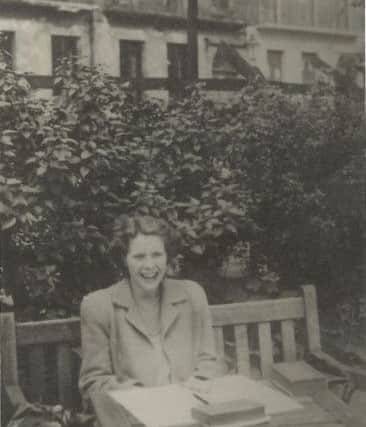
Image 3: Joan Woodhouse
On Saturday 31st July 1948, Joan spoke with her roommate - Nicole Ashby - at around 8:30am, telling her that she was planning to catch the 10:10am train from King's Cross Station to Barnsley. She was dressed in a multicoloured dress with a Paisley print pattern, described as similar to a Hungarian-style frock, with blue lace gloves and blue sandals. She carried with her a fawn and white striped coat, an emerald-green mackintosh, and a blue suitcase. She was seen to place around £8 (equivalent to around £284 today) in the knitted handbag which her father had gifted her for her birthday, and wrote her name on the hostel blackboard list to request an evening meal for Tuesday 3rd August - the day she planned to return to London.
The last time Joan was seen by someone she knew was when she walked out the doors of the YWCA hostel at just after 8:30am on Saturday 31st July - presumably in the direction of King's Cross Station, as she had mentioned to her roommate. However, this would be where things started to take a strange turn, with her movements becoming more and more bewildering and leaving behind a mystery which still endures to this day.
Joan never boarded the 10:10am train from King's Cross Station. She never arrived in Barnsley for the bank holiday break. She never called her father to advise him of her arrival time, or to tell him that she was delayed. She never returned to the YWCA hostel on Tuesday 3rd August for the evening meal.
If anyone at the hostel had thought it unusual that Joan had not returned when she had said she would, their anxieties were increased when the University Central Library contacted the establishment on Wednesday 4th August to enquire if Joan was perhaps unwell, as she had failed to return to work after the bank holiday weekend. Mounting concerns led to the property warden, Jessie Maddocks, opening a telegram which had arrived, addressed to Joan, on Thursday 5th August, which transpired to be from her father. It read: 'Are you ok. If not come home. Auntie is worried.' With this information confirming that not only had Joan failed to return to the hostel after the bank holiday weekend but that she had also failed to reach her intended destination in Barnsley, Jessie Maddocks responded to John Woodhouse by telling him that Joan had not returned to her room as they had expected. After sending the return telegram, she made her way to Lee Road Police Station to report the 27-year-old as a missing person.
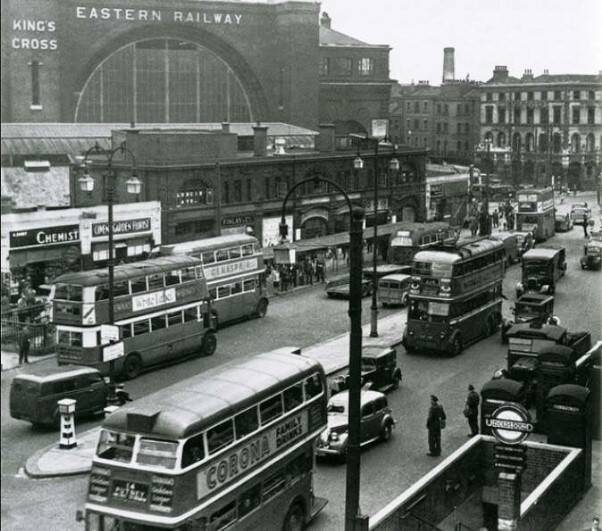
Image 4: King's Cross Station in the 1940s
Although they didn't react with an immediate search, authorities duly released a description of Joan Woodhouse to the public which stated that the young woman was 5ft in height, slim in build, and had a 'sallow' complexion. I'm not sure if their interpretation of a sallow complexion at the time is the same as ours today - it's normally associated with someone who looks unwell or is under-the-weather, with a yellow or grey tint to their face or a paleness which looks unhealthy. If this is what the police meant, it seems a little unfair - Joan was described as being much improved in health in the couple of weeks proceeding her disappearance, and none of the publicly released statements from residents at the hostel mention this. One would have thought that it would have been mentioned later on in interviews with the other hostel tenants if she had been looking physically unwell in the lead up to her disappearance.
Unbeknownst to the YWCA hostel staff, John Woodhouse was making his way to London in the company of Ida Sheriff - his sister-in-law - with the pair arriving at the residence to collect Joan's possessions at 9am on Saturday 7th August. Rooms in hostels would have had a relatively rapid turnover, and although there was no mention of the staff chasing the Woodhouse family to empty Joan's bedspace, they may have wanted to collect her things to leave the space free for someone else, or - and what seems the more likely option - they wanted to check what items she had taken with her, and what she had left behind. During the visit, they disclosed to the hostel staff that Joan had made a prior attempt to take her own life and that they were deeply concerned for her welfare, considering that she may have travelled somewhere to make a second attempt.
John Woodhouse and Ida Sheriff remained in London until Tuesday 10th August, waiting for any word from police about the location of their missing daughter and niece. Remember, at the time methods of communication would have been considerably slower than they are today - telephones were still largely owned by businesses and wealthier homes, letters would have taken time to arrive, and sending a telegram would have required access to a phone or a local post office, with the message then being printed and delivered to the addressee by a telegram boy. It would likely have been far easier for John and Ida to remain in the area for a period of time where they could perhaps visit the police station each day and ask if there was any news. As it happened, they made the decision to return to Yorkshire on the same day that a very important update would be uncovered.
The Discovery
At approximately 4:45pm on Tuesday 10th August 1948, 24-year-old labourer Thomas Stillwell emerged from a group of trees in Arundel Park and headed towards Swanbourne Lake Lodge. Arundel Park sits in the grounds of Arundel Castle - the home of the Duke of Norfolk - with the park, castle and lake being popular attractions for tourists and locals alike. Today, people can hire boats to row around the lake in the warmer months and the grade-II listed lodge has been transformed into a tearoom with spectacular views across the water. In 1948, however, the lodge was still a residential property and home to one of the Duke of Norfolk's ground keepers - Mr Ferris - with whom the 24-year-old intended to speak.

Image 5: Swanbourne Lake and Lodge, as seen in modern times
Upon finding the man, Thomas Stillwell asked to borrow a bicycle as a matter of urgency. If Mr Ferris had any qualms about lending the mode of transport to Stillwell - who had his right arm in a sling and a limp in his leg - he didn't voice them, he simply handed over his daughter's bicycle and let the man go on his way. Stillwell pedalled as well as he could to the local police station in Arundel, walking into the building at 5:20pm and telling the officer behind the front desk that he believed he had found a body.
Planning to confirm whether the report was correct or if Stillwell was mistaken, two police officers headed to a secluded area of Arundel Park known as Box Copse, with Stillwell following steadily on the bicycle. The 24-year-old later reportedly that he did not wish to see the human remains again and instead waited a distance away whilst directing the two officers to the area. Unfortunately, they quickly realised that Thomas Stillwell's observation had been entirely correct and sent for reinforcements.
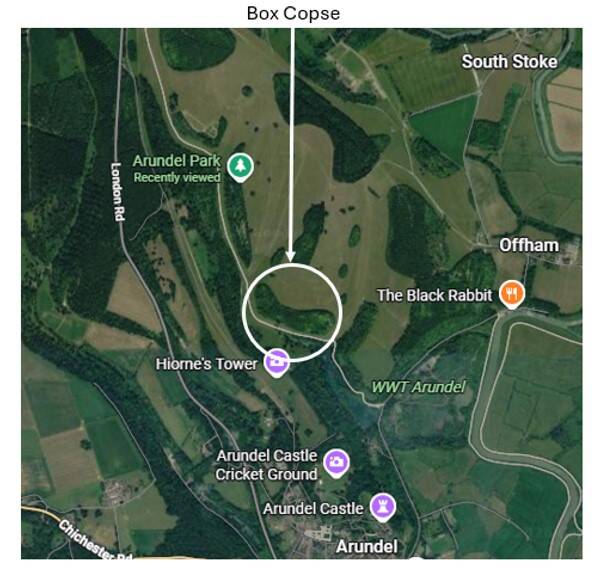
Image 6: an aerial view of Arundel Park and Box Copse
Despite the onset of decomposition and presence of maggots, it became apparent that the body was that of a woman. She was partially clothed in a bra, knickers, a suspender belt which was attached to her stockings, and sandals. A string of pearls was visible around her neck. Stillwell was able to point the officers in the direction of a pile of clothing which he had stumbled across, approximately twenty yards away from the body. A green mackintosh was spread out on the ground, on top of which lay a neatly-folded stack of clothes containing a fawn and white striped coat, a Paisley-print dress, a knitted handbag and an empty bottle of soft drink. The contents of the handbag was examined in case it could help to identify the woman and was found to contain a compact mirror, a powder puff, lipstick, a pair of sunglasses, cash, a cheque (the monetary value of which is undisclosed), a diamond and sapphire ring, and a ticket stub for the left luggage office at Worthing Train Station. At the time, rationing was still in place across Britain but no rationing book or form of identification was located. A couple of magazines were also said to be found a short distance away.
There seems to be some discrepancies in the newspaper reports from the time as to whether the cash - which amounted to just under the £8 which Joan was known to have with her when she left the hostel - the cheque, the ring and the ticket stub were, indeed, found in her handbag at the scene or whether these were found separately. Some of the articles state that police had to search for these items as they were initially deemed to be missing, and the press interviewed Thomas Stillwell who said: '"I was walking through the park when I decided to take a short cut. This took me through Box Copse. I hadn't gone far when I saw a handbag and some women's clothing. I looked into the handbag, which was very wet. There was no money in it and nothing to identify the owner. I think there was a newspaper in it. I left everything where I found it and went to the police."' Ultimately, once the victim was identified and their possessions accounted for, it was ascertained that robbery was not the motive for the attack - all the necessary items were located and nothing was noted to be missing, so I'm not going to dwell on where the items were each found.
Visible bruising was noted on the thighs of the woman, leading to the early assessment that she had been indecently assaulted, and close review of the body led authorities to believe that she had been manually strangled and had potentially had her nose and mouth covered. They were quick to ascertain that they were dealing with a case of sexual assault and murder, but aside from some scuff marks on the trunk of a nearby tree, there was little disturbance in the immediate area to indicate a struggle.
As was the procedure at the time, Arundel Police quickly contacted New Scotland Yard and two detectives - Chief Inspector Fred Narborough and Detective Sergeant Pattison - were dispatched from the murder squad to join Superintendent Eagle, head of Arundel CID, who was heading the investigation. Local policing units were rarely trained or equipped for such significant criminal investigations in the early to mid 1900s, and Scotland Yard were generally called upon to support the investigation of the more serious crimes, as they contained highly trained and specialised staff with a wealth of experience.
With authorities releasing to the public that they had embarked on an investigation into the rape and murder of a young woman, the story hit national newspapers at a shocking speed, perhaps bolstered by the nation-wide increase in crime since the end of the second world war, and the increase in crimes against females. The case of the victim found in Arundel Park went to print in multiple newspapers right across the country almost immediately, with reporters clamouring for more information from Scotland Yard and Arundel Police Station. Meanwhile, the entire park was cordoned off as police set about scouring the area for possible clues in a bid to find out who the young woman was and how she came to be in Box Copse.
The Investigation
From an early stage in the investigation, the police had an inkling that the victim in Box Copse may have been Joan Woodhouse, who hadn't been seen since she left the YWCA hostel where she was staying on Saturday 31st July. This was confirmed when a post-mortem examination conducted by Dr Keith Simpson, Home Office pathologist, in conjunction with police surgeon Dr D. J. Hunt, ascertained that the description of the 27-year-old closely matched that of the body which had been recovered from the scene, with features of note including two overlapping teeth and a mole on her upper lip. She was ultimately identified from her physical features and the clothing found with the body, confirming the victim to be Joan Woodhouse.
The post-mortem lasted two hours, and concluded that Joan's body had lay in the isolated woodland for between 8 and 10 days. A precise time of death could not be narrowed down any further than this due to the level of decomposition, which also hindered the ability to take samples of semen from the body, but it gave cause to consider that Joan may have died on the day she disappeared, or at least across the bank holiday weekend. Cuts and bruises to her lower legs gave the impression that she may have run through the undergrowth in the park prior to her death, and bruises to the upper legs and further examination confirmed the initial assessment that she had been indecently assaulted. Her cause of death was found to be pressure to the neck which had been so severe that part of the voice box was damaged.
Whilst the post-mortem was being completed and documented, and Joan's family were being given the devastating news of the death of their loved one, police were following the information available to them. Officers were sent to Worthing Railway Station with the ticket for the left luggage office which had been found with Joan's personal effects, where they retrieved the blue leather suitcase which she had checked in on Saturday 31st July. Examination of the contents of the case found sufficient clothing and toiletries to last for a weekend, adding to the assumption that Joan had planned to have returned to her hostel room in London by Tuesday 3rd August. Although it was considered that she had travelled by train from London to Worthing, and then likely from bus from Worthing to Arundel, no train or bus tickets were found amongst her possessions.

Image 7: police officers in Arundel Park
Officers were deployed to Worthing and neighbouring coastal resorts, instructed to visit every hotel, hostel or boarding house to see if someone matching Joan's description had booked a room over the bank holiday weekend, or whether they had a customer who had reserved a room but failed to check in. Initial considerations were that Joan had stayed - or intended to stay - in the area with a man, perhaps meeting for a secret weekend away, and that the man may have been responsible for her death. As it could not be confirmed which day she died, officers had to consider that she may have stayed overnight at an establishment on the Saturday, perhaps then meeting her death on the Sunday or Monday, but the primary theory remained that she had died on the Saturday, otherwise it was considered that she would have returned to collect her suitcase from the left luggage office.
Due to the way her clothing had been neatly folded in a pile near to where her body was found, there was suggestion that she may have taken it off voluntarily, perhaps in the company of a boyfriend - a suggestion which her family strongly refuted, stating that Joan was a respectable and dedication Christian woman and that the subject of chastity was very important to her. We also know that Joan had experienced a period of emotional difficulties across recent months, and that there are things that people don't always share with those closest to them, so it simply couldn't be ruled out in the eyes of police that Joan may have been meeting someone.
The suggestion that Joan may have booked to stay at a seaside resort within reaching distance of Arundel played into police's next theory - that Joan may not have travelled to the town by bus at all, and may instead have been given a lift by the person who she had been meeting, a theory which was borne from the lack of tickets or ticket stubs in her handbag. If she had travelled by train and bus, then perhaps her companion had kept hold of the ticket stubs, explaining why none were found amongst her own possessions. To cover all bases, they set about interviewing train staff on the lines to Worthing and London Victoria as well as bus drivers and taxi drivers in the Arundel area in case any of them remembered the woman in the Paisley print dress.
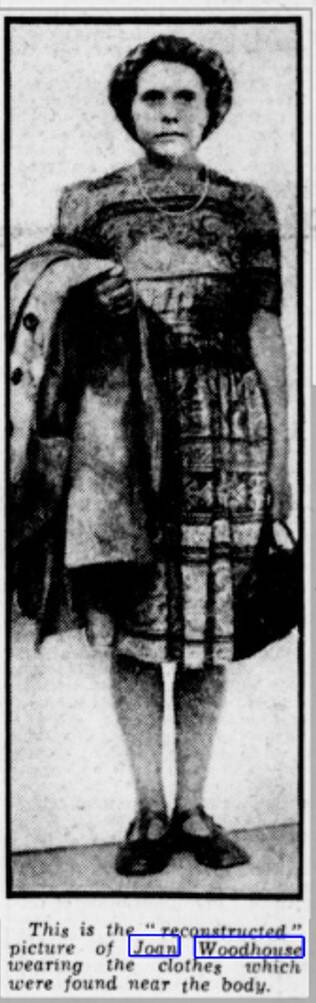
Image 8: the reconstructed image of Joan Woodhouse
Utilising the technology available to them at the time, the police asked a woman matching Joan's height and approximate weight to dress up in Joan's clothing before taking a photo of the woman and superimposing an image of Joan's face onto the figure, forming something of a photo fit of how Joan Woodhouse would have looked on Saturday 31st July. This image was widely circulated not only by police, but also by the press who printed it in every available newspaper along with an appeal for anyone with information to come forward and speak with authorities. A large copy of it was attached to the entrance of Arundel Park, and was also shown in cinemas in the Arundel, Worthing and London areas in an attempt to attract any witnesses who may have seen her.
Many of the young women who were staying at the YWCA hostel at 29 Bennett Park were interviewed by authorities, asking what they knew of the 27-year-old victim and whether they were aware of her intended actions on Saturday 31st July and bank holiday weekend. They spoke to Nicole Ashby - Joan's roommate - who was able to tell them of Joan's plans to go home to Barnsley via the 10:10am train from King's Cross, but no-one else seemed to know any reason why she may have changed her plans - especially with such short notice - or what she may have been hiding from those around her.
None of her fellow residents had a bad word to say about Joan - it seemed that she kept largely to herself but was generally well liked. Claire Pettigrew, who stayed at the hostel and was employed by the Ministry of Health, described Joan as quiet and studious and said: '"she often played the piano to us in the evening and seemed to keep herself to herself. She was well-dressed."' Another woman described her as: '"one of the nicest girls I have ever met and always well dressed."' Officers also spoke to the residents at number 32 York Street, as well as their neighbours, with one man telling the Record newspaper: '"the photograph of Joan issued by police does not do her justice. She was a girl with an attractive face and the figure of a ballerina. But she was quietly dressed, tastefully if you like. I could never imagine her wearing a loud Hungarian dress."'
Some speculation around Joan's romance's started creeping into the press. Several women at the hostel had told police that Joan had been a little secretive in the weeks leading up to her death, with her friends saying that she was taking longer to reply to letters than she normally would, and had cancelled several engagements at the last minute. Police were already starting to suspect that she may have been seeing a new man - perhaps someone who was married and needed to keep the relationship a secret - a theory which was encouraged by one of the women at the hostel saying: '"we all knew Joan had a boy friend, whom she sometimes referred to as 'John', but so far as I know none of the girls had ever seen him or knew anything about him."' A 19-year-old student, Edna 'Nella' Adams, who had previously shared a hostel room with Joan, even told police that Joan had shown her and one of Edna's friends an engagement ring containing two stones as well as two photos of someone she described as her fiancé, with one being of his head and shoulders and the other being a full portrait. Edna had asked Joan why she didn't wear the engagement ring, to which Joan had given the cryptic response: '"it is my fault"'. Edna reported that Joan hadn't mentioned the name of the man, but as Joan had only been living in the YWCA hostel for four weeks prior to her disappearance and had separated from former boyfriend Ted at the beginning of the year, it could be assumed that it was not him.
Ted, meanwhile, had attended the Scotland Yard building on 11th August after hearing about the discovery of a body in Arundel. Described in the press by his full name of Edward Roberts, Ted was reportedly informed by officers at the Yard that they were still awaiting a formal identification at that stage. He was interviewed in the press after Joan's identification was confirmed, talking about how the two had met at University College as students. He had decided to train in the School of Librarianship after he left the army, and told journalists: '"up until last Christmas I expected to marry Miss Woodhouse, although she didn't want any engagement announced. Then our relationship became strained, and I have not seen her since April. I had a letter from her in early May when it was arranged that we should meet at Scarborough later that month, but she did not come. I received a letter from an aunt of hers afterwards, saying that she was ill."' Ted told the press that he believed her illness to be a delayed onset of war neurosis, which would today be described as an early form of post-traumatic stress disorder. He had noted that she had started to cut herself off from people she had been friendly or acquainted with prior to her stay with her aunts in Bridlington, and said that he had been trying to trace her in recent weeks by contacting people that she knew. He concluded the interview by saying: '"I am as baffled and perplexed as anybody about this."' Ted was never indicated as having any involvement in Joan's murder and was able to provide a solid alibi for the bank holiday weekend, but it is a little interesting that he was quick to put her depression and 'illness' down to war neurosis rather than considering that it may have had anything to do with the end of their relationship.
An inquest into Joan's death was opened on Friday 13th August 1948, with four witnesses called within twenty minutes, one being John Woodhouse to confirm the identity of the deceased, and Thomas Stillwell to describe how he had come across the remains. John Woodhouse told the court that the knitted bag found near to Joan's body had been the one which he had had hand-made for her birthday just two weeks before she died. Thomas Stillwell described how he had found the body at 4:45pm on Tuesday 10th July. The inquest was subsequently adjourned by Coroner Mr F. W. Butler to allow police to continue with their enquiries. However, the initial hearing enabled a provisional death certificate to be issued and for her body to be released from the mortuary, enabling the family to hold a funeral.
Joan's body was conveyed to Barnsley on Saturday 14th August, with details of her funeral being kept a complete secret to give the family privacy away from the prying eyes of the media and the public. The only mourners were her father and two male relatives, with Joan being laid to rest in Ardsley Cemetery in Barnsley on Tuesday 17th August 1948.
Although it was initially thought that Joan had never been to Arundel before, it emerged that her two aunts had previously lived along the south coast and that Joan had travelled to Arundel Park with them for picnics when she had visited. Her vague knowledge of the area did little to explain why she had decided to divert her journey there on bank holiday weekend, and police persisted with the theory that she had gone there with, or to meet, a companion. Some unconfirmed witness statements suggested that a man had been present with Joan when she dropped her suitcase at the left luggage office at Worthing Railway Station, and police confirmed in the press on Friday 13th August that they were trying to ascertain if the man mentioned by witnesses had travelled with her from London or had met her at Worthing.
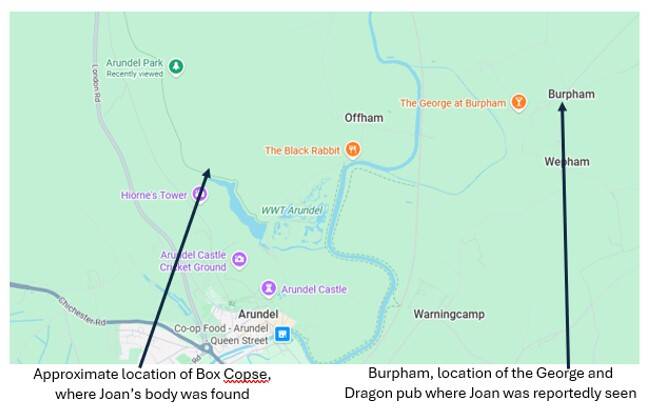
By this time, images of Joan had been seen across the nation and witness statements had trickled in, with police stating on Saturday 14th August that they had started to develop a description of Joan's possible male companion. Leslie Grant, the licensee of the George and Dragon pub in the hamlet of Burpham, not far from Arundel Park, believed that he had seen Joan in his pub on Saturday 31st July with a light-haired male. Mr Grant said: '"I saw a picture of Miss Woodhouse in a newspaper and recognised the dress as one worn by a woman in the private bar during lunch-time on 31 July. She was with a man who spoke with a cultured voice. I don't think I could describe the man, but I might recognise him again. So far as I can remember he was fairish and clean shaven."' He placed the age of the man as being somewhere in his late thirties, and described him as being of medium height. Of Joan, he said: '"I remember particularly her sandals and and her 'Hungarian' type stripe frock. She laid a coat by her side. Her companion said they were going to walk to Arundel, which they could do by the river path. They had a drink and left."' He was confident in his observation, citing that the dress worn by Joan was unique: '"I couldn't be mistaken about that dress. It was distinctive. You don't see two dresses like that in a village like this in a lifetime."'
The suggested route between Burpham and Arundel by road is just over 5 miles long and would have relied on the couple seen by Leslie Grant having access to a car. However, if they were taking a direct walk along the river between the two destinations, it would - at a guess - have been one or two miles. The consideration would then have been whether Joan and her companion had travelled from Worthing to Arundel and walked to Burpham, or whether the pair had taken a bus to Burpham and walked back to Arundel, intending to take a return bus from Arundel to Worthing. Of course, there was always the chance that Joan had been driven to Burpham by her companion and that the two had planned to walk from Burpham out to Arundel Park and back again. The possibilities, if it was Joan seen in the pub, are extensive.
Image 9: map showing Burpham village in comparison to the approximate location of Box Copse
Further reports of sightings of the 27-year-old were submitted to police, with some describing her as being with a companion and others stating that she was alone. She was reportedly seen having lunch in an Arundel hotel restaurant on Saturday 31st July with a man who was described as being in his thirties, clean shaven, and wearing a sports jacket and flannel trousers. The couple were specifically remembered by two waitresses in the hotel, as they recalled the man being unhappy that several dishes on the menu were unavailable. A man described seeing the same couple walking down the high street in the town and in the grounds of Arundel Castle, recalling that the male had almost unnaturally wavy hair. Another report was made to police stating that they had seen Joan with a man at an event in Arundel Castle. During the bank holiday weekend, an exhibition of dolls was on display in the castle, with each doll dressed to depict a different era of fashion. The witness said that the couple had left the event and headed in the direction of Swanbourne Lake.
Two further witnesses recalled seeing Joan on her own during the afternoon of the 31st, with the local chemist - Mr Bowles - telling police that she had entered his shop to purchase a bottle of lemon barley drink, and Miss Dibley - who was visiting friends in the area - describing how she had seen a woman matching Joan's description in Arundel Square. The report from the chemist was considered to be particularly credible on the basis that the empty soft drink bottle was found along with the pile of clothes near to Joan's body.
Each report was dutifully followed up by police, and when Arundel Park reopened to the public on Friday 13th August officers were stationed at the entrance with a large copy of the photofit of how Joan would have looked on Saturday 31st July. They stopped anyone going into the park and asked if they remembered seeing her in or around the area, managing to obtain photo negatives from a photographer who had been taking images in the park that day, just in case Joan could be seen in any of them, and securing six other witness accounts of people who thought they had seen her. They took a copy of the superimposed image to hotel owners, shop keepers and tea-room staff in Arundel, just in case anyone recalled the 27-year-old in the distinctive dress.
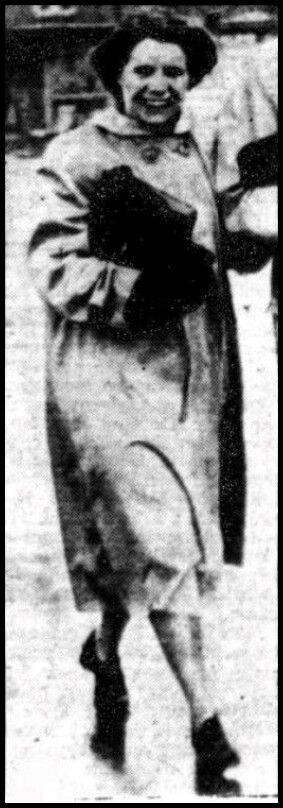
Image 10: Joan wearing the mackintosh which was found with her body
One of the focal points early on in the investigation was a contact book which was found with Joan's possessions. The book contained the names and contact details for more than 100 men and police set about reaching out to every man on the list, with Inspector Narborough considering that Joan may have been what was known as a 'good time girl' - something which her family strongly disputed due to her Christian faith. An enormous amount of resources were piled into tracing each man and interviewing them, only to find that each individual was a student or librarian with whom Joan had contact as part of her work at the National Library. The man known only as 'John', who had been mentioned by some of the girls in the hostel, proved to provide no leads, either, when it transpired that he was simply a friend with whom Joan went to church.
Joan's father approached police with a stack of letters which he had found amongst the possessions which the family had collected from her room at the YWCA hostel. A total of 55 letters were handed over to authorities for their examination, with many being from male friends and with some containing endearing terms. Off the back of this, officers were deployed to addresses in Farnborough in Kent, and Guildford in Surrey, in addition to properties in Paddington, London, to follow up on information obtained within the handwritten pages. Two of the men with whom Joan had been communicating provided statements to police, but little of significance came from this line of investigation. An additional item retrieved from Joan's personal effects by police was a diary containing details of Joan's schedule and personal engagements, as well as the names of more than 150 acquaintances, friends and family members. Bizarrely, no notes of her activities were documented in the two weeks prior to the bank holiday weekend - the very period which police were most keen to investigate. No appointments, meetings or coffee dates were jotted down - something which was reportedly out of character for the organised 27-year-old. This naturally opened up some questions as to whether this was a deliberate omission to try to keep something secret, or if there was a specific reason why Joan had failed to write down any of her scheduled activities. Police followed up on some of the names in the contact list, but again nothing transpired from this.
Police received information about a party which Joan had attended on Tuesday 13th July - just a couple of weeks before she died - and they set about tracking down the location of the event and each of the attendees. They believed that she had made her bank holiday arrangements at this event, although it's unclear why they thought this. The get-together transpired to have been held at an address in Highgate Village in North London and, although it took time, officers were able to obtain the names and contact details for all of those who had been present. Every single attendee at the Highgate Village party was interviewed except one, with police telling the press that they believed that one of the female party-goers was withholding information, and that they were very keen to trace her as they thought that she may have additional information about Joan's plans on the bank holiday weekend. Apart from the continued search for this woman, all other party attendees were spoken to and ruled out as either having any involvement in Joan's death, or having any knowledge of her activities that weekend. However, some of her friends did mention to officers that Joan had been lower in mood in the months leading up to her death - a far cry from her normal, cheerful self. Was this simply a continuation of the depression and illness her aunts had supported her with? Had her mental state perhaps not improved as much as Ida and Annie had indicated? Or was there something else going on in Joan's life which had caused a further change in her mindset?
Chief Inspector Fred Narborough and his team visited Arundel Park for a further walk round on 19th August, again reviewing the crime scene and talking through potential theories. Their working theory continued to be that Joan had been attacked by someone she knew based on the way her body had been discovered and the lack of signs of a significant struggle having taken place. Narborough had clocked up over one thousand miles travelling the country to interview people known to Joan, or who had been present in the area that weekend - remember, due to the bank holiday there were more tourists and visitors to London and the south east coast than usual, and officers worked tirelessly to track down as many of these people as possible.
By Friday 20th August, police had further narrowed down the description of the man they believed Joan to have been with on Saturday 31st July. The press printed that he was between 30 and 40 years old, of medium build and with brown, wavy hair. Authorities had also narrowed down the window of time in which they believed that Joan had travelled to Worthing, telling the media that she had most likely taken the 9:20am train from London's Victoria Station across to Worthing, then reaching the village of Burpham by around midday. Despite these minor updates, one officer cautioned the public against expecting a swift resolution to the case. Inspector Percy Edwards, of Marylebone Lane Police Station, told the Record newspaper: '"do not expect sensational developments. This is going to be a hard case to crack. We need the Press and public to assist us with information. However slender it may be, every clue could help us in our search for the killer."'
Scotland Yard told the press that two anonymous letters were received at the police headquarters in August, with Chief Inspector Fred Narborough considering them to be highly relevant to the case of Joan Woodhouse. He said: '"if the letters are true, the person who wrote them knows something about the private life of the dead girl."' Although he wouldn't divulge the contents of the letters, he did confirm that the handwriting appeared to be the same on each one and that the second letter had been received around one week after the first. He publicly urged the letter writer to come forward to speak to authorities, promising that their confidence would be respected. By the end of August, a total of three letters had been received with each being send from the EC1 postal area and addressed to the City of London Police.
Not long after this, a receptionist at a club in the coastal town of Bognor - a short distance from Worthing - made a police report after a bizarre experience. Joan Bates reported that on or around the 13th August a letter had been delivered to the club for the attention of a Joan Woodhouse, with a second letter arriving shortly after. She told police that the postman who had delivered them distinctly remembered the name as it was unfamiliar to him. The letters had been placed in a specific delivery slot in the reception pigeon holes and had subsequently disappeared, with Joan Bates telling a reporter: '"two letters for Joan Woodhouse arrived at the club about ten days ago. The postman remembered delivering them and the name aroused his interest. Two days later he asked me if they had been collected and we could not find them. We were very suspicious and the club manager, Mr Ernest Rogers, put a dummy letter addressed to Miss Woodhouse on the reception desk. Last Tuesday a man came in, grabbed the letter, and ran out. I ran after him but he disappeared. He was about 35 and had very wavy hair and a long nose. He was wearing sports clothes. His face was so easy to remember that I made a sketch of it and gave it to the police."' Joan Bates added that no-one by the name of Joan Woodhouse had been recorded as ever staying at the club, and it was a total mystery why letters addressed to her had been delivered there.
It can't have escaped the notice of authorities that the description given to police of the man who had taken the fake letter was shockingly similar to that provided by witnesses in the Burpham and Arundel areas of Joan's reported companion on 31st July. If you wanted to play devil's advocate, you could argue that the report given by Joan Bates to the press was printed on 23rd August - more than enough time for her to have read the descriptions of the man printed in the newspapers. Could she have been influenced by the huge amounts of information being batted around in the national news, or was this a genuine sighting? If so, why were letters for Joan Woodhouse being delivered to a club in Bognor where she had never stayed?
By the end of August 1948, the focus of the investigation had transferred mainly to London, where Joan had lived, worked and socialised. Authorities appeared to feel at the time that they had gained as much information as they could from the areas of Worthing and Arundel, and the priority switched instead to finding out as much about Joan's life as possible in a bid to find out why she had chosen to go south instead of north on 31st July.
As the weeks trickled by and August rolled into September, Scotland Yard assembled to conduct a review of the information they had retrieved so far. In the wake of this review, Inspector Narborough and his colleagues sat down with the Woodhouse family - including John, Ida and Annie - to discuss what progress had been made in the case, which transpired to be very little indeed. Despite thousands of man hours being dedicated to the investigation, hundreds of statements being taken and forensic examinations from the scene being completed, authorities had no leads, no suspects, and no idea why Joan had chosen to travel to Arundel that day. They had no idea who her supposed companion was, whether he had travelled with her via train or met her at Worthing, and - indeed - whether he definitely existed.
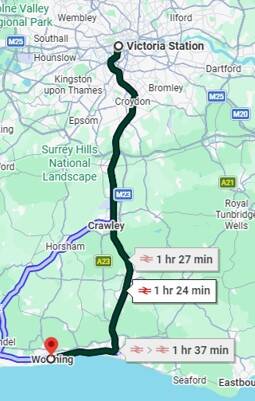
Image 11: the train journey from Victoria Station to Worthing
Inspector Narborough asked the family if they could think of any additional information which may help the investigation in any way - even the tiniest detail could be vital - although arguably this was a question which should have been asked in the days after Joan's body was identified. The family spoke at length about Joan's life, her education, her faith, and her likes or dislikes, but it was Ida Sheriff who dropped the bombshell that changed the way that the police looked at the case. She told the officers present that her niece loved the sun and loved sunbathing - so much so that she would find quiet locations where she wouldn't be spotted before taking off her outer wear and laying down to catch some rays.
Police were stunned. They had been working on the theory that Joan had gone to the area with someone she knew and had engaged in a consensual intimate act in a quiet area before being attacked. They had spent weeks tracking down anyone who had known the 27-year-old, and following up eye-witness sightings which placed her with a companion. Was it possible that there had been no companion, no consensual meeting, and that Joan had simply taken her clothes off to sunbathe in a secluded area? It would certainly explain why her clothes had been neatly folded and placed on the top of her mackintosh, rather than being tossed to one side and discarded.
Authorities had been set back by a 10-day delay between Joan's death and her body being found, and now it appeared that they may have spent six weeks trawling through her contacts when her death may, in fact, have been the result of a chance encounter with a stranger. Chief Inspector Narborough considered this to be time wasted, and a huge setback in the case.
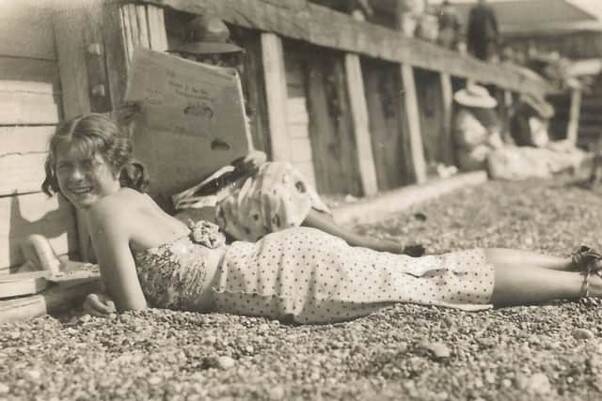
Image 12: a young Joan Woodhouse sunbathing at the beach
By the middle of September, reports in the press had done a complete U-turn. Police now claimed that the attacker was not known to Joan, and was likely an acquaintance she had met by chance in Arundel Park on Saturday 31st July. They stated their belief that the 27-year-old had taken the train to Worthing alone, although her motive for doing so remained a mystery. Any mention of the wavy-haired companion who had been seen by several eye-witnesses seemed to vanish into the background, and any talk in the press of Joan meeting a secret boyfriend ceased. Police instead focused on interviewing every man over the age of 15 in and around Arundel, assessing what their movements were on the 31st July.
At the beginning of October 1948, Inspector Fred Narborough and his team again returned to the scene of the crime to start a renewed intensive investigation. They met for discussions with local officers in Arundel Police Station, and it was here where the first of a series of interviews was carried out with a then-unnamed local man. It was reported in the press that he remained in the station for ten hours prior to being given a lift home by police, and returned the next day for further questioning. He was released back to his home with no charges being laid against him at the time, but what the national press hadn't been printing was the rife speculation in Arundel and the surrounding area as to the identity of Joan's killer. This man became the only name ever linked with Joan's murder and, although he was never found guilty of the crime, rumours followed him throughout his life and continued well after his death.
Thomas Stillwell
Thomas Stillwell was 24 years old at the time when he discovered the body of Joan Woodhouse in August 1948. He lived with his parents, Thomas and Ellen, his brothers Arthur and Philip, and his maternal grandfather George Parsons, in a small cottage called the Foxes Oven on the Duke of Norfolk's estate. The property was very isolated and sat alongside a path near the village of Offham, a short distance from Arundel.
Thomas senior was described as many years older than his wife and had a reputation for being a heavy drinker. He had previously served in the Royal Navy but his occupation - if any - was unknown by 1948. His wife, Ellen, had previously worked in service at Arundel Castle, and it was due to this employment that rumours around Thomas Stillwell junior's parentage began. In 1917, the 15th Duke of Norfolk had died and left his 9-year-old son as his heir. Bernard Marmaduke Fitzalan-Howard took ownership of the estate immediately, and speculation grew in the local community that he would go on to be the illegitimate father of Ellen's son, Thomas, when he was in his late teens - although there has never been any evidence to support this suggestion. Even Stillwell's father was doubtful about his parentage and had a poor relationship with him, later refusing to act as a character witness for him in court.
Thomas, like many working class young men at the time, started work at the age of 14. He was employed as a butcher's boy in Arundel, delivering meat to houses in the local area. He went on to hold down jobs as a painter and decorator, and also worked odd jobs tending to the gardens of local residents. By July 1948, he was working on a nearby farm as a labourer. He spent his free time with his family in the pub nearest to their property - the Black Rabbit in Offham - which was managed at the time by landlord Mr Knight and his wife. He was a regular darts player at the pub, and had his own set of darts which he carried in the top pocket of his jacket - a fact which would be of note later on.
Although Thomas had no criminal convictions, he was known in the local vicinity as something of a Peeping Tom - he reportedly followed young women and girls around Arundel Park to spy on them, and some said that he had exposed himself to them. It's unclear if reports were filed with Arundel Police and - if they were - whether these were ever followed up, but it was clear that Thomas Stillwell had no previous convictions against his name at the time that he reported finding Joan's body.

Image 13: Thomas Stillwell
Whether he was known to Arundel Police or not, it was clear that Thomas didn't do himself any favours when questioned by police. He originally told them that he had stumbled across Joan's body as he took a shortcut home through Box Copse, but then changed this to say that he had been intending to poach rabbits. At one stage, it was reported that he admitted that he had intended to expose himself to two women in the area, and also said that he had followed a woman who could have been Joan with the intention to engage her in conversation, but then said that he didn't believe that the woman was Joan. Stillwell told the police that he had lost one of his set of three darts - he played regularly at his local pub, and generally carried them around in his top pocket - and was informed by police that they had found a dart which matched his set at the crime scene. This, naturally, posed a number of questions to the 24-year-old, although he explained this away by saying that it must have fallen out of his pocket when he bent to look at the pile of clothes in Box Copse. Was he telling the truth? Or was it possible that Stillwell was the killer, and that the dart had fallen out of his pocket when he was committing the offence? The fact that the dart contained no rust or signs of environmental damage indicated that it can't have been lying in the copse for very long, giving weight to his suggestion that it had fallen out of his pocket when he found the body.
Much of what Thomas Stillwell said to police was deemed inadmissible as evidence, however, when it emerged that Fred Narborough had failed to caution him before he was interviewed - something which is a legal requirement. It's unclear if Stillwell had access to a lawyer at the time when he was questioned - he may have declined a lawyer if he felt that he had nothing to hide, and there is no mention of him having a lawyer in custody, but this may not have worked to his advantage.
With the press publishing articles stating that a local man was being questioned in relation to Joan's murder, speculation was rife in Arundel and it's surrounding villages. Thomas Stillwell's name was banded around as the main suspect, something which he would later say made things incredibly difficult for him and his family, but it didn't become clear to the general public that the man who had found the body was the same man being questioned by police until the Coroner's inquest resumed.
The Coroner's Inquest
The inquest was presided over by the oldest Coroner in the country at the time, 90-year-old Mr F. W. Butler as it reopened on Monday 22nd November 1948 at the 300-year-old Shire Hall in Arundel, with the evidence being heard by a jury. Coroner Butler addressed the panel as the inquest into Joan's death recommenced, saying: '"the pathologist will satisfy you, I am sure, that there was foul play and that she was murdered."'
Stillwell had been called to give evidence at the inquest and was supported by legal representation in the form of solicitor Vincent Jackson - something which sparked some media interest, as he came with fees which were far out of the range of the working-class Stillwell family. This reignited rumours around Thomas Stillwell's parentage, with many suggesting that the Duke of Norfolk had funded the legal representation.
Vincent Jackson made a statement at the inquest on behalf of his client, saying: '"I represent this man. He has already given certain evidence at the first hearing. But if anyone is seeking today to bring out any of the statements that Stillwell has subsequently made to the police I submit here and now that those statements are inadmissible."' We've mentioned before that the Coroner's inquest is not a location for apportioning blame or seeking criminal convictions against a person. It's purpose is to assess how the deceased person came to meet their end, but the boundaries of this have, at times across the course of history, been pushed. Stillwell was told by the Coroner that he was not '"bound to answer any questions which might incriminate you, but anything you say can be taken and given in evidence on another occasion"'. The attendance of legal representation at a Coroner's inquest is an unusual move for a witness, but Vincent Jackson's statement almost giving the impression that he was there to keep a watchful eye on proceedings.
Stillwell told the inquest how he had taken a shortcut home on Tuesday 10th August 1948 and how he had first found a pile of folded clothes in Box Copse before stumbling across the decomposing body of Joan Woodhouse. He took the witness stand for 45 minutes, dressed in a blue suit and grey-blue overcoat with newspapers describing him as slim, pale and fair-haired. He was questioned by the police solicitor - Mr C. V. Porter - about his differing statements to police regarding his reasons for being in the area, with varying reports that he had said he'd been taking a shortcut, then saying he hadn't. Multiple objections were issued to this line of questioning by Vincent Jackson, stating that the answers given by Thomas Stillwell could incriminate him in a matter unrelated to the murder - after all, if he had been planning to poach rabbits or hoping to expose himself to unsuspecting women, both activities would land him in legal trouble.
Instead, the police solicitor questioned Stillwell about why he had told police that he was in Arundel Park on Saturday 31st July - the day when Joan was last seen. Stillwell responded that he had told police this information under pressure, and that he couldn't be sure of the exact date when he was in the park over the bank holiday weekend, saying that he had only agreed that he was present in the park because he was told by police that there were witnesses who would attest to it. And - let's be honest - if it was an area where one walked on a regular basis, would you be able to remember each and every occasion when you were there?
He described how, yes, he had seen a woman walking around the edge of the lake and in the region of Box Copse, but was unable to recall the day or the date. He had mentioned seeing a woman in the park, but upon being shown a photo of Joan he said that he did not believe that she was the woman he had seen on the day he had been there - he described the woman he had seen as wearing a dark coat, whereas Joan's was light fawn and white. Stillwell was also questioned on the injury he had received to his leg, and asked whether the pain would have made it difficult to navigate the terrain in Box Copse - presumably to establish whether he would have attempted to take this route as a shortcut or whether it would have been more problematic for him, meaning that he was going there for another reason. Stillwell responded: '"my foot would hurt, but I would make it."'
Before Thomas Stillwell left the stand, the foreman of the jury asked: '"the jury would like to know if there is any special reason why this witness should be legally represented if he is only giving evidence of finding the body. Is there any significance about it?"' To which the Coroner responded: '"I cannot answer that. You will have to use your own judgement."'
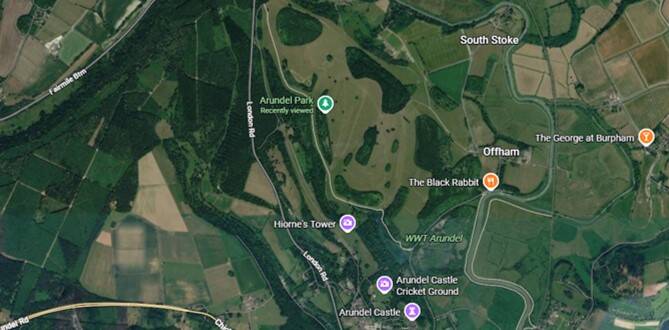
Image 14: satellite view of Arundel Park
Pathologist Dr J. G. Hunt took the stand to describe the injuries to Joan's body and his assessment that she had been strangled, as well as '"subject to interference against her will'". Ida Sheriff gave evidence about her niece's love for sunbathing and how she would often take off her outer wear if she thought she had enough privacy to do so. Throughout, Joan was described as being a woman of exceptionally good character, perhaps in a bid to reverse some of the discussions as to whether she had met a man on the day she died.
Detective Superintendent Fred Narborough naturally took the stand and described how officers believed that, based on the scene, Joan had managed to briefly escape her attacker and run a short distance to where her body was found, indicated by the fresh cuts to her legs which had likely been caused by the undergrowth. He made it clear that police had struggled to piece together a stable case against any one person, with the lead officer saying: '"up to the present we are unable to provide sufficient evidence to justify the institution of criminal proceedings"'. He went into the specifics of the police investigation and described how statements had been taken from every male over the age of fifteen who had been in the area of Arundel or Worthing across the bank holiday weekend, travelling across the UK to speak to some of them. The investigation had clearly been extensive and thorough, but had still failed to produce an official suspect.
To the surprise of no-one, the jury returned a verdict of murder by some person or persons unknown. Thomas Stillwell spoke to the press very briefly on his way out of the town hall, saying: '"I'm glad it is all over now. My conscience has always been quite clear."' To the Woodhouse family, however, it was far from over. They may have a report and a death certificate from the Coroner stating how Joan had physically met her end, but there was no-one paying the price for the crime which, in the 1940s, still amounted to the death penalty.
1949 to 1950
At the start of January 1949, the media published statistics which had been released by the police service showing that the post-war crime wave had shown no signs of decreasing. The number of arrests made by Scotland Yard and during patrols by the Metropolitan Police throughout 1948 had been the highest on record. Forty murders had been reported in London across the year, with 13 remaining unsolved and under investigation at the turn of the New Year. John Woodhouse, Ida and Annie refused to let Joan's case fall by the wayside and be left to gather dust on a shelf in the premises at New Scotland Yard, adding to a list of statistics which people would cast their eyes over in a newspaper before turning the page.
The three family members employed the services of former East Riding Detective Sergeant turned private investigator Mr Thomas Percy Jacks, a resident of Bridlington where Ida and Annie both lived, to investigate Joan's case. Despite having experience as a police officer, he had little practice investigating serious crime. Nevertheless, he retraced the steps taken by Scotland Yard, but also spoke to many of the residents of Arundel and the surrounding villages, who it appeared had made up their minds early on as to who had committed the devastating crime. There didn't seem to be a single person who believed that someone other than Thomas Stillwell was guilty, and it couldn't be argued that this was a result of media publicity - Thomas Stillwell's name hadn't been mentioned in the press outside of the Coroner's inquest and the discovery of Joan's body.

Image 15: The Woodhouse family
Under pressure from the Woodhouse family and the public to take some sort of action, Scotland Yard reignited the search for Joan's killer under the supervision of Superintendent Reginald Spooner, another highly experienced detective. Despite an intense review of the evidence, statements and paperwork, however, on 10th April 1950 it was reported that an arrest of any kind would be unlikely due to a lack of supporting evidence.
It was an outcome that the Woodhouse family and Thomas Jacks simply would not accept. On 26th June 1950, Jacks was called into Scotland Yard for talks with Reginald Spooner and the detectives assigned to Joan's case, but a lack of promising action as a result of this meeting prompted Jacks to advise his clients to apply directly to the Attorney General for a private prosecution against Thomas Stillwell - something which was possible under the Indictable Offences Act 1848 but was practically unheard of in practice, with the last successful application prior to the case of Joan Woodhouse being 85 years earlier.
At the tail end of August 1950, a magistrates hearing was called following an application submitted by John Woodhouse for a private prosecution against the then 26-year-old Thomas Stillwell. A panel of five magistrates consisting of four men and one woman presided over the special hearing, which was held in the office of the magistrates clerk, Mr Geoffrey Campbell. Stillwell was not present - the hearing was simply to hear the case presented by Jacks and to decide if there was enough information to move forward. The opening statement - read by barrister Mr A. W. Stephenson, of Hull on behalf of the Woodhouse family - lasted for 90 minutes out of the two-hour long hearing. Private detective Mr Jacks followed this with evidence from his investigation, and a small handful of other names were called to speak - although if the hearing only lasted for two hours and 90 minutes of that was taken up by one person, they must have been very short statements indeed.
At 6pm, the magistrates retired to consider the information presented to them and took just 23 minutes to reach a decision. A warrant for the arrest of Thomas Stillwell was handed to the police, who set out immediately for the Foxes Oven cottage in Offham.
The Magistrate Hearing
Detective Inspector Dean and Detective Sergeant Cowley arrested Thomas Stillwell at his home on Thursday 31st August 1950, and left the property with him one hour after their arrival - he walked the 200 yards to the waiting police car with a raincoat draped over his head to hide his face from the onlookers who had gathered outside of the property. He was conveyed to Arundel Police Station where he was charged with murder, and was subsequently transported to Littlehampton where he would appear in court the following morning.
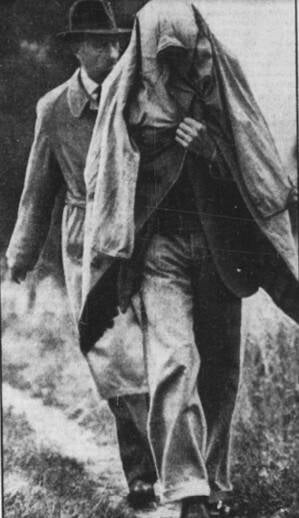
Image 16: Thomas Stillwell being escorted to the waiting police vehicle
Thomas Stillwell entered a plea of not guilty when he stood before the court on Friday 1st September 1950, where the magistrate's clerk read out the charge, stating: '"on the information of Mr John Thomas Woodhouse, of Park Road, Barnsley, you are charged that on July 31, 1948, at Arundel Park, in the County of Sussex, you did murder one, Joan Mary Woodhouse."' Stillwell was held on remand after an application was submitted by Superintendent Harry Catt under the instruction of the Director of Public Prosecutions, despite his lawyer - Victor Jackson, who had represented him at the Coroner's inquest - applying for bail and describing the proceedings as unusual and perhaps unheard of.
John Woodhouse was quoted in the press after the arrest of Stillwell, saying: '"it has taken two years of hard work, but it has been worth it."'
Stillwell was held on remand until the start of the magistrates' hearing, which was set to begin on Tuesday 19th September and was predicted to last between two and three days - a process which was necessary to ascertain if the case could be taken before a Crown Court. A representative for the office of the Director of Public Prosecutions, who had formally taken over the prosecution of the case, stated that approximately 35 witnesses would be called during this time.
On Tuesday 19th September 1950, Thomas Stillwell sat in court in Littlehampton with a large sprig of white heather through his buttonhole, provided to him by his fiancée ahead of the hearing commencing, in front of a magistrate panel of three men and two women. Next to him was his defence barrister, Victor Jackson. They, along with a packed courtroom comprising mostly of women, listened as prosecutor Mr J. S. Bass gave a 90-minute opening speech where he admitted that the hearing was based on evidence which was wholly circumstantial, saying: '"there is not one single piece of evidence which goes directly to show that he was a party to the commission of that crime. It follows therefore, no doubt, that you will wish to examine the evidence with the greatest of care, to see whether it shows any more than that this man had the opportunity to commit the crime if he so desired or whether there is evidence from which a jury could properly draw the inference that he was the person who in fact murdered Joan Woodhouse. If you come to the conclusion that the evidence does really no more than to show that he had the opportunity to commit this crime if he so desired, I submit it would not be proper to commit the man to take his trial."'
Mr Bass discussed, at length, the events between July and August 1948 and the extensive investigation carried out by police. He mentioned how robbery was ruled out as a motive for the attack due to the items found amongst her possessions, but that a medical examination had identified that indecent assault was likely the motive. She had either been strangled where her body was found, or had been attacked a short distance away before managing to run approximately twelve yards down a slope to where she was later discovered. He went through a list of the items found near to her body, describing how the green mackintosh was spread out on the ground at the foot of a tree, and that her coat had been folded on top of it in the shape of a pillow. As well as her dress and her handbag, police found an empty lemon barley drinks bottle and - something which hadn't been mentioned previously in the press - a sleeping tablet.
The barrister spoke of some of the witnesses he intended to call to the stand, including a woman who had reportedly seen Stillwell and Joan Woodhouse together in Arundel Park on 31st July, as well as opening the debate about Stillwell's changing accounts of that day to police. He had originally told authorities that he had walked through Box Copse at 4:45pm on 10th August - the day he found Joan's body - as he was taking a shortcut on the way home, but later admitted that he had not been taking a shortcut at all, and had instead returned to the site where Joan's body lay out of sheer curiosity.
Speaking of how Joan's body was found approximately 15 minutes' walk from the entrance of Arundel Park, Mr Bass said: '"how did it come about that this man was able to walk straight up to the spot, return in half an hour, and arrive at the police station at 5:20? It is a remarkable thing if the finding of a body was by chance and you may wonder if it is a true statement. You may think this man killed this woman on July 31 and, seeing nothing about it or finding of the body, could not restrain his curiosity any longer."' Mr Bass spoke of how Stillwell had originally told police that he had not been in the park on Saturday 31st July, but had visited a shop in Arundel before heading to the cinema in Littlehampton as he often did on a Saturday. Stillwell's account later change to admit that yes, he had been in the park that day and seen a girl some way ahead of him. He had hurried after her but had not caught her up. He had seen and spoken to a couple of people he knew before following after the direction the girl had gone in. He reportedly saw her turn around and head back towards him, at which point he said: '"good morning, lovely day,"' a comment to which she had not replied - she simply carried on walking. He had walked back around the lake and headed home. After this description of the accounts Stillwell had given police, Mr Bass added: '"you will have to decide if there is any evidence that this man not only tried accosting the woman, but slew her in the wood that afternoon."' He pointed to a moment when Stillwell had reportedly broken down and cried in front of police during an interview, with the accused saying: '"I suppose I am to blame for what happened to her. If it was the girl I saw I may have frightened her into the copse. Mind you, I am not dead sure she is the same, but the facial resemblance and build is similar to the photograph of Joan Woodhouse. It has been worrying me about that girl."' This moment has been debated across the years as a moment where Stillwell reportedly 'confessed' to the crime, and it certainly seemed that it was brought up in court with the same premise.
Image 17: an aerial view of Arundel, as photographed in 1949
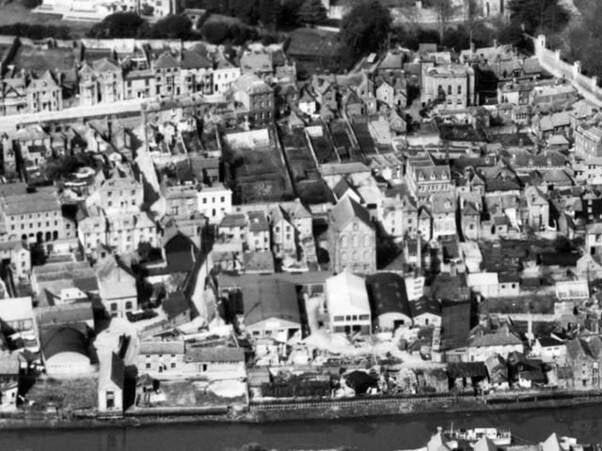
Nine witnesses were called on the first day of the hearing, including John Woodhouse, and local Arundel shopkeeper Miss Dibley, who had seen a woman matching Joan's description in a striking blue dress between 2pm and 2:30pm on Saturday 31st July. She had watched the woman walk in the direction of Mill Road, which headed towards Arundel Park. Miss Dibley's statement was then followed by information provided by Mrs Petley and Mrs Bidwell, who had been enjoying a picnic together in Arundel Park when they saw a man and a woman heading up the hill from Swanbourne Lake. Mrs Petley described how the pair appeared to be having words - that is to say, having a disagreement. She said: '"the two passed me going away from the lake. They sat on the slope about 200 yards away - a substantial distance from me. I never saw them any more after the few minutes."'
Mrs Petley spoke of how she had been interviewed by private investigator Thomas Jacks and had been shown five photographs of Stillwell before being asked to attend an identity parade earlier in September 1950. She was swiftly cross-examined by Stillwell's barrister, Vincent Jackson, who read an extract from a letter which Mrs Petley had written to private detective Thomas Jacks in which she had said she believed the events she had described to him had in fact occurred on Sunday 1st August rather than Saturday 31st July. He also questioned her about her understanding of a reward being offered for information into the death of Joan Woodhouse, which Mrs Petley admitted she had thought about claiming. However, she was adamant that she had reported her sighting to the police long before the reward had been offered, and had been able to describe the dress which Joan had been wearing before it's description was written in the newspapers. Her friend, Mrs Bidwell, then took the stand and said that their picnic in Arundel Park had, in fact, been on the Saturday and that was when they had seen the couple. She had attended the same identity parade as Mrs Petley but had failed to pick Thomas Stillwell out of the line up.
Dr Keith Simpson, the Home Office pathologist who had conducted the post-mortem on Joan's body, spoke about the injuries to her body. He was questioned by Mr Bass on whether she would have been able to defend herself against an attacker based on her size and stature, to which the pathologist responded: '"I should not consider her likely to have effected very strong resistance."' He also commented that there was no indication that Joan's arms had been held by force during the attack, prompting the defending barrister Mr Jackson to ask: '"is it not a fair inference that her arms would be free to strike and scratch?"' The pathologist answered: '"this does not necessarily mean that the arms were free."'
I'm going to pause here very briefly to reflect on the comments made during Dr Simpson's testimony. We are already aware from observations made by Scotland Yard that there was little sign of a struggle in Box Copse, aside from some scuff marks to the trunk of a tree. Joan was slim and slight in stature, but it's also worth noting that she may not have put up much of a fight because she'd been caught off-guard. If the suspicion was that she had taken her outer wear off to sunbathe, she may have been lying down or even dozing in the sunshine - the last thing she would have expected is to be attacked by a stranger when her guard was down. Alternatively, if she had been attacked by someone she knew, it's likely that she wouldn't have been expecting it at all if she trusted the person (I'm aware that the general consensus from authorities was that this was a stranger attack, but I think it's a point worth bearing in mind). The comment about her being able to scratch her attacker is a valid one, though. It's possible that she wasn't able to freely use her arms, but if there was no sign of her arms being restrained then could her attacker had sustained some injuries such as scratches or bruises? Would someone not have noticed if Stillwell had suddenly developed some visible injuries in the days around the bank holiday weekend? There are no accounts of Arundel residents coming forward to note that Stillwell had any injuries at the time when Joan was thought to have died, and one would have thought that, if most of the town believed Stillwell to be the killer, someone would have mentioned this to police.
The most incriminating item against Thomas Stillwell had been the discovery of a dart near to Joan's body. We know that he played darts at his local pub, the Black Rabbit, and that he tended to carry these around with him in his top pocket. He had even asked police in the days following the discovery of Joan's body whether they had found a dart in the area, as he had noticed that one of his was missing - something which many argue was a highly incriminating piece of information. Many believed that one of the darts had fallen from his pocket as the attack on Joan was carried out, but Stillwell explained this away by saying that it most likely fell from his pocket when he bent to pick up the clothing he found lying on the ground before he found Joan's decomposing remains.
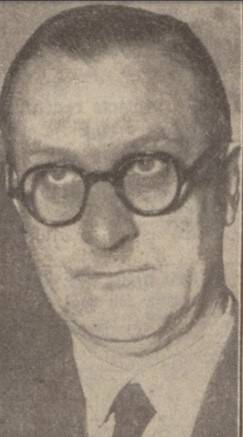
Image 18: private detective Thomas Jacks
Also called to the stand was a person with critical evidence - or, perhaps, a lack thereof. Dr H. S. Holden, the Director of the Metropolitan Police Laboratory, talked the hearing through the extensive forensic tests which had been conducted in the Joan Woodhouse case. Full examination of her clothing, fingernail scrapings and possessions had been carried out, but nothing indicated that a struggle had taken place between Joan and another person. Not only that - he described how hairs found on Joan's bra differed in physical appearance from those which had been collected and stored in an envelope marked 'from Stillwell', and hairs which had been collected from Stillwell's own clothing. This, surely, was critical information - we rely so much in the modern age on the indisputable facts from forensics, and that nothing on Joan's body or clothing could be attributed to Thomas Stillwell was surely damning for those seeking to prosecute him.
Statements were provided in court from multiple other witnesses, including the police officers and Scotland Yard team who had been involved with the case from the outset, along with witnesses from the YWCA where Joan had been staying prior to her death. The five magistrates were transported to Box Copse in Arundel Park to see the scene of the crime for themselves and gain a better picture of the area where Joan had died.
The closing statement from Vincent Jackson, defence solicitor, stressed the lack of evidence provided by the prosecution was simply not enough to take Thomas Stillwell to a criminal trial: '"it will be my respectful submission there is not any circumstantial evidence which could possibly lead to the conviction of this man. Never before in a charge of murder have you had less evidence."' He pointed to the fact that no-one knew Joan's precise movements after she left London on Saturday 31st July 1948, and couldn't even ascertain which train she took out of the city: '"what evidence has been brought before you to give you any assistance in coming to the conclusion that this woman was killed on July 31?"' Indeed, the pathologist had been unable to specify the exact date when Joan had died and was only able to narrow it down to between 8 and 10 days before she was found, making it difficult to connect Thomas Stillwell with the subsequent events.
Police had focused on the fact that Joan was wearing a striking and noticeable dress on the day she vanished, but he openly questioned elements of her attire, saying: '"she is supposed to have been carrying a mackintosh and overcoat and does it not occur to you that nobody apparently noticed this extraordinary thing of a woman on a sweltering hot day carrying an overcoat and a mackintosh?"'
He speculated on possible reasons why Joan hadn't returned straight home to Barnsley on the bank holiday weekend, stating: '"she told Miss Ashby (her roommate at the hostel) she was going home. Either she told her she was going home when she had no intention of doing so, and told her a deliberate lie because she was going to meet somebody else and spend the weekend with that person. Or alternatively she left her home intending to go to Yorkshire, but on her way she met somebody else as a result of which she altered her mind and decided to come to Worthing and Arundel. The only evidence you have in any way that connects Stillwell with this matter is the evidence of Mrs Petley and Mrs Bidwell."' Even this, he pointed out, differed from other accounts and no-one seemed to be able to agree if Thomas Stillwell had been seen in Arundel Park during the morning of Saturday 31st July or in the afternoon.
Vincent Jackson concluded his closing speech by pointing out two key facts - that Joan would likely have scratched the face or body of her attacker in some way during a frantic bid to defend herself, with no injuries being noted to Thomas Stillwell in the wake of the bank holiday weekend, and that the hairs found on Joan's undergarments were not consistent to those provided by Stillwell for forensic testing.
The court retired to consider the decision from the hearing, and the attendees in the public gallery - many of whom had queued outside for several hours to be let into the courtroom - cheered as the statement was read out on behalf of the five magistrates: 'we are of the unanimous opinion that there is insufficient evidence to justify sending Stillwell for trial. We therefore direct Stillwell be discharged from custody."' Thomas Stillwell did not react as the outcome of the hearing was read out, and did not respond to clapping from the public gallery. He was escorted from the court by police officers, and spoke briefly to a reporter before climbing into a private car with his solicitor's adult son: '"now I am a free man after two years of being pointed at and talked about as the man of the Arundel Park murder. Now that shadow has gone. I can go back home and resume my life and forget all this horror."'
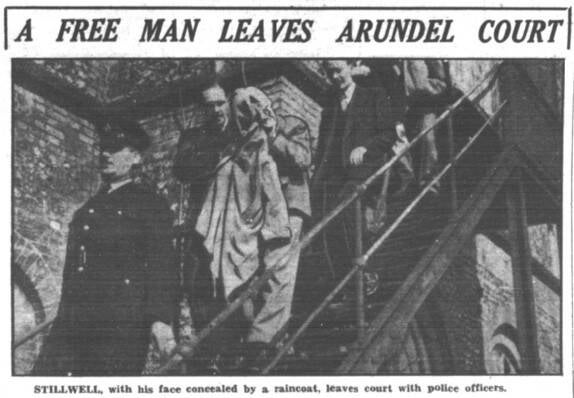
Image 19: Thomas Stillwell leaving the court with a police escort, his face covered by his jacket
His solicitor applied for costs to be provided to contribute to the defence provided to his client, and 40 guineas were awarded by the court to go directly towards the fees paid for Mr Vincent Jackson's services. Before leaving court, Jackson publicly thanked those who had cooperated with the defence team, and to the officers who had enabled him to speak with his client in custody whilst he had been on remand.
John Woodhouse spoke to the press after the hearing. It had emerged in the days prior to the hearing commencing that he had adopted an 8-year-old girl in an attempt to fill the gap left by his only child, saying: '"her name is Pamela and she has come to live in my house at Barnsley. I do not think I could have got through this difficult time without her."' On the subject of the hearing, he stated: '"I shall carry on the fight to find my daughter's murderer. I cannot say how much it has cost us - Joan's aunts and myself. I don't know whether £500 would cover it."' In today's money, this would have amounted to just under £18,000.
Although Thomas Stillwell had escaped the prospect of the hangman's noose and had been deemed that no case could be brought against him, he was still seen as a guilty man by the public and the residents of Arundel. Two weeks after the court hearing, he married his fiancée in secret and the couple resided in Horsham, leaving the isolated cottage of the Foxes Oven and the grounds of Arundel Castle behind them.
Beyond 1950
Thomas Stillwell gave only one interview in the wake of the magistrate's hearing. He spoke to the Weekly Dispatch newspaper in London about how he had come across the body and how it had taken him several moments to realise what he was looking at before he headed for Swanbourne Lake to borrow a bicycle. He had realised that evening - Tuesday 10th August 1948 - that one of his set of darts was missing when he went to use them in the pub, and had retraced his steps around the gardens he had tended in the local area as his job, thinking that it must had fallen out of his pocket whilst he was working. He explained that he had approached police to ask if they had found one after he failed to track it down, and suddenly thought that it may have fallen from his pocket in Box Copse.
He spoke to the press about how rumours around his involvement with the murder of Joan Woodhouse had spread rapidly around the town of Arundel and the surrounding areas. He had lived in the area for his whole life, aside from a short period during the war, and was aware of how quickly speculation would spread, saying: '"when one tongue begins to wag there are many ears eager to listen."' His mother was not recognised as much as her son - who worked around the town doing odd jobs - and Ellen Stillwell would have to listen to gossip in shop queues, with Thomas describing: '"many of the people did not know my mother by sight, and often they talked openly, saying: "of course we know very well who murdered the girl." My name inevitably followed."' The 26-year-old spoke of how he had worked as a painter prior to Joan's murder, but after rumours started circulating in the town he had been sacked on the premise that he was working too slowly. He had become so used to fingers being pointed at him in the street wherever he went that he often wondered whether it was to do with his work pace, or if the local gossip had anything to do with it.
Thomas Stillwell had been unaware that he had been the recipient of anonymous letters for some time, with many of them containing torrents of abuse and even threats on his life. His mother had been intercepting them from the postman whilst he was out at work, ensuring that her son never read them. It was only when he became engaged to his childhood friend, Jean Rapley, and the letters started arriving at her and her mother's home that the truth came out. Jean ultimately gave up her job as an assistant in a drapery store in Arundel when the gossip became too overwhelming. Stillwell had become aware of Thomas Jacks, the private detective, arriving in Arundel and questioning many of it's residents - but he had never visited the Foxes Oven cottage or spoken to Thomas himself. He said that he was glad that Jacks had performed a thorough investigation, as it only went to prove that there was simply no evidence against him. He had even received a letter from Ida Sheriff - Joan's aunt - asking she and Annie visited Arundel, whether he could show them where Joan's body had been found. He had replied to the letter, saying that he would be able to do so, and even inviting them to stay in the Foxes Oven cottage - but he never received a response.
The Weekly Dispatch asked him about his legal representation at the Coroner's inquest and beyond, which Stillwell explained had been at the insistence and arrangement of his uncle, Bill Parsons. His uncle had recognised the precarious position which his nephew found himself in and knew that the Stillwell family had very little knowledge of criminal law, subsequently arranging legal representation. Despite everything which had happened to him across two years, Stillwell insisted that he bore no grudge against the police and described Superintendent Reginald Spooner as a gentleman throughout the process.
After this discussion with the Daily Record, Thomas Stillwell never gave another interview. He managed to keep much of his life private after this stint of intense publicity, and passed away in 2008 as a free man.
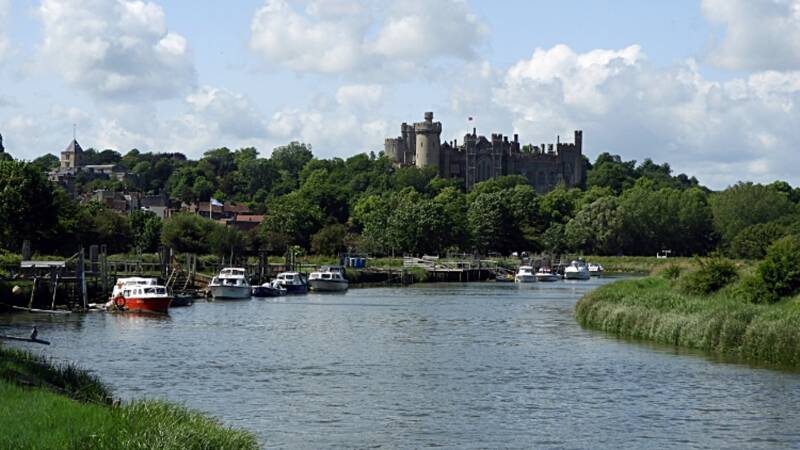
Image 20: Swanbourne Lake and Arundel Castle
Despite the private and public sectors failing to take Thomas Stillwell to trial, his name was never far from the Joan Woodhouse case. Many still considered him to be guilty of the crime, and this was only emphasised further when author Martin Knight published the book Justice for Joan: The Arundel Murder in 2016. The book was the result of many years of research, including information obtained via Freedom of Information requests made to the police, and an investigation by the podcast creator True Crime Investigators UK who visited several locations involved in the case. You can see their page on the Joan Woodhouse case by following this link: Joan Woodhouse | True Crime Investigators UK Podcast.
Martin Knight spoke at length with Joan's long-time friend, Lena Bamber. He was interviewed by the Sussex Express in advance of his book being released, speaking of his meeting with Joan's friend: '"I headed up to Derbyshire to meet with Lena - a very pleasant lady, very sharp. She was a former headmistress, and you could tell that. Within a few minutes, she produced this brown leather suitcase with the letters J T W embossed on it. It was Joan's father, John Woodhouse's personal case of everything related to Joan's murder. As I unclicked the case, it creaked, dust flew, and I was transported back to 1948. There were newspaper cuttings, certificates, and countless letters. I remember having a strong sense that this cobwebbed baton had been passed to me."' The True Crime Investigators UK team have published a special page on their website which shows some of the contents of the briefcase, and you can check that out here: The Briefcase contents | Joan Woodhouse Murder. Please note that I have no affiliation with this team at all - it's just nice for readers to head over there to take a look at their content and see this information first hand.
The briefcase notably contained letters written by John Woodhouse, Ida Sheriff and Annie Blades which were highly critical of the police investigation and the attempt at a private prosecution, adamant that opportunities to gather evidence early on in the case had been missed. They wanted to know why the boots of Thomas Stillwell had not been checked for evidence of bark from the tree which had been scuffed during the attack on Joan Woodhouse, and why further investigation wasn't made into the injury which had caused his arm to be placed in a sling - convinced that the septic wound had been caused during the struggle with their daughter and niece. The letters do make for fascinating reading, so I'd encourage you to head to the website if you get a chance.
Many of the documents which Knight requested via Freedom of Information submissions could only be released after the death of Thomas Stillwell in 2008, with many more being inaccessible due to the files being sealed until around 2030.
I haven't read the book myself, but if I do I will provide this page with some feedback around it. It's clear from those who have reviewed and spoke about it that a huge amount of research has gone into it's production, and that suggestions of police incompetence and a series of cover ups were looked into, including the speculation that Thomas Stillwell was the illegitimate son of the Duke of Norfolk and that the Duke footed the bill for his legal representation. Ultimately, it is about the life-long quest by one family to seek justice for their loved one - something which has never come to pass, but brought the case into new light nearly 70 years after Joan's death.
Through his submission of Freedom of Information requests, Martin Knight will have had access to documents previously unseen by members of the public, and the contents of these must be eye-opening. Since the publication of the book in 2016, no new updates around the case or new information about the crime have surfaced.
Image 21: an image of the front cover of the book by author Martin Knight
In a truly bizarre move, a fictional book was published in 2003 from author Michael de Larrabeiti. It revolved around a family in war-time Britain living in a small cottage named... the Foxes Oven. In it, the eldest son of the house - whose paternity is brought into question - kills a young woman, with the fictional character's body being found just 500 yards from where Joan's body was located in 1948. The mother of the man accused of the murder was named Agnes, which also happened to be the middle name of Thomas Stillwell's mother, Ellen. The publication of the book understandably struck a chord with Thomas Stillwell, who was 78 years old at the time of its release and who had moved back to the Arundel area. He was questioned by the press about the book in response to the author saying that it was entirely fictional, with Stillwell stating: '"Larrabeiti says the book is fiction. It is not. My mother lived in Foxes' Oven. I lived there. I was born in that house. The book is not fiction. Why did he incorporate a murder by the son of the house into his book? I was the son of the house. But it was the way that he slags off my mother that got me so much."' He described his mother as the kindest person one could imagine.
With it being the first time that Thomas Stillwell had spoken publicly since he gave his interview in 1950, he was naturally asked about the case. He said: '"people still think I did it now. There are idiots around now pointing the finger. But it does not bother me. What is the point of being angry? I can't do anything about it."' '"I wish it had gone to trial. I could have given my defence and my defence would have proved conclusive because I had something to argue. I don't know that the book is trying to get at me in particular, but what annoys me in particular is the way that it slags off the household. He says it is fiction, but a number of people are mentioned with real names, but slipped in in ways that you can read things into it. If you know the names and if you know the area, you will know exactly who is who when you start prying and probing."'
The author of the book denied that the characters in the book held any resemblance to real life, although Larrabeiti admitted that he knew of the Joan Woodhouse case, as he had been evacuated to Offham during the war and would make deliveries to the Foxes' Oven cottage. It does, however, seem absurd that the book would contain such close parallels to the activity in the Arundel area between 1948 and 1950.
Conclusion
There is, sadly, little more which can be added to the story of Joan Woodhouse. No-one has ever been brought to trial for her murder. No-one has been able to ascertain why she was in Arundel on Saturday 31st July 1948, rather than taking a train to Barnsley. No-one has found out how she ended up in Box Copse, and the reality is that the answers are unlikely to ever be uncovered. We are now nearly 80 years down the line - anyone involved with the case will likely be in their grave.
Thomas Stillwell was seen by many as a guilty man until the day he died. He had to spend his life ignoring pointed fingers, whispers and outright accusations. As the author Martin Knight stated, many still believe in his guilt to this day - but how convincing is the circumstantial evidence against him? His own accounts of his movements changed when he spoke to police, and one of his darts was found at the scene. He had a septic injury to his hand which Joan's family believe occurred as a result of the attack in Box Copse, but magistrates and police failed to see this as sufficient evidence to take him to trial.
Despite the clear passion from the Woodhouse family and their insistence that Stillwell was guilty, the evidence submitted seems unbelievably weak. The dart wasn't rusted or degraded by the environment, and could quite easily have fallen from Stillwell's pocket when he discovered Joan's body. His accounts to police changed, but this could be put down to the stress and strain of the situation he found himself in, or fatigue from the extended periods of time he was spending under questioning. The septic injury to his hand could have been caused by one of the odd gardening jobs he undertook. We rely so much today on forensic testing, and no evidence of Thomas Stillwell was identified on Joan's body or clothing - the hairs which were found on her bra bore no similarity to those taken from him. There was no mention of injuries to his face or body which may have been a result of a struggle or fight around the bank holiday weekend of August 1948. So, why do people still believe him to be guilty when the evidence against him is so flimsy and debatable?
Stillwell had a reported reputation for being a Peeping Tom and had apparently exposed himself to women in Arundel Park, but there is an enormous gap between someone taking part in such an act and killing someone. Offenders of this kind generally go through a period of progression where their crimes develop into larger and more serious acts, but we don't see that here at all. If Stillwell was suspected to be the culprit, it would have meant that he suddenly decided to progress from flashing unsuspecting women to attacking and killing someone, without any developing crimes in between. It's entirely possible, but it seems like a stretch. And would someone who committed such a crime never go on to do so again? If it was Stillwell, did he decide that he came too close to being caught and never risked such a move again? Or is he completely innocent of the attack on Joan? Was he followed by rumour and speculation throughout his life over a crime he didn't commit?
One thing which I simply can't get over - and I'm sure that others reading this article will feel the same - is why so much police time and energy was put into seeking the mystery man seen with Joan on Saturday 31st July, only for them to then decide that he simply didn't exist. There are so many news articles from the time providing the most accurate description of the man, including how many people had seen them together and where. A landlord from a local pub had described them stopping there before planning to walk back to Arundel along the river path, which would have taken them very near to Box Copse. How did this mystery man - who, by the way, bears little similarity to Thomas Stillwell - disappear entirely from the police investigation? Did the people who gave statements that Joan was seen with this companion all collectively make a mistake? It seems quite bizarre that regular appeals for information about this man were issued by police, and then they just completely stopped.
What if Joan was with a man that day? We're aware that she had very stringent rules and deep religious views about relationships and sexual relations, but we also know that she previously had a boyfriend, Ted. Perhaps she had started seeing someone new and hadn't wanted the world to know about them for one reason or another. We know that she had been going through a period of emotional turmoil, so perhaps her mind wasn't in the right place and she may have been particularly vulnerable. Is it possible that she had met someone she trusted, and that something had gone wrong? Police spoke to every man in Arundel and the surrounding areas to assess their location and actions over the bank holiday weekend, but what if her attacker was from further afield? What if they had left Joan in Box Copse whilst they got as far away from the location as they could? It's possible that they could have driven their own car, which would explain why Joan was never traced on a bus to or from the Arundel area - she could have been given a lift by her attacker, who subsequently left in their own vehicle.
The questions could simply go on and on, and the reality is that we are unlikely to ever find answers. Joan's family and friends spent the rest of their lives trying to find out what happened to their loved one, with no success and no closure. The concept that they went to their graves without being able to achieve justice for Joan Woodhouse is haunting, and so devastating. She was deeply loved and cared for by her father, her two aunts, and her close friends. She was a valued employee at the National Library and a treasured teacher at Sunday School. She was a dedicated Christian with strict morals and devotion to her faith.
Whatever Joan's reason for travelling to Arundel that day, she should have made it home. She should have been able to visit her family in Barnsley and return for the meal she had requested at the hostel the following Tuesday. She should have been able to sunbathe in a quiet area without worrying that she could be the victim of a horrendous attack.
The unsolved murder of Joan Woodhouse is a case which has endured nearly 80 years, and ruined countless lives along the way. We can only hope that one day she will receive the justice she deserves.
References for text:
Joan Woodhouse | True Crime Investigators UK Podcast
Joan Mary Woodhouse (1921-1948) - Find a Grave Memorial
Murder of Joan Woodhouse whose body was found in Arundel Park in 1948 never solved | Daily Mail Online by Euan Mclelland, published 2nd June 2016, retrieved 31st July 2026
Arundel's cold case revisited in new book
Joan Woodhouse: The Arundel Murder – Crime Immemorial
Social history of post-war Britain (1945–1979) - Wikipedia
Justice for Joan by Martin Knight - Defrosting Cold Cases
What is a Private Prosecution ?
Justice for Joan: Arundel’s cold case revisited in new book – Emily Jessica Turner
The British Newspaper Archives:
Yorkshire Evening Post, published Wednesday 11th August 1948, retrieved 31st July 2026
Evening Despatch, published Wednesday 11th August 1948, retrieved 31st July 2026
Western Morning News, published Thursday 12th August 1948, retrieved 31st July 2026
Torbay Express and South Devon Echo, published Thursday 12th August 1948, retrieved 31st July 2026
Western Daily Press, published Thursday 12th August 1948, retrieved 31st July 2026
Gloucestershire Echo, published Thursday 12th August 1948, retrieved 1st August 2026
Bradford Observer, published Thursday 12th August 1948, retrieved 1st August 2026
Leicester Daily Mercury, published Thursday 12th August 1948, retrieved 1st August 2026
Evening News (London), published Thursday 12th August 1948, retrieved 1st August 2026
Western Mail, published Thursday 12th August 1948, retrieved 2nd August 2026
Daily Herald, published Thursday 12th August 1948, retrieved 2nd August 2026
Birmingham Daily Gazette, published Thursday 12th August 1948, retrieved 2nd August 2026
Nottingham Evening Post, published Friday 13th August 1948, retrieved 2nd August 2026
Torbay Express and South Devon Echo, published Friday 13th August 1948, retrieved 2nd August 2026
Daily Express, published Friday 13th August 1948, retrieved 2nd August 2026
Evening News (London), published Friday 13th August 1948, retrieved 2nd August 2026
Littlehampton Gazette, published Friday 13th August 1948, retrieved 2nd August 2026
Western Daily Press, published Saturday 14th August 1948, retrieved 2nd August 2026
Leicester Evening Mail, published Saturday 14th August 1948, retrieved 2nd August 2026
Bradford Observer, published Saturday 14th August 1948, retrieved 2nd August 2026
Daily News (London), published Saturday 14th August 1948, retrieved 2nd August 2026
Daily Mirror, published Saturday 14th August 1948, retrieved 3rd August 2026
Sunday Express, published Sunday 15th August 1948, retrieved 3rd August 2026
Sunday Mirror, published Sunday 15th August 1948, retrieved 3rd August 2026
The People, published Sunday 15th August 1948, retrieved 3rd August 2026
Halifax Evening Courier, published Monday 16th August 1948, retrieved 3rd August 2026
Evening News (London), published Monday 16th August 1948, retrieved 3rd August 2026
Daily News (London), published Monday 16th August 1948, retrieved 3rd August 2026
Yorkshire Post and Leeds Intelligencer, published Monday 16th August 1948, retrieved 3rd August 2026
Coventry Evening Telegraph, published Tuesday 17th August 1948, retrieved 3rd August 2026
Bradford Observer, published Tuesday 17th August 1948, retrieved 3rd August 2026
Evening News (London), published Tuesday 17th August 1948, retrieved 3rd August 2026
Daily Herald (London) published Thursday 19th August 1948, retrieved 8th August 2026
Hull Daily Mail, published Thursday 19th August 1948, retrieved 8th August 2026
Daily News (London), published Friday 20th August 1948, retrieved 8th August 2026
Lincolnshire Echo, published Friday 20th August 1948, retrieved 8th August 2026
St Marylebone and Paddington Record, published Friday 20th August 1948, retrieved 8th August 2026
Sunday Mirror (Sunday Pictorial), published Sunday 22nd August 1948, retrieved 10th August 2026
Bradford Observer, published Monday 23rd August 1948, retrieved 10th August 2026
Belfast Newsletter, published Monday 23rd August 1948, retrieved 10th August 2026
Daily Herald, published Tuesday 24th August 1948, retrieved 10th August 2026
Daily Herald, published Wednesday 25th August 1948, retrieved 10th August 2026
Sunday Pictorial (Sunday Mirror), published Sunday 29th August 1948, retrieved 10th August 2026
Halifax Evening Courier, published Wednesday 8th September 1948, retrieved 10th August 2026
Evening News (London), published Saturday 9th October 1948, retrieved 10th August 2026
Bradford Observer, published Wednesday 20th October 1948, retrieved 10th August 2026
Coventry Evening Telegraph, published Thursday 21st October 1948, retrieved 11th August 2026
Coventry Evening Telegraph, published Monday 22nd November 1948, retrieved 11th August 2026
Torbay Express and South Devon Echo, published Monday 22nd November 1948, retrieved 11th August 2026
Lincolnshire Echo, published Monday 22nd November 1948, retrieved 11th August 2026
Evening Despatch, published Monday 22nd November 1948, retrieved 11th August 2026
Daily Herald, published Tuesday 23rd November 1948, retrieved 11th August 2026
Daily Express, published Tuesday 23rd November 1948, retrieved 11th August 2026
Halifax Evening Courier, published Saturday 1st January 1949, retrieved 12th August 2026
Daily News (London), published Thursday 31st August 1950, retrieved 12th August 2026
Gloucestershire Echo, published Thursday 31st August 1950, retrieved 12th August 2026
Birmingham Daily Gazette, published Thursday 31st August 1950, retrieved 12th August 2026
Yorkshire Post and Leeds Intelligencer, published Thursday 31st August 1950, retrieved 12th August 2026
Yorkshire Post and Leeds Intelligencer, published Friday 1st September 1950, retrieved 12th August 2026
Wolverhampton Express and Star, published Friday 8th September 1950, retrieved 12th August 2026
Gloucestershire Echo, published Thursday 14th September 1950, retrieved 12th August 2026
Edinburgh Evening News, published Tuesday 19th September 1950, retrieved 12th August 2026
Gloucestershire Echo, published Tuesday 19th September 1950, retrieved 12th August 2026
Yorkshire Post and Leeds Intelligencer, published Wednesday 20th September 1950, retrieved 12th August 2026
Leicester Evening Mail, published Wednesday 20th September 1950, retrieved 12th August 2026
Daily Express, published Wednesday 20th September 1950, retrieved 12th August 2026
Huddersfield Daily Examiner, published Wednesday 20th September 1950, retrieved 12th August 2026
Daily News (London), published Friday 22nd September 1950, retrieved 12th August 2026
Yorkshire Evening Post, published Friday 22nd September 1950, retrieved 12th August 2026
Coventry Evening Telegraph, published Friday 22nd September 1950, retrieved 12th August 2026
Weekly Dispatch (London), published Sunday 24th September 1950, retrieved 12th August 2026
Weekly Dispatch (London), published Sunday 22nd October 1950, retrieved 12th August 2026
West Sussex Gazette, published Thursday 24th April 2003, retrieved 2nd September 2026
Credit for images:
Image 1 - Joan Woodhouse: Justice for Joan by Martin Knight - Defrosting Cold Cases
Image 2 - St. Mary's Church: About us - St Mary Bryanston Square - A Church Near You
Image 3 - Joan Woodhouse: Arundel's cold case revisited in new book
Image 4 - King's Cross Station in the 1940s: Pin on London Overground
Image 5 - Swanbourne Lake and Lodge: Arundel, Arundel Park, Swanbourne Lake and River Arun
Image 6 - aerial view of Box Copse: image from Google Maps with endorsements by the author
Image 7 - police officers in Arundel Park: Joan Woodhouse | True Crime Investigators UK Podcast
Image 8 - the reconstructed image of Joan Woodhouse: published in the Evening News (London) on Friday 13th August 1948
Image 9 - map showing Burpham and Box Copse: image from Google Maps with endorsements by the author
Image 10 - Joan wearing the mackintosh found with her body: printed in the Worthing Herald on 20th August 1948
Image 11 - the train route from Victoria Station to Worthing: image and route suggestion from Google Maps
Image 12 - a young Joan Woodhouse sunbathing at the beach: Arundel's cold case revisited in new book
Image 13 - Thomas Stillwell: Murder of Joan Woodhouse whose body was found in Arundel Park in 1948 never solved | Daily Mail Online
Image 14 - satellite view of Arundel Park: image from Google Maps
Image 15 - The Woodhouse family: Murder of Joan Woodhouse whose body was found in Arundel Park in 1948 never solved | Daily Mail Online
Image 16 - Thomas Stillwell under police escort: image published in the Daily News (London) on Thursday 31st August 1950
Image 17 - an aerial view of Arundel in 1949: Image by Mark Phillips Compare pictures from the past to see how historic Arundel has changed over the past 100 years
Image 18 - private detective Thomas Jacks: image from the Yorkshire Post and Leeds Intelligencer, published on Friday 1st September 1950
Image 19 - Thomas Stillwell being escorted from the courtroom: published in the Yorkshire Evening Post on Friday 22nd September 1950
Image 20 - Swanbourne Lake and Arundel Castle: Arundel, Arundel Park, Swanbourne Lake and River Arun
Image 21 - front cover of Martin Knight's book: Joan Woodhouse | True Crime Investigators UK Podcast
Add comment
Comments