

The Flannan Isles Lightkeepers
Disclaimer: this article contains details which may be upsetting for some readers. Discretion is advised.
In this casefile, we're delving into a story which is a little bit different. We're heading back to the year 1900 to look at the mysterious disappearance of three men, each of whom were going about their job when they seemed to simply vanish, leaving loving wives, children, family members and friends without answers. Although there is no evidence of anything criminal, the tale is one which has been passed down through the years, with speculation, rumour and a series of unanswered questions meaning that the case is still talked about to this day.
The origin of the structure which we know today as being the lighthouse dates back hundreds of years, with the early idea developing from the flaming towers and beacons used in ancient times to signal across hills and mountains. The earliest lighthouse design on record was documented in 280BC with the building of the Pharos of Alexandria in ancient Egypt, formed from limestone and granite blocks and reinforced throughout with lead to protect from environmental impact, with it standing for nearly 1000 years before it's eventual collapse.
The design consisted of a square base, measuring 30 metres on each side, followed by an octagonal central section with a spiral ramp, complete with a cylindrical top section which housed the beacon. A fire was lit at the top overnight and a bronze mirror was utilised during the day to reflect sunlight, with a visibility range estimated to be between 30 and 50 kilometres, or up to 30 miles, in clear weather. The structure stood over 100 metres tall, and perched on the island of Pharos in order to safely guide ships and other vessels into the harbour, the entrance to which needed to be carefully navigated due to the reefs and sandbars in the approach. It also served to deter any hostile forces - the sight of such an imposing structure outside the walls of a settlement was likely to make anyone with evil intentions think again when approaching.
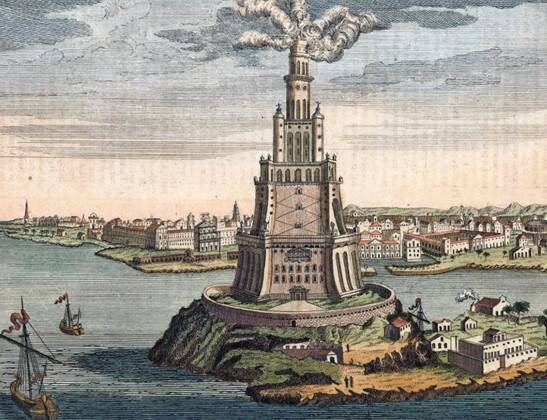
Image 1: Pharos of Alexandria
Over the years the building and its functionality caught on, with designs developing over centuries until something akin to the structure we recognise today emerged in the UK at the start of the 1800s, accompanied by the profession of lighthouse keeping.
Across the 19th and 20th centuries, lighthouses cropped up around the coast of the UK, their lights and sirens serving as a warning to ships of the proximity of their vessel to the coastline. The beacon across the water assisted the captain of each vessel to avoid rocky outcrops and reefs, reducing the risk of running aground in shallow waters or become shipwrecked on jagged surfaces, assisted by the sound of the fog horn or siren in poor weather. The towers also helped seafarers assess their location, as each lighthouse had its own unique light pattern, meaning that if they could identify the lighthouse, they could figure out where they were geographically.
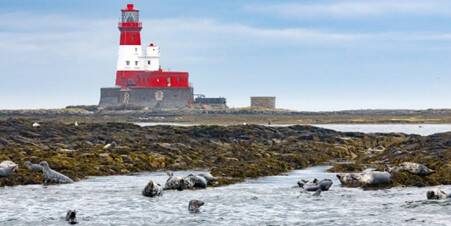
Image 2: Longstone Lighthouse, Northumberland, an example of the structure we recognise today
The towers were manned by small groups of trained lighthouse keepers, many of whom had worked in the profession all their lives or had perhaps been mariners before taking up the role, benefiting from an intimate knowledge of the sea and its hazards. The wages were good, but they had to be - working conditions were difficult and sometimes life-endangering. Facilities in the lighthouse were often poor, with very basic toilets and washing facilities. The environment was cramped, and working for weeks on end in such close proximity to two or three other men with little contact from the outside world or their families could be mentally challenging and emotionally draining.
The work was tough and the hours long - someone had to be watching the lamp overnight to ensure that it remained lit and visible to passing ships. The keepers were responsible for maintenance such as trimming lamp wicks, replenishing fuel and cleaning the windows inside and out. They took on roles of managing the fog signals and weather stations, as well as taking part in search and rescue operations if a ship or mariner met with trouble. All of these roles were taken on regardless of the weather, meaning that lighthouse keepers often risked their own safety, and sometimes their lives, to help keep others safe and to keep the lighthouse running.
The last manned lighthouse ceased operation in 1998, with all UK towers now being automated. Whilst there are still some employed lighthouse keepers, none are full time and their work now includes technical maintenance of the systems which are used on site. Ships are now generally equipped with in-built safety features such as GPS and radar, making much of the function of a lighthouse void.
To many, though, the building is seen as a symbol of safety and security. It has been used as the focal point of songs, and has even been used in episodes of comedy shows, and the image on many seaside souvenirs. Many of the structures around the UK have been turned into museums, visitors centres or even houses, with communities and authorities opting to keep the beloved landmarks standing rather than reduce them to rubble.
In this casefile, we're heading back in history - the furthest back we've been for an Undiscovered tale - to talk about three lighthouse keepers who vanished during the execution of their duties. Not only did no-one notice their absence for eleven days, their bodies were never found and their families were forced to live without certain knowledge of what happened to them.
This is the story of the Flannan Isles Lighthouse Keepers.
The Disappearance
The Flannan Islands are a combination of seven large pieces of rock, sometimes informally known as the Seven Hunters, set in the Atlantic Ocean. The Islands are situated 21 miles away from the next nearest land, another island in the Outer Hebrides named the Island of Lewis, and to reach the Scottish mainland one would need to travel more than twice as far. Although the largest piece of rock in the Flannan Islands, known as Eilean Mor, now houses a helipad, this would naturally have not existed back in 1900 and the only way to travel to and from the island was via the steam tender boat running from the Island of Lewis.
The Islands are named after St Flannan, a 6th century Irish bishop who built a chapel on Eilean Mor which has long since fallen into the sea. Although sheep used to be transported to the island to graze, the shepherds who tended them refused to stay overnight with them, with rumours of the island being haunted by spirits.
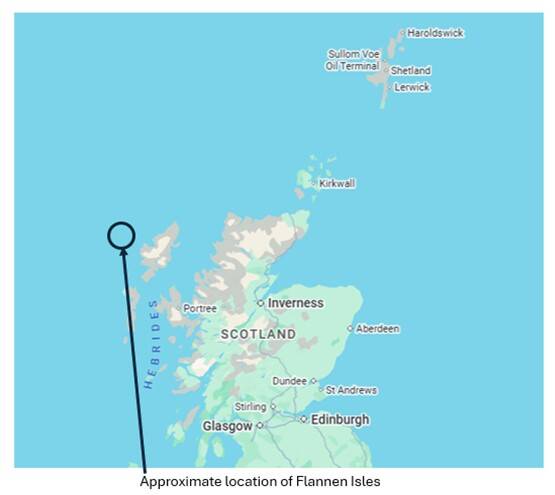
Image 3: approximate location of the Flannan Isles in the Outer Hebrides
I would suspect that the shepherds were less inclined to stay on Eilean Mor not due to rumours of spirits crawling the land overnight, but due to the extreme weather conditions to which the group of rocks could be subjected. Exposed as it was to the full force of the Atlantic weather, the Islands could be battered by wind speeds of up to 150mph and waves which reached high up the cliff sides. Being alone on such a desolate and distant venue in such conditions - especially, at the time, without secure shelter, would have been quite terrifying. The group of rocks measured a total distance of two miles across and quarter of a mile high, with the largest Island - Eilean Mor - being less than a quarter of a mile in width.
In 1896, Eilean Mor was identified as an area where a lighthouse would be of benefit and the development was officially sanctioned. With ships passing the Islands on their way between America and the Scottish mainland, and the unpredictable nature of the Atlantic Ocean, safety was paramount and the best way to improve this at the time was the installation of a tower to alert seafarers to the jagged rocks in the area.
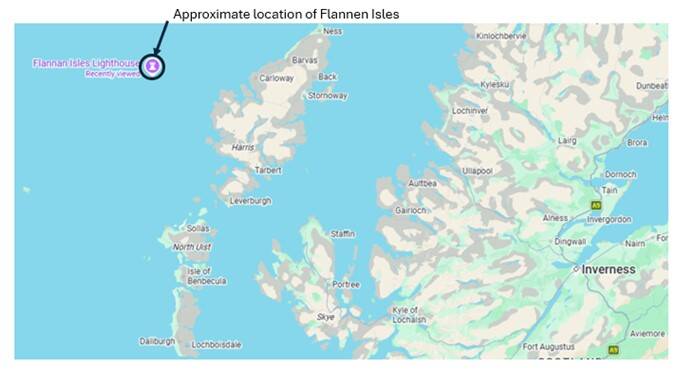
Image 4: map showing the location of the Flannan Isles in relation to the Island of Lewis (directly to its right) and the Scottish mainland
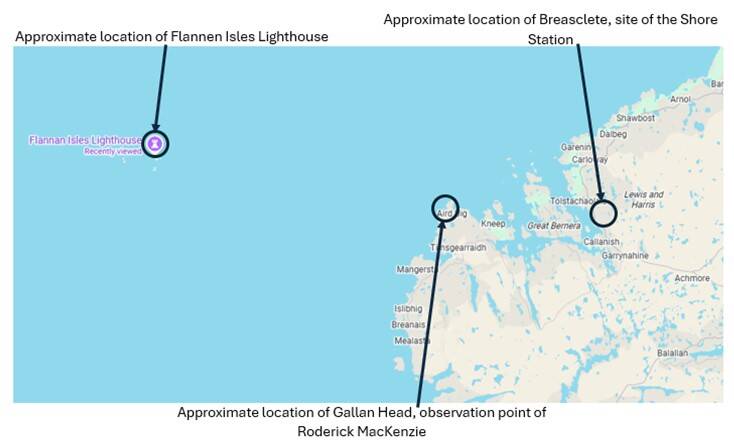
The lighthouse began construction in 1899, with the design and construction work - which included the lighthouse tower, the surrounding wall, a landing station on the west and east side of the island, steps up to the lighthouse, and a cable-powered railway line - all totalling a cost of £6,914, today worth more than £540,000. The build took a year to complete - quite a feat when you consider that all materials and labour would have been shipped from the mainland approximately 50 miles across the sea. At the same time, construction was in progress for living quarters for the lighthouse keepers and their families at the land operation base - known as the Shore Station - in Breasclete on the Isle of Lewis. The Shore Station was situated close to Loch Roag, a sheltered inlet which had been selected as the safest area for the steam boat to depart and return when the keepers rotated shifts.
The lamp in the lighthouse was set 75 feet above the surface of the island, 330 feet above sea level, had six wicks, and the setup enabled a power of 140,000 standard candles which could be seen across twenty-four nautical miles in clear weather.
As there was no radio communication being installed in the new lighthouse, a way of communicating messages between the Flannan Isles lighthouse and the Breasclete Shore Station needed to be established. The Northern Lighthouse Board opted to employ a nearby gamekeeper, Roderick MacKenzie to be a lighthouse observer from his prime position at Gallan Head on a far westerly point of the Isle of Lewis. This was three miles further west than the Shore Station, standing at 18 miles from the edge of the Flannan Isles. He would be paid £8 per year for this role - equivalent to £625 today - and was responsible for keeping a watch on the lighthouse via a telescope and feeding back any changes or concerns, such as a lamp failure, to the master at the Shore Station. If anything was noted to be wrong, the Shore Station would then send a telegram to the Northern Lighthouse Board headquarters in Edinburgh and assistance would be sent to the island.
Image 5: map showing the Flannan Isles, Gallan Head and the approximate location of Breasclete where the Shore Station was sited
By the end of 1899, the lighthouse was complete and ready for occupation. Appointed to the roles were 43-year-old James Ducat as the Principal Keeper, William Ross as the First Assistant Keeper and 40-year-old Thomas Marshall as the Second Assistant Keeper. Rock lighthouses - structures built on rocky islands such as the Flannan Isles - would generally have teams of six people, with three on the island and three on the mainland at any one time and would rotate between these groups.
James Ducat had been working for the Northern Lighthouse Board for more than 20 years, having joined the trade in 1878. He was born and raised in Arbroath, on the east coast of Scotland, and had spent a few years working as a clerk and as a teacher before joining the lighthouse industry. His wife, Mary, was the daughter of two lighthouse keepers and was familiar with the lifestyle and the demands of the role. The couple travelled to the various posts Ducat was appointed to over the years, joined by their growing family of four children. Thomas Marshall was also married with two children of his own, and both families moved to the lodgings at the Shore Station in Breasclete as the two men commenced their roles.
An article in the Arbroath Guide, printed on Saturday 5th January 1901, gave an account from the Scotsman publication written by someone known only as S.M.P. He had reportedly joined the men on the Island for an afternoon, and wrote: 'at one o'clock the lighthousemen invited me to dinner. Ducat, the head keeper, who had already shown me over the lighthouse, and whose previous experience of lighthouse work had been at the other end of the island, at Loch Ryan, Wigtownshire, asked a blessing. The fare was plain but abundant - broth, beef, with excellently mashed potatoes, and plum pudding. The cook, if I remember right, was Ross, a powerful fellow, who has not apparently shared in the disaster, but who had already had a sufficiently unpleasant experience. He was sitting on a trolley when the brake or something gave way. The trolley dashed down to the end of the line, and there he was pitched out, and fell on the rocks fifteen feet below, just above the east landing-stage. Marvellous to relate, he escaped with a broken arm, and, as the steamer was in at the time, was taken ashore without delay. We took Ducat off with us that afternoon, as it was his turn ashore, and I last saw him the same evening, as I can see him now, at the gate of his house, glad to be once more at home with wife and children. He was a most civil and pleasant man, and I little thought there was such a tragedy in store for him and his brave comrades on outpost duty.' 'I have, throughout the months that have passed, looked back with nothing but pleasure to my voyage, during which I received the utmost kindness and attention both on board ship and on land. Alas! there will always now be a sadness connected with thoughts of the Flannan Islands and their first lighthouse keepers.'
On 7th December 1900, the team rotated and Robert Muirhead joined James Ducat, Thomas Marshall and occasional relief Keeper Donald MacArthur, 28, a native of Breasclete on the Isle of Lewis who was filling in for the unwell William Ross. Muirhead had been sent to complete a routine monitoring assessment of the lighthouse and lamp, ensuring that everything was in working order. He took the opportunity to chat to the three men, discussing concerns about the heavy mist which frequently descended on the Islands, before shaking their hands and heading back to the Isle of Lewis to obtain transport to the mainland.
Superintendent Muirhead had no idea that this would be the last time he saw the three men alive.
Roderick MacKenzie and his two sons, who assisted in keeping watch on the lighthouse, would document that the lamp light from the tower was visible on 7th and 12th December, but could not be seen at any other time. They originally put this down to poor weather conditions and the frequent mist which circulated the island, but after eight consecutive days without a visible light they were starting to become concerned. However, they did not escalate this through to the Short Station and it's unclear if anything would have been different if they had.
On 15th December, the Archtor ship passed the Flannan Isles on its journey from Philadelphia, USA, to Leith, Scotland. The Captain of the ship noted that the lamp was not lit, nor were any sirens sounding to warn passing ships of the island and rocks - something which troubled the man. He made note of the date and intended to alert the Northern Lighthouse Board when the vessel docked in Leith, but the Archtor ran aground in the Firth of Forth. The delay this caused in the journey meant that the ship didn't dock in Leith until after Christmas.

Image 6: an aerial view of the Flannan Isles
At around noon on Wednesday 26th December 1900, the Hesperus - the tender boat which transported the lightkeepers between the lighthouse and the Shore Station - approached the Flannan Isles. The boat was several days later than scheduled - sea conditions and the recent storms which had swept in from the Atlantic Ocean had put a hold on sending the relief keeper across to Eilean Mor, and they were far past the two-week changeover date. Captain James Harvey was concerned that the flag, which was usually raised by the keepers to indicate that they had noted the arrival of the steamer and were sending a rowing boat out to meet them, was not visible - likewise, there was no-one waiting at the landing platform as he would have expected. Captain Harvey blew the ship's whistle and then the siren in a bid to attract attention, but there was no movement on the land. In a final attempt to alert the three men on the shore, he sent up a flare. There was still no response.
Becoming increasingly alarmed, Captain Harvey lowered a rowing boat down into the water containing Joseph Moore, the relief keeper, who steadily made his way to Eilean Mor and docked at the east landing platform. He climbed the 160 steps of the steep cliff staircase towards the lighthouse tower, later describing how he experienced a strong sense of foreboding as he ascended.
When Moore reached the station, he found the external entrance gate to be closed. He let himself through and found the front door of the lighthouse tower to be closed but unlocked. Easing it open and stepping into the property, he was met by a scene which seemed frozen in time.
Two oilskin coats - which the lighthouse keepers would wear in poor weather conditions when going down to the landing platforms - were missing from the pegs by the front door, but the third one remained on the hook. If Moore had hoped that this would mean someone still resided in the property, the heavy silence which hung within the building showed that he was sadly mistaken.
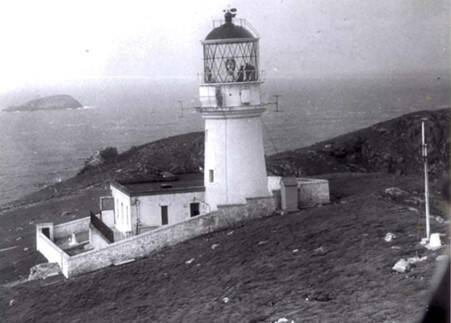
Image 7: an early photo of the Flannan Isles lighthouse
Heading into the kitchen, he found half eaten meals on the dinner table and one of the chairs tipped backwards on the floor as though someone had sprung up from their seat in a hurry. The kitchen clock had stopped, which some articles portray as quite a bizarre fact, but I wonder if the clock ran on a winding mechanism and needed to be wound in order to run. If this was the case, it would indicate that no-one had been in the property for some time to keep it working. The grate in the fireplace of the main room was empty and cold, appearing as though it had not been lit for several days.
Moore, by now feeling incredibly uncomfortable, checked all three bedrooms in the tower and found the beds to be empty and the rooms deserted. Anxious to escape the building, he hurriedly headed back to the rowing boat at the landing platform and rushed back to the Hesperus to relay his findings to Captain Harvey.

Image 8: the 160 steps leading up to the lighthouse
In an effort to maintain a level head in such an unnerving situation, and limited by the inability to contact the Shore Station from the boat or the lighthouse tower, Captain Harvey asked for volunteers to remain on the Island until help could be summoned.
Remember, this was the year 1900 - the telephone was not widely available and travel took far longer than it would today. There was never going to be a quick response in the same way we would expect to see today - communication and any kind of investigation would take time, not only to assemble the staff who would need to be involved, but to transport them to the Isle of Lewis and then onwards to the Flannan Isles.
As Captain Harvey steered the SS Hesperus away from the Flannan Isles, there was no information about where the three keepers could have gone, nor how long they may have been missing for, and it was unclear if he was heading back to arrange a rescue mission. Upon arrival at the Shore Station in Breasclete, he sent an immediate telegram to the Northern Lighthouse Board headquarters in Edinburgh for the attention of the organisation's secretary. The words of the telegram were as follows:
'A dreadful accident has happened at Flannans.
The three Keepers, Ducat, Marshall and the occasional have disappeared from the island. On our arrival there this afternoon no sign of life was to be seen on the Island.
Fired a rocket but, as no response was made, managed to land Moore, who went up to the station but found no Keepers there.
The clocks were stopped and other signs indicated that the accident must have happened about a week ago.
Poor fellows they must have been blown over the cliffs or drowned trying to secure a crane or something like that.
Night coming on, we could not wait to make something as to their fate.
I have left Moore, MacDonald, Buoymaster and two Seamen on the island to keep the light burning until you make other arrangements.
Will not return to Oban until I hear from you. I have repeated this wire to Muirhead in case you are not at home. I will remain at the telegraph office tonight until it closes, if you wish to wire me.'
The Investigation
The telegram reached the eyes of Robert Muirhead, the superintendent who had travelled with the men to the Flannan Isles to conduct routine monitoring on 7th December. He set off for the Isle of Lewis in order to board the tender boat to take him to Eilean Mor, but travel times back in 1900 and the need to make urgent arrangements to replace the missing men still meant that he arrived more than 48 hours after the telegram had been sent. He sailed across to Eilean Mor in the company of John Milne, a Principle Keeper whom he had drafted in from Tiumpan Head lighthouse, and Donald Jack, a second Assistant Keeper. Muirhead was aware that the Flannan Isles currently held no Principle Keeper, and that the posting of volunteers on the Island had been a temporary one until he could send replacements.
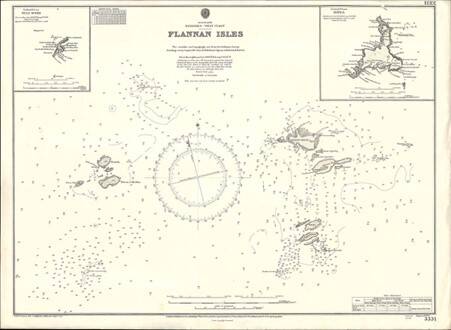
Image 9: an Admiralty chart of the Flannan Isles, drawn in 1903
On 29th December 1900, Muirhead, Milne and Jack docked on Eilean Mor and climbed the steps to meet the four current residents in the lighthouse tower. As he had just weeks previously on 7th December, Muirhead checked that the light was functioning correctly and ensured that the four men left on the Island had been able to operate it correctly.
He took statements from all four men present, who had completed a more intricate search of the Island between the departure of the Hesperus on 26th December and the arrival of the Superintendent on the 29th, where they had come across evidence of extreme weather conditions.
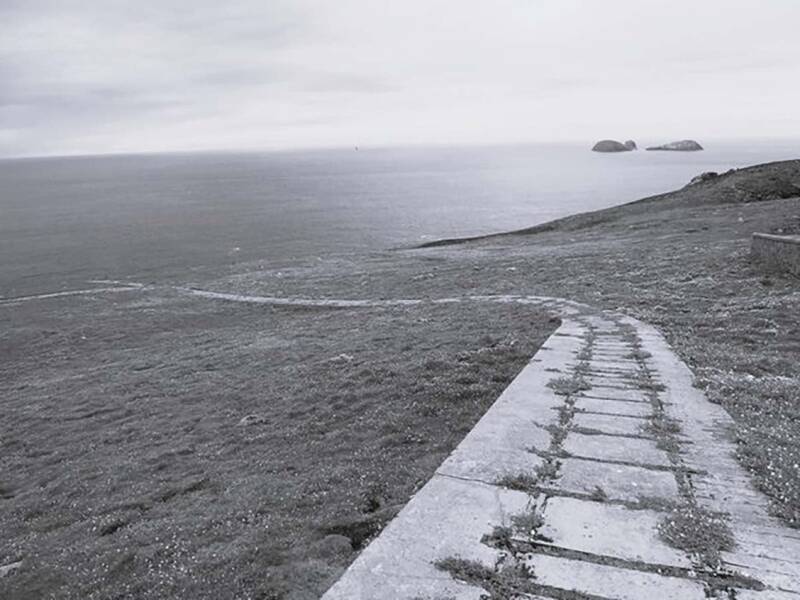
Image 10: the remnants of the cable-powered railway line in the years after it had ceased operation
In addition to the stone steps which led from the landing platform to the lighthouse, the Island was also home to a cable-powered rail line which led from sea level up the cliff to enable transportation of supplies without the need for Keepers to manually carry these. The box, which was normally stored in a crevice more than 70ft up the side of the cliff, containing landing and mooring ropes as well as tackle, had been dislodged and its contents strewn across the rocks below. Some of the ropes were still mostly coiled, indicating that they had fallen from within their storage position in the crate rather than been removed for use, and others were tangled around the base of the crane at the base of the railway. Iron railings had been pulled from their foundations and broken in several places, and a rock reportedly weighing at least a tonne had been rolled some distance down the side of the hill.
There was little else of note in the lighthouse tower itself which had not already been reported, and as the property had been habited by four men since 26th December, elements such as the empty fire grate and uneaten food on the tables were not left for Muirhead to examine. He did, however, take a close look at the station log which was updated daily by the Keepers in the property. These records showed the parameters noted each day - such as temperature, wind speed and direction, and barometer readings, in addition to notes of activity. A piece of slate with chalk hung in the kitchen for the Keepers to quickly write the measurements for each day, and these would be added to the log book when the full records were completed each evening. The information from the contents of the log book would not be released for several years - a fact which will become important later.
Muirhead was struck by some of the unusual comments in the book, which read as follows:
'December 12th: Gale, north by north-west. Sea lashed to fury. Stormbound 9pm. Never seen such a storm. Everything shipshape. Ducat Irritable.
'December 12th: 12pm. Storm still raging. Wind steady. Stormbound. Cannot go out. Ship passed sounding foghorn. Could see lights of cabins. Ducat quiet. MacArthur crying.
'December 13th: Storm continued through night. Wind shifted west by north. Ducat quiet. MacArthur praying.
'December 13th: 12noon. Grey daylight. Me, Ducat and MacArthur prayed.' This was the last note written in the log book.
December 14th: no entry in the log book, but the time when the lamp was extinguished in the morning was still visible on the slate waiting to be documented for that day.
December 15th: no entry in the log book, but all parameter readings for the day were present on the slate - including temperature, barometer readings, a description of the 9am wind conditions, and the time when the lamp was extinguished in the morning. Bizarrely, a note was also scribbled on the slate reading: '1pm. Storm ended. Sea calm. God is overall.' Whilst the previous daily records had been written by Marshall, the final note on 15th December was in the handwriting of James Ducat.
There were several factors which seemed odd to Muirhead as he read through the documentation. A side note by James Marshall on the 12th December mentioned that there were 'severe winds the likes of which I have never seen before in twenty years.' This, in addition to the other information about extreme weather mentioned in the log book, simply didn't add up with the official weather forecast from those dates. No storms had been forecast for the Flannan Isles on 12th, 13th, 14th or 15th of December 1900 - poor weather was due to to hit the area, but not until at least the 17th. On the contrary, on the specified dates the weather was expected to be fair and the sea calm. Why, then, did the log book indicate otherwise? Had extreme weather hit the Flannan Isles much earlier than anticipated?
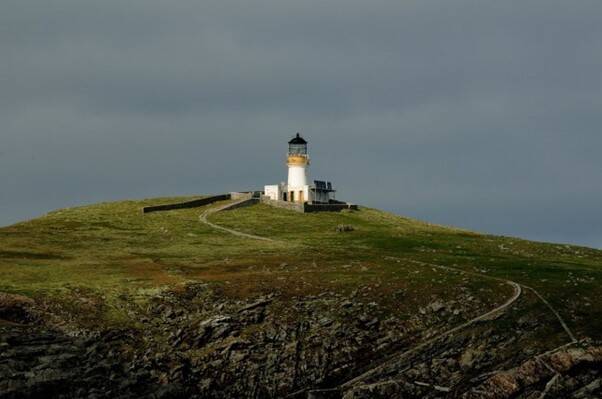
Image 11: a view of the Flannan Isles lighthouse as seen today, with the paths up to the station still visible
The four men manning the station between 26th and 29th December reported that the preparation work to light the lamp on the evening of 15th had been completed, as the light had been cleaned and set up. This was reflected in the list of chores for the day, with all of the pre-midday duties having been completed. Muirhead could only assume that whatever had happened the three men had occurred sometime in the afternoon on 15th December.
Muirhead was confused by the comments in the log book relating to William MacArthur. MacArthur, although only 28 years old, was a seasoned mariner and, although relatively new to the lighthouse keeping role, had extensive experience of seafaring and the dangers of the elements. On top of his career knowledge, he was known to be a tough and hardened man with a reputation for engaging in several pub brawls on the mainland. Why would he have been crying in the midst of a storm? In fact, why would any of the three men have been so affected by the weather conditions which the log book indicated had hit the Islands? They were almost 150ft above sea level, far out of the reach of the waves below, and shielded by the thick and sturdy walls of the lighthouse tower.

Image 12: the Flannan Isles lighthouse, as seen today
Muirhead pondered the presence of the single oilskin coat left on the hook by the door. It was against regulations for all three men to leave the lighthouse building at the same time - one person should always have been present in the building. The fact that one of the coats was still on the peg indicated that one person had, indeed, remained in the tower - or had at least intended to. Why had they left? And more to the point, why had they left without their jacket? This was the middle of December in the Outer Hebrides in 1900, and would have faced temperatures far below what they reach today. The log book indicated that the weather was severe, so anyone outside for more than a couple of minutes would surely be drenched through. The concept of anyone leaving the tower without their coat was a bewildering one.
Ducat, Marshall and MacArthur were all described as being highly experienced men. The concept that they would break protocol and leave the lighthouse unattended was almost unthinkable, unless the situation was one of an emergency.
Muirhead left the lighthouse tower and headed out onto the Island, making his way down to the landing platform where the four men had reported finding the damage. He found it just as they had described - the crate which normally sat 70ft above sea level was missing, its contents strewn across the platform below and around the legs of the crane. Despite the unusual findings he had noted in the log book, his consideration was that two of the men - likely Ducat and Marshall - had headed out to try to salvage some of the fallen equipment and been swept into the sea by a huge wave. MacArthur had possibly witnessed the event from the lighthouse tower and run down to the landing platform in a bid to assist his two colleagues, but met a similar fate himself.
With this seeming to Muirhead to be the most likely explanation to his findings, he left the Flannan Isles and headed back to the Isle of Lewis. On Eilean Mor, he left John Milne and Donald Jack, with whom he had travelled to the Island, in addition to third Assistant Keeper Joseph Moore. He also left Lamont, one of the seamen who had volunteered to stay on the Island on 26th December, as he noted that Joseph Moore had been badly shaken by the events and would benefit from the company of someone he knew. Lamont would remain on the Island for one to two weeks until things had settled down.
Upon his arrival on the Isle of Lewis, Robert Muirhead made tracks to the Shore Station and sent a telegram to the Northern Lighthouse Board secretary to inform them of his findings. He visited the widows of James Ducat and Thomas Marshall, whose families resided in the lodgings in Breasclete. Between the two men, they left six children without a father and two broken families who would now have no income and - without the connection to the lighthouse profession that the men had provided - no home. They would likely have had to move out of the family properties to make way for the relatives of the new Keepers who had been sent to the Flannan Isles, although the time period they would have been given to make arrangements is unclear.
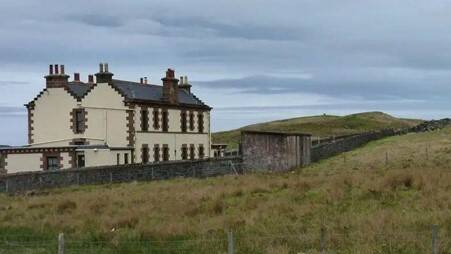
Image 13: the lodgings reserved for family members of the Flannan Isles Keepers in Breasclete
From Breasclete, Muirhead travelled to Gallan Head in Uig, where Robert MacKenzie and his family were paid to keep watch for signals from the Flannan Isles lighthouse. Upon his arrival on 30th December, he learned that the gamekeeper was away from home but that the role was being carried out by his two sons - aged 16 and 18 and also in the gamekeeping profession - who were able to present their notes in what was known as the Return Book.
The records kept by the family, who all participated in keeping a watch for the lighthouse tower, showed that the light had been seen on 7th December and then again on the 12th, but even with a telescope it wasn't visible again until the 26th - the night when it would have been lit by Joseph Moore. The brothers explained that it was completely normal for the light to not be seen for four or five nights due to the mist which frequently coated the islands and the poor weather which often blocked the view, but the length of time when it hadn't been seen was becoming an increasing concern for them. They had even called on the help of neighbours in the hope that others may be able to see something from their various vantage points, but all efforts were without success.
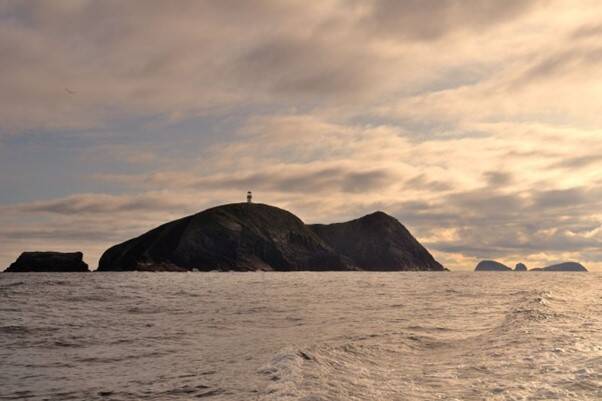
Image 14: the Flannan Isles
Robert Muirhead considered that, had the watch for the light been undertaken by a trained lightkeeper, the alarm may have been raised much earlier. The situation was somewhat understandable, though - the family had been asked to take on the role due to the location of their property and, although none were trained in the lightkeepers profession, they were diligent and hardworking people who were supporting a newly established tower as best they could. They had clearly made considerable effort in their duties, even calling on neighbours to help when they became concerned. That being said, the alarm not being raised sooner and the lack of light for thirteen consecutive nights meant that Northern Lighthouse Board were incredibly lucky that a ship hadn't become wrecked on the rocks.
Whilst alerting the Board of the lack of light sooner would likely not have changed the outcome for Ducat, Marshall and MacArthur, it would have meant that remedial action could have been taken to keep the lamp lit and maintain safety for passing vessels. As a result of the incident, training was provided to the MacKenzie family on raising the alarm if they believed that the light should be visible but was unable to be seen.
Muirhead also considered whether the lack of wireless telegraphy contributed to the loss of three men from the Flannan Isles, but he concluded that the ability to send a telegram to the mainland would have had little impact on the outcome. If the mainland had not heard from the Keepers for several days, Muirhead decided it was likely that the Shore Station would have deemed there to be an issue with the equipment rather than with the Keepers themselves. I have to wonder, though, if the Keepers would have contacted the Shore Station to raise concerns about the extreme weather or the reported distress of the men on the Island? Would better communication have enabled a more thorough picture as to what happened in the lead up to their disappearances?
The full report from Superintendent Robert Muirhead was printed on 8th January 1901. I'm going to quote a lengthy extract below - we have already covered much of the information it includes, but I feel it's important and interesting to see it in the investigators own words.
Quote from the post-incident report written by Robert Muirhead, published on 8th January 1901:
'The men left on the Island made a thorough search, in the first place, of the Station and found that the last entry on the slate had been made by Mr Ducat, the Principle Keeper on the morning of Saturday, 15 December. The lamp was crimmed, the oil fountains and canteens were filled up and the lens and machinery cleaned, which proved that the work of the 15th had been completed. The pots and pans had been cleaned and the kitchen tidied up, which showed that the man who had been acting as cook had completed his work, which goes to prove that the men disappeared on the afternoon which was received (after the news of the disaster had been published) that Captain Holman had passed the Flannan Islands in the steamer ARCHTOR at midnight on the 15th ulto, and could not observe the light, he felt satisfied that he should have seen it.
'On the Thursday and Friday the men made a thorough search over and round the island and I went over the ground with them on Saturday. Everything at the East landing place was in order and the ropes which had been coiled and stored there on the completion of the relief on 7 December were all in their places and the lighthouse buildings and everything at the Stations was in order. Owing to the amount of sea, I could not get down to the landing place, but I got down to the crane platform 70 feet above the sea level. The crane originally erected on this platform was washed away during last winter, and the crane put up this summer was found to be unharmed, the jib lowered and secured to the rock, and the canvas covering up the wire rope on the barrel securely lashed round it, and there was no evidence that the men had been doing anything at the crane. The mooring ropes, landing ropes, derrick landing ropes and crane handles, and also a wooden box in which they were kept and which was secured in a crevice in the rocks 70 feet up the tramway from its terminus, and about 40 feet higher than the crane platform, or 110 feet in all above the sea level, had been washed away, and the ropes were strewn in the crevices of the rocks near the crane platform and entangled among the crane legs, but they were all coiled up, no single coil being found unfastened. The iron railings round the crane platform and from the terminus of the tramway to the concrete steps up from the West landing were displaced and twisted. A large block of stone, weighing upwards of 20cwt, had been dislodged from its position higher up and carried down to and left on the concrete path leading from the terminus of the tramway to the top of the steps.
'A life buoy fastened to the railings along this path, to be used in case of emergency had disappeared, and I thought at first that it had been removed for the purpose of being used but, on examining the ropes by which it was fastened, I found that they had not been touched, and as pieces of canvas were adhering to the ropes, it was evident that the force of the sea pouring through the railings had, even at this great height (110 feet above sea level) torn the life buoy off the ropes.
'When the accident occurred, Ducat was wearing sea boots and a waterproof, and Marshall sea boots and oilskins, and as Moore assures me that the men only wore these articles when going down to the landings, they must have intended, when they left the Station, either to go down to the landing or the proximity of it.
'After a careful examination of the place, the railings, ropes etc and weighing all the evidence which I could secure, I am of the opinion that the most likely explanation of the disappearance of the men is that they had all gone down on the afternoon of Saturday, 15 December to the proximity of the West landing, to secure the box with the mooring ropes, etc and that an unexpectedly large roller had come up on the Island, and a large body of water going up higher than where they were and coming down upon them had swept them away with resistless force.
'I have considered and discussed the possibility of the men being blown away by the wind, but, as the wind was westerly, I am of the opinion, notwithstanding its great force, that the more probable explanation is that they have been washed away as, had the wind caught them, it would, from its direction, have blown them up the Island and I feel certain that they would have managed to throw themselves down before they had reached the summit or brow of the Island.'
'In conclusion, I would desire to record my deep regret at such a disaster occurring to the Keepers in this Service. I knew Ducat and Marshall intimately, and McArthur the Occasional, well. They were selected, on my recommendation, for the lighting of such an important Station as Flannan Islands, and as it is always my endeavour to secure the best men possible of the establishment of a Station, as the success and contentment at a Station depends largely on the Keepers present at its installation, this of itself is an indication that the Board has lost two of its most efficient Keepers and a competent Occasional.'
The Aftermath
Despite the decisive report submitted by Robert Muirhead and his conclusion as to how the three Flannan Island Keepers had disappeared, the Northern Lighthouse Board were reportedly sceptical about the suggested outcome. Not one of the bodies had washed ashore, and it didn't explain why all three of them had left their posts against protocol - and especially why one had left their oilskin coat hanging on the hook in the tower. Muirhead had already specified that these were highly experienced men. Why, then, would they run out onto the landing platform in the midst of what they had suggested in the log was such an awful storm, when their experience surely told them that a wave could whip up from the sea? Why would MacArthur, who it was suggested had seen what happened to the two men and run out to help, go without his coat? Surely he would have thrown on his outerwear either as he left the tower, or grabbed it and put it on as he ran down the steps?
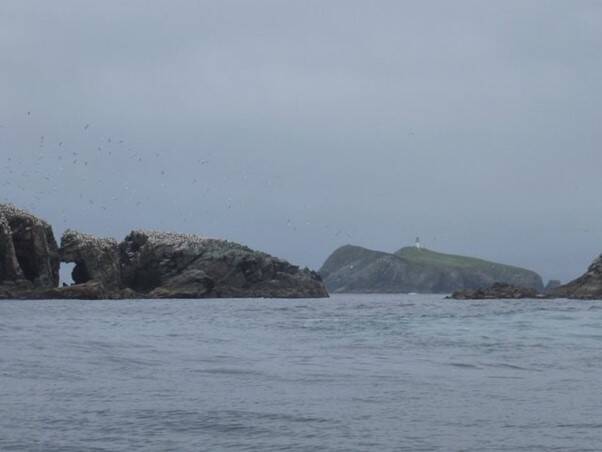
Image 15: the Flannan Islands
Something doesn't quite add up, though. If Ducat had supposedly written a note on the slate, to later be transcribed in the log book, that the storm had ceased and 'God is over all', how did the three men get swept away in bad weather? For one of them to have written the note, the weather should have been calm and much more settled, meaning that if they went outside they were at much lower risk of harm from the elements.
Historian Mike Dash, who studied the case for 20 years, was interviewed over his opinion that the log book entries were nothing more than a hoax. He stated that the log contained personal details which wouldn't normally have been documented, as the log was a place for facts and statistics to be written down. The mention of one of the men being quiet, and another praying were things that wouldn't have usually been added to the records, according to the historian. He went on to say that the first mention of the log book entries didn't appear until 1929 when they were printed in American magazine True Strange Stories, the editor of which later admitted to inventing details of cases written about in the publication in order to entice readers and sensationalise the stories. It's true that the report written by Robert Muirhead doesn't make any mention of the log book entries, something which one would think to be pivotal to write about in the case of three missing men. If Muirhead didn't acknowledge any entries in the log book, is it possible that the entries which have been circulated in the media weren't actually written down at all? Is it, as Mike Dash suspects, a poor and distasteful attempt at a hoax?
If this was the case and the log book entries released to the public were, in fact, fabricated, what should people believe? Was the weather leading up to the 15th December actually bad, or was this falsified information entirely? Was the weather calm until 17th as had originally predicted? Could the damage to the crate which was suspended 70 feet above sea level have occurred after the men had disappeared? The ropes were noted to still be coiled, as though they had fallen straight from the box and hadn't been touched. Is there a chance that whatever happened to the men happened before the storm which had been forecast?
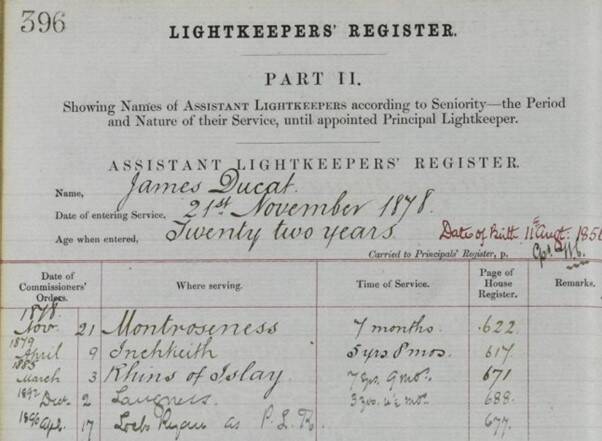
Image 16: James Ducat's service record
An author from the area of Hungerford, England, spent extensive time looking into the mystery, visiting some of the descendants of the missing men, and writing about his findings. Kevin McCloskey doesn't buy into Robert Muirhead's theory of a freak accident causing the disappearance of the experienced Keepers, suggesting instead that a disagreement or argument may have played a role in what happened to Ducat, Marshall and MacArthur. He spoke to Metro and mentioned how occasional Keeper Donald MacArthur was known to have unstable mental health, saying the man was: '"extremely volatile, prone to violence and a heavy boozer. When you're cooped up with two other blokes in a small space like that, the differences can come to the surface very, very quickly."'
It had already been mentioned that MacArthur had something of a reputation on the Isle of Lewis for being involved in brawls, and surprise had been expressed that he was supposedly crying in the lighthouse tower during the storm as he was known to be a tough individual. McCloskey suggested that something had triggered MacArthur to fight with Ducat and Marshall, that the fight had been taken outside, and that it had ended with the Principle and Second Keeper being thrown into the sea, with MacArthur hurling himself in after them. Could an argument have gone that far?
Dr Michael Swift from the British Psychological Society was interviewed as part of the same article, where he spoke about the negative effects which loneliness and isolation can have on mental health. And, let's be honest, there are few environments which would have been more lonely and isolated than a lighthouse on a tiny island more than 18 miles from the next nearest land - especially if you are in an enclosed space with two other people. He said: '"even those who tolerate solitude well, extended periods without meaningful human contact place the mind under significant load. What the research consistently shows is that connection is not just a social nicety but a stabilising force for mental health and, when it is disrupted, the psychological impact can be far-reaching."'
I'm sure that many of us can relate to Dr Swift's words after the COVID pandemic and the forced isolation. Mental health issues continue to be a struggle for many in the long-lasting wake of 2020 and 2021. In 1900, the three men in the Eilean Mor lighthouse tower wouldn't have had the luxuries of radio or television as a temporary distraction, likely heightening the effect of isolation. Could it be that someone snapped and something awful ensued?
One would have thought that if this was the case, the initial findings by Joseph Moore and his colleagues who trawled the Island looking for clues would have been significantly different. The outer gate of the lighthouse Station was locked. Who would have stopped to lock the gate if the three men were in the middle of a fight? Who would have stopped to put on their oilskin coats? Why would only two men have put coats on and not the third if they intended to take the argument outside?
Both theories - the one suggested by Robert Muirhead and the one suggested by Kevin McCloskey - leave multiple questions in their wake, with elements of each theory simply not adding up with the findings in the lighthouse tower and the surrounding land. It begs the question that, if the Northern Lighthouse Board weren't completely happy with Muirhead's assessment at the time, why wasn't further investigation completed?
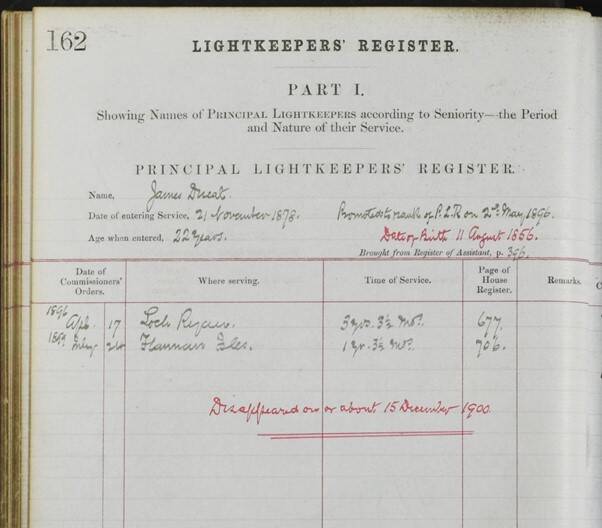
Image 17: the Principal Lightkeeper's Register, showing the page for James Ducat
One of the other major questions should surely be whether it was possible for a wave to have reached 110 feet up the side of the cliff on Eilean Mor in order to cause the damage witnessed by Muirhead, Joseph Moore and the other men. Means of measuring wave height weren't in place until later in the century, so no data from the early 1900s exists on the size of the waves which could occur.
The highest wave ever recorded was documented in 1958 as the result of tsunami in Alaska's Lituya Bay. This colossal wave reached 1,720 feet and pulled down trees which sat 1,700 feet up the side of a mountain. In the same year, an underwater nuclear test produced a wave of 800 feet high after a weapon was detonated 3,200 feet below sea. Both of these examples are something of an anomaly, though, as they were produced by extreme events or man-made simulation. In 2013, a surfer tackled a 100ft wave in Portugal whilst managing to remain on his surfboard, with another surfer in Portugal conquered an 86ft wave in 2020. In 1985, the Fastnet Lighthouse in Ireland was reportedly hit by a wave estimated to be 157ft tall, causing considerable damage to the tower. Norway recorded a wave of 84ft in 1995 at a monitoring platform. Up until this point, the concept of so-called rogue waves - where an unexpected swell occurred rapidly and with little warning - was thought to be fictitious. It was concluded from this event that the crest of two or more waves had collided and combined to form one huge wave, resulting in the significant height measurement. The waves surrounding the 84ft curl were reaching 20ft.
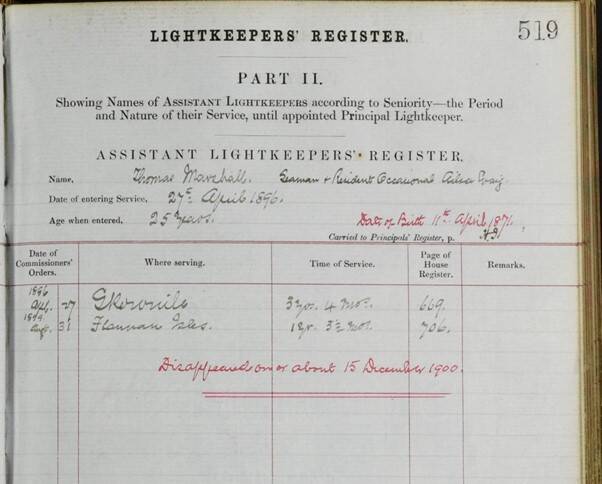
Image 18: Assistant Lightkeeper's Register, showing records of Thomas Marshall
We know that the weather and elements around the Flannan Isles could reach extreme conditions, but is it possible that a wave had reached so far up the side of the cliff and had demolished a row of iron railing? As we mentioned above, the weather on 15th December 1900 was supposedly calm - how then, would choppy waters have combined to make a rogue wave? I'm certainly no expert on the sea, so I'm not the best one to comment on whether this may have occurred despite the relatively serene conditions.
Although the Northern Lighthouse Board reportedly questioned why none of the men's bodies were washed ashore, the storm which was forecast from 17th December and the length of time it took for the incident to be identified would have given enough of a window for them to have been swept far out into the water.
It's an awful thought, and something which surely made this tragedy all the more distressing for the families of James Ducat, Thomas Marshall and Donald MacArthur. Their anguish was likely heightened by the outlandish theories which emerged in the years following the incident.
Unsatisfied with the report from Robert Muirhead, and bewildered by the emergence of conflicting information - especially the release of the supposed log book entries in the 1920s - the general public began to speculate as to what else could have happened to the Keepers. This naturally led to wild suggestions, such as the men being snatched by a monster sea serpent or carried away by a giant bird. Some believed that the men had sailed away to start new lives away from their families and in a bid to evade possible debts., whilst others mused that they could have been taken by the skeletal pirates of a ghost ship. There was even a suggestion that they had been kidnapped by spies, although why spies would remove three lightkeepers from their posts is a mystery.
With the bizarre ideas being batted out of the way, three of the suggestions remained and were passed around discussions in pubs, family homes and communities. The first and second theories revolved around the character of William MacArthur, whose reputation seemed to have spread by word of mouth - likely being escalated and inflated for dramatic effect along the way. The first theory is almost identical to that suggested by Kevin McCloskey - that a fight had broken out after an ill-tempered William MacArthur preferred to solve a disagreement with his fists, and that Ducat and Marshall had been thrown over the cliffs into the sea, with MacArthur hurling himself after them. The second theory bypassed the idea of a fight, and went straight to the suggestion that MacArthur had killed both of his colleagues and disposed of their bodies in the sea before throwing himself off the cliffs.
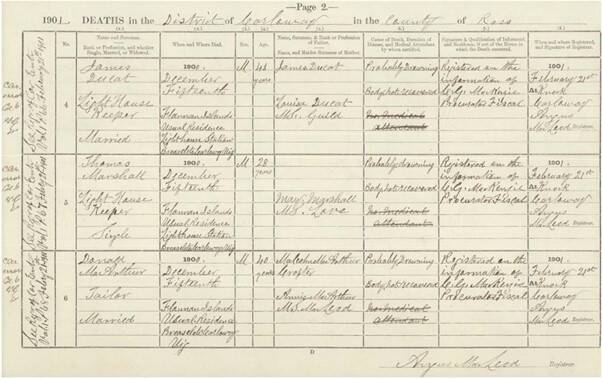
Image 19: register of deaths showing the names of the three lightkeepers
The third theory matched largely with the report from Robert Muirhead - that Ducat and Marshall had gone out to save some equipment on the West landing in the midst of a storm, or assist a vessel in distress, and had been swept out to sea in the process. MacArthur had stayed in the lighthouse tower to ensure that it wasn't left unmanned, but had become concerned after his colleagues failed to reappear. He perhaps looked out of the window and suspected something to be amiss, and ran from the Station without first collecting his oilskin coat. He met the same fate as Ducat and Marshall, being swept away by the sea, with the doors of the Station being slammed behind him in the bad weather. Upon asking the question why the men would go out in such conditions when they could have remained safely in the tower, the answer transpired that Thomas Marshall had previously been fined five shillings for losing equipment in a horrendous storm. Five shillings in 1900 would equate to somewhere near £20 today - not an insignificant sum by any means, but was it worth risking his life for? We know that Marshall had a wife and two children to provide for, but surely they would rather he come home at the end of his rotation rather than risk his safety to save the lighthouse equipment? And if the men had been assisting a vessel in distress, why didn't the sailors on the vessel come forward to mention this to the Northern Lighthouse Board?
Conclusion
After more than 125 years, we will likely never know what really happened on Eilean Mor in December 1900. We will never know whether there was a storm raging on the 15th, nor whether the three men went out to try to secure equipment and were swept away. The theories around a fight or a murder are purely speculation across more than a century of rumours and people trying to fill in the gaps of the story. There is no evidence to say that William MacArthur lost his temper with his colleagues, and this suggestion would surely have added to the distress already inflicted on his family members. Even if there had been a fight, how likely would it have been that one man could overpower the other two? They would all have been strong men from the manual labour involved in their duties. Looking at a picture of the men together, and provided the information I've found is correct, the man labelled as James Ducat was actually a considerable amount taller and more burly than his two colleagues, so the concept of being overpowered by one man seems slim.
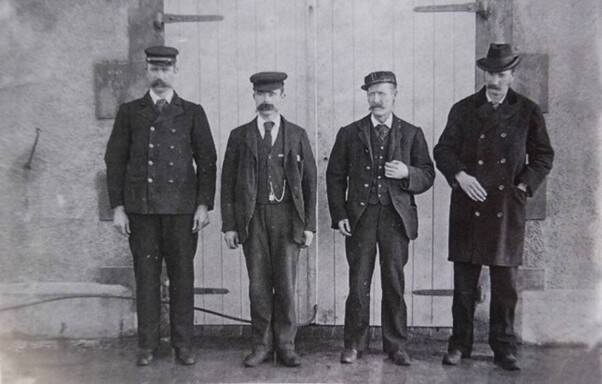
Image 20: from left to right, James Ducat, Thomas Marshall, Donald MacArthur and Robert Muirhead
The most likely answer is that the three men ended up in the sea and that their bodies were never found due to the storm, regardless on which day(s) it occurred. Whatever happened seems likely to have occurred on the afternoon or early evening of 15th December, but beyond this there are still a lot of questions. Even with the report from Robert Muirhead - who seemed to believe that the case was firmly closed - the public have speculated for years over the events.
Ultimately, the families of three men have endured decades without firm, clear answers. They were forced to mourn their loved ones without their bodies to lay to rest in a grave, and without a headstone to visit. Six children grew into adulthood without their fathers, and the hopes of Donald MacArthur going on to marry or have a family of his own were taken away from him. The three men should have been able to grow old, retire with their families, and perhaps even become grandparents.
In this case, it's the lack of knowledge which is the issue. The facts are so scarce, meaning that the families of James Ducat, Thomas Marshall and Donald MacArthur have no closure at all. They were expected to get on with their lives with the knowledge only that their loved one was dead - no funeral, no resting place, and no answers.
The legacy of this mystery has endured many, many years. Kevin McCloskey was able to interview relatives of the three men, meaning that their families are still haunted by the open ended questions stemming from December 1900. It's truly heart-breaking, and they deserve to have peace.
In Breasclete, a monument stands in the memory of the three men and an exhibition containing newspaper articles from the time, documents which were released over the years such as a copy of the Northern Lighthouse Board instruction manual to its Keepers (inscribed by Thomas Marshall), and items donated to the exhibition by the Keepers' families. The exhibition opens in the warmer months of the year, between April and October, and enables members of the public to glimpse a window into the life of a lighthouse Keeper.
The monument depicts a large rock, on top of which is perched a tiny model lighthouse. A bronze wave can be seen rolling to one side. The Flannan Isles lighthouse became automated in 1978, negating the need for full-time Keepers.
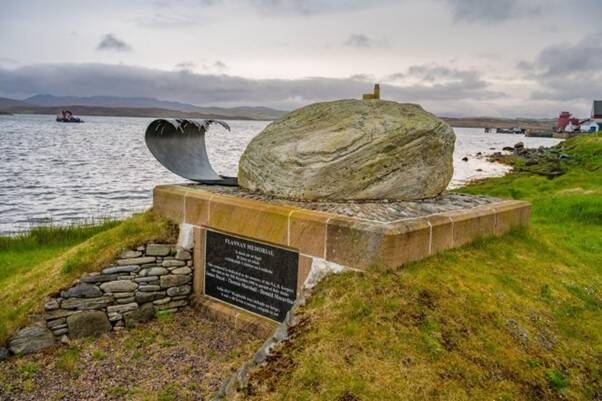
Image 21: the Breasclete monument
This case has been the talk of gossip for decades. People have speculated and debated. The Flannan Isles mystery has been the subject of poetry, documentaries and even provided the base story for film The Vanishing, released in 2019 starring Gerard Butler.
What seems to have been forgotten somewhere along the line is that this is the case of three men - James Ducat, Thomas Marshall and Donald MacArthur. It's the case of three dedicated workers who chose a profession which centred around keeping people safe at sea. It's the case of three men who would risk their own lives to keep an isolated lighthouse tower working efficiently. It's the case of men who were husbands, brothers, uncles, sons, grandsons and in-laws. It's the case of three human beings who were everything to the people they left behind, and who should have been able to return to their homes after their Island rotation to be with their families.
So whilst the story of the Flannan Island mystery has been developed, speculated on, gossiped about and theorised on across the years, the only message at the end of this casefile is that there are three men at the centre of it who most likely lost their lives in the pursuit of their duties. They left behind families who loved them and cared about them and missed them. The primary message from this casefile is that these men were far more than the Flannan Island Lightkeepers. They were James Ducat, Thomas Marshall and Donald MacArthur - family members, loved ones, and dearly missed by those who knew them.
References for text:
The mysterious disappearance of the Eilean Mor lighthouse keepers. By Ben Johnson, published 26th August 2016, retrieved 19th April 2026
Flannan Isles - Northern Lighthouse Board retrieved 20th April 2026
Lighthouse Keeping - Northern Lighthouse Board retrieved 22nd April 2026
Property linked to Flannan Isles lighthouse mystery to be restored - BBC News published 17th December 2025, retrieved 22nd April 2026
Why did three lighthouse keepers vanish without a trace in 1900? | News UK | Metro News by Josh Milton, published 25th December 2025, retrieved 22nd April 2026
Missing Three Flannan Isles Lighthouse Keepers - Historic Mysteries by Shelly Barclay, published 9th July 2010, retrieved 24th April 2026
Lights Out: The Flannan Isles Lighthouse Mystery - WildBounds by Gordon Eaglesham, published 31st July 2025, retrieved 24th April 2026
The 10 Tallest Waves Ever Recorded published 18th May 2024, retrieved 4th May 2026
The Flannan Isle mystery: The three lighthouse keepers who vanished | Sky HISTORY TV Channel by BP Perry, retrieved 4th May 2026
Flannan Isles exhibition reopens published 24th May 2021, retrieved 4th May 2026
The British Newspaper Archive – Bath Chronicle and Weekly Gazette (page 5), printed Thursday 27th December 1900
The British Newspaper Archive – Dundee Evening Telegraph (page 5), printed Friday 28th December 1900
The British Newspaper Archive – Bradford Daily Argus (page 3), printed Friday 28th December 1900
The British Newspaper Archive – Dublin Daily Express (page 5), printed Friday 28th December 1900
The British Newspaper Archive – Arbroath Guide (page 3), printed Saturday 5th January 1901
Credit for images:
Image 1 - Pharos of Alexandria: Lighthouse of Alexandria | History, Location, & Facts | Britannica
Image 2 - Longstone Lighthouse, Northumberland Britain’s best places to see: Heritage lighthouses – Museum Crush
Image 3 - map showing the approximate location of the Flannan Isles: taken from Google Maps with endorsements by the author
Image 4 - map showing the Flannan Isles in comparison to the mainland: taken from Google Maps with endorsements by the author
Image 5 - map showing the Flannan Isles, Gallan Head and Breasclete: taken from Google Maps with endorsements by the author
Image 6 - aerial view of the Flannan Isles: taken from Google Maps
Image 7 - early image of the Flannan Isles lighthouse: Lights Out: The Flannan Isles Lighthouse Mystery - WildBounds
Image 8 - the steps leading up to the lighthouse: Lights Out: The Flannan Isles Lighthouse Mystery - WildBounds
Image 9 - Admiralty chart of the Flannan Isles: Lights Out: The Flannan Isles Lighthouse Mystery - WildBounds
Image 10 - the Island railway: Lights Out: The Flannan Isles Lighthouse Mystery - WildBounds
Image 11 - photo of the lighthouse as seen today: Why did three lighthouse keepers vanish without a trace in 1900? | News UK | Metro News
Image 12 - photo of the lighthouse as seen today: Property linked to Flannan Isles lighthouse mystery to be restored - BBC News
Image 13 - the family lodgings in Breasclete: Property linked to Flannan Isles lighthouse mystery to be restored - BBC News
Image 14 - the Flannan Isles: Why did three lighthouse keepers vanish without a trace in 1900? | News UK | Metro News
Image 15 - the Flannan Islands: The mysterious disappearance of the Eilean Mor lighthouse keepers.
Image 16 - James Ducat's service record: Why did three lighthouse keepers vanish without a trace in 1900? | News UK | Metro News
Image 17 - James Ducat's page in the Principal Lightkeeper Register: Mystery of Eilean Mòr lighthouse keepers' disappearance as records released for first time | STV News
Image 18 - Thomas Marshall's page in the Assistant Lightkeeper Register: Mystery of Eilean Mòr lighthouse keepers' disappearance as records released for first time | STV News
Image 19 - register of deaths: Mystery of Eilean Mòr lighthouse keepers' disappearance as records released for first time | STV News
Image 20 - the three Keepers and Robert Muirhead: Why did three lighthouse keepers vanish without a trace in 1900? | News UK | Metro News
Image 21 - the Breasclete monument: Why did three lighthouse keepers vanish without a trace in 1900? | News UK | Metro News
Add comment
Comments